Thursday, September 15, 2022

Operation Destruct

Christopher Robin Nicole (born: 1930), author of over 200 books, was born in Guyana and settled in the Channel Islands nestled between England and France. He wrote a three-book espionage series starring Jonathan Anders — all currently available as affordable ebooks — with the first installment being Operation Destruct from 1969. 

Jonathan is a 23 year-old chess prodigy and skin-diving enthusiast in southern England. He works for an antiquarian book dealer that is actually a front for a secret counter-espionage agency of the British government. He’s a rookie operative who, as the paperback opens, hasn’t really been tested in the field. This is his first assignment. 

The Ludmilla is a boat — a Russian trawler — that recently sunk in the English Channel in 30 feet of water with no recovered survivors. The intelligence service tasks young Jonathan with traveling to the island of Guernsey near the shipwreck to determine why a Russian fishing boat was there in the first place and what contributed to its sinking. 

There’s a good likelihood that a British sleeper agent posing as a Soviet marine biologist was aboard the Ludmilla. The boat clearly contained Soviet secrets that sparked the shipwreck, and Jonathan’s assignment is to quietly learn the score. The setup for this one is a total pleasure, and the writing quality far surpasses a normal 180-page 1969 spy paperback. 

Guernsey is an interesting setting for much of the novel. The island is located in the British territorial waters of the English Channel between England and France. It was German-occupied during WW2 and is filled with underground bunkers and fortifications like a honeycomb across the island’s eight-mile length. During the war, the Germans were expecting Guernsey to be the site of an allied invasion, but we opted to hold the D-Day festivities in Normandy, instead. The residents are known as Guernseymen, but that was 1969 — I’m sure there’s another term, now. 

In a world filled with paperbacks starring self-assured, confident spies, Jonathan is a pleasure precisely because he is green, uncertain of himself, and wet behind the ears. He’s thrust into his first field assignment alone with only his wits guiding him to sink or swim (sometimes literally). 

The book’s opening scenes and exciting conclusion are both awesome. However, there’s a good bit in the middle that was rather dumb and at times almost descended into parody. I’d still recommend the novel because the ending is so interesting and unlike other books you will read in the genre. Overall, Operation Destruct is an easy recommendation, and I look forward to the next book in the trilogy. 

Buy a copy of the eBook HERE.

Wednesday, September 14, 2022

Paperback Warrior Primer - Howard Hunt

There is already a lot that can be said about Howard Hunt. He was both a WW2 veteran, a spy, a Hollywood screenwriter, war correspondent, and a criminal. His life has been fictionalized by the film industry, his exploits chronicled by numerous non-fiction books about the infamous Watergate incident, and his possible involvement in the assassination of U.S. President John F. Kennedy. Even Hunt himself wrote non-fiction books about his own life. While all of these things are fascinating, the purpose of this Paperback Warrior Primer is to examine some of his literary highlights. You can dig the hole deeper through any number of other resources. He authored at least 88 novels, most featuring lurid covers that we appreciate.

Everette Howard Hunt Jr. (1918-2007) was born in Hamburg, New York. He attended the prestigious Brown University and later began writing for Life as a war correspondent. Later, Hunt joined the Navy, serving on the USS Mayo during the early days of WWII. After, he went to the Army Air Corps and then finished his military stint with the OSS, the nation's wartime precursor to what is now known as the CIA. Beginning in 1949, Hunt was an officer for the CIA, performing 21 years of international counter-intelligence until 1970. During this entire time, Hunt was writing novels.
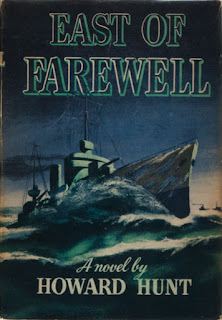
His first book was East of Farewell, published in hardcover by Alfred Knopf in 1942. The book reads like a true biography as Hunt recounts the day-to-day life upon a Fletcher-class destroyer. Hunt also used his Army Air Corps experience to write his second novel, Limit of Darkness. It covers a single 24-hour period in the "life" of a Navy torpedo bomber squadron on Guadalcanal in 1943. With the success of these two novels, Hunt won the prestigious Guggenheim Fellowship, which provided him a grant to help fund his writing career and provide blocks of time where he can pursue his art form. 

During the 1950s, paperback original novels became extremely marketable by publishers. Hunt was in the perfect position to take advantage of this publishing craze by writing and selling a lot of books under his name and various pseudonyms. 

As John Baxter, Hunt authored the two novels A Foreign Affair and Unfaithful in the mid-1950s. 
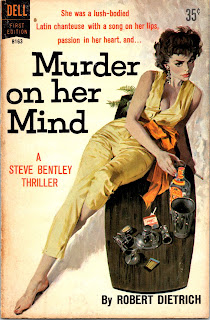
Using the name Robert Dietrich, Hunt authored 12 total novels, but 9 of these make up the Steve Bentley series. Hunt produced nine series installments between 1957 through 1962 as Dietrich. He revisited the series in 1999 under his own name with one additional installment featuring the titular hero at an advanced age. In the novels, Bentley is a Washington D.C. accountant that stumbles into a lot of crime inside the Nation's Capital. Mostly, these crimes are solved by doing favors for clients or business associates. But often, they just conveniently appear in strip clubs, bars, and even by the roadside. Bentley is easily likable and shares a lot of stereotypical genre tropes with the popular private-eyes of the era - he drinks a lot of alcohol, engages in various relationships with women, owns a boat, former military, and can fight, shoot straight, and speak the truth. Paperback Warrior has a number of reviews about the series HERE. Some of the Steve Bentley books have been released in brand new editions by Cutting Edge Books, including an ebook omnibus containing a majority of the series. Cutting Edge also offers the stand-alone Dietrich novels One for the Road, Be My Victim, and The Cheat

1. Murder on the Rocks (1957)
2. End of a Stripper (1959)
3. House on Q Street (1959)
4. Mistress to Murder (1960)
5. Murder on her Mind (1960)
6. Angel Eyes (1961)
7. Curtains for a Lover (1961)
8. Calypso Caper (1961)
9. My Body (1962)
10. Guilty Knowledge (1999, as Howard Hunt)

As David St. John, Hunt authored a nine-book series starring CIA operative Peter Ward. These books were published between 1965 through 1971, and then later were reprinted under Hunt's own name in the 1970s to capitalize on his newfound fame connected with Watergate. In this series, Ward is helping Soviet scientists defect, dodging enemy assassins, chasing sensational cults, and investigating assassinations of foreign leaders. It's stereotypical spy-fiction of the era, but enjoyable nonetheless. Hunt also used the David St. John pseudonym to author the 1972 novel The Coven, a stand-alone thriller about a Washington D.C. attorney navigating witchcraft and murder. 

1. On Hazardous Duty (1965)
2. Return from Vorkuta (1965)
3. The Towers of Silence (1966)
4. Festival for Spies (1966)
5. The Venus Probe (1966)
6. One of our Agents is Missing (1967)
7. The Mongol Mask (1968)
8. The Sorcerers (1969)
9. Diabolus (1971)

Hunt's Gordon Davis works are all stand-alone novels. Paperback Warrior reviewed Where Murder Waits HERE and Hard Case Crime reprinted House Dick in 2009 using the name E. Howard Hunt. A majority of the Gordon Davis paperbacks were reprinted by various publishers under Hunt's name, once again to capitalize on Watergate.

In 1972, President Richard Nixon was running for re-election. A group of men beholden to the President was caught burglarizing the Democratic National Committee headquarters – President Nixon’s opposition party – at a hotel called The Watergate in Washington, DC. One of the burglars caught was Howard Hunt. It became known as the Watergate Scandal and one of the central questions was: What did the President know about this burglary and when did he know it? The burglary led to the resignation of President Nixon. Howard Hunt, among others, was incarcerated for his part in the burglary and served 33 total months in federal prisons in Pennsylvania and Florida. While in prison, Hunt suffered a minor stroke. 

The prison stint did not dampen Hunt's literary career. If anything, it improved his sales. Publishers were able to list a front-cover blurb that connected the author's name with one of the greatest scandals in U.S. history. Once he was released from prison, Hunt began writing consistently, but also realized that his prior pseudonyms were being converted to his real name.

In 1985, Hunt created an action-adventure series starring Jack Novak, an agent with the Drug Enforcement Agency. The series ran seven total novels from 1985 through 2000. 

1. Cozumel (1985)
2. Guadalajara (1990)
3. Mazatlan (1993)
4. Ixtapa (1994)
5. Islamorada (1995)
6. Izmir (1996)
7. Sonora (2000)

While he was authoring the Novak series, he also authored three-stand alone action-adventure novels using the pseudonym P.S. Donoghue from 1988-1992 - Dublin Affair, Sarkov Confession, and Evil Time.

On January 23, 2007, Howard Hunt died from pneumonia in Miami. He is buried in Prospect Lawn Cemetery in Hamburg, New York.

You can read all of our Howard Hunt reviews and listen to a podcast episode dedicated to the author HERE.

Tuesday, September 13, 2022

Night Hunter #01 - Night Hunter

According to Wikipedia, Robert Holdstock (1948-2009) was a British author that specialized in science-fiction, horror, and fantasy genres. He won several literary awards for his novel Mythago Wood in 1984 and 1985, the first in a fantasy series about an ancient forest. Along with series titles like Berserker, Raven, and The Professionals, Holdstock authored a six-book supernatural series called Night Hunter using the pseudonym Robert Faulcon.

The series debut, The Stalking, and its sequel The Talisman, were published as a hardcover omnibus in 1987 by London's Century Hutchison. However, the series also debuted the same year in individual paperbacks by Charter. My wife purchased the debut, The Stalking, which is simply titled Night Hunter for this paperback edition, and provided it to me as a birthday gift. 

Daniel Brady has a research position in England's Ministry of Defense. He lives an average life with his wife and kids in a Berkshire suburb. However, as the book begins, Brady and his wife both sense that something is in their house. They feel something watching them. Further, Brady's wife even experiences this unseen entity at her job. So, the book begins with a really creepy overtone. 

Brady's entire existence is turned upside-down when a group of cult members, apparently possessing supernatural abilities, breaks into his house, rape his wife, and then capture his family. Severely injured in the attack, Brady succumbs to a coma and spends weeks in the local hospital. He awakens to answer questions from the detective, and in turn, learns that no one knows where his family is.

It turns out that the weird cult has been providing the rape 'em and grab 'em traveling gig for a long time. There are other survivors out there. Brady swaps his story with a woman named Ellen, and the two form a relationship that doesn't strictly focus on intimacy. Instead, Ellen shows Brady that he has psychic powers and proves to him that he can fight this menacing cult. With his newfound X-Men powers, Brady sets out to kill the cult and find his family.

This book had potential and started out fantastic. When Brady awakens from the coma, the author unfortunately shifted the novel from horror to fantasy, complete with long sections on spells, archaic rituals, and protection rings. It was like reading a card-playing game's tutorial on how to level up your character. These sections were tedious, dull, and lacked excitement. I was hoping for a cool hybrid of horror and action-adventure, but that wasn't the case. I was thoroughly unimpressed with Night Hunter

Buy a copy of this book HERE

Monday, September 12, 2022

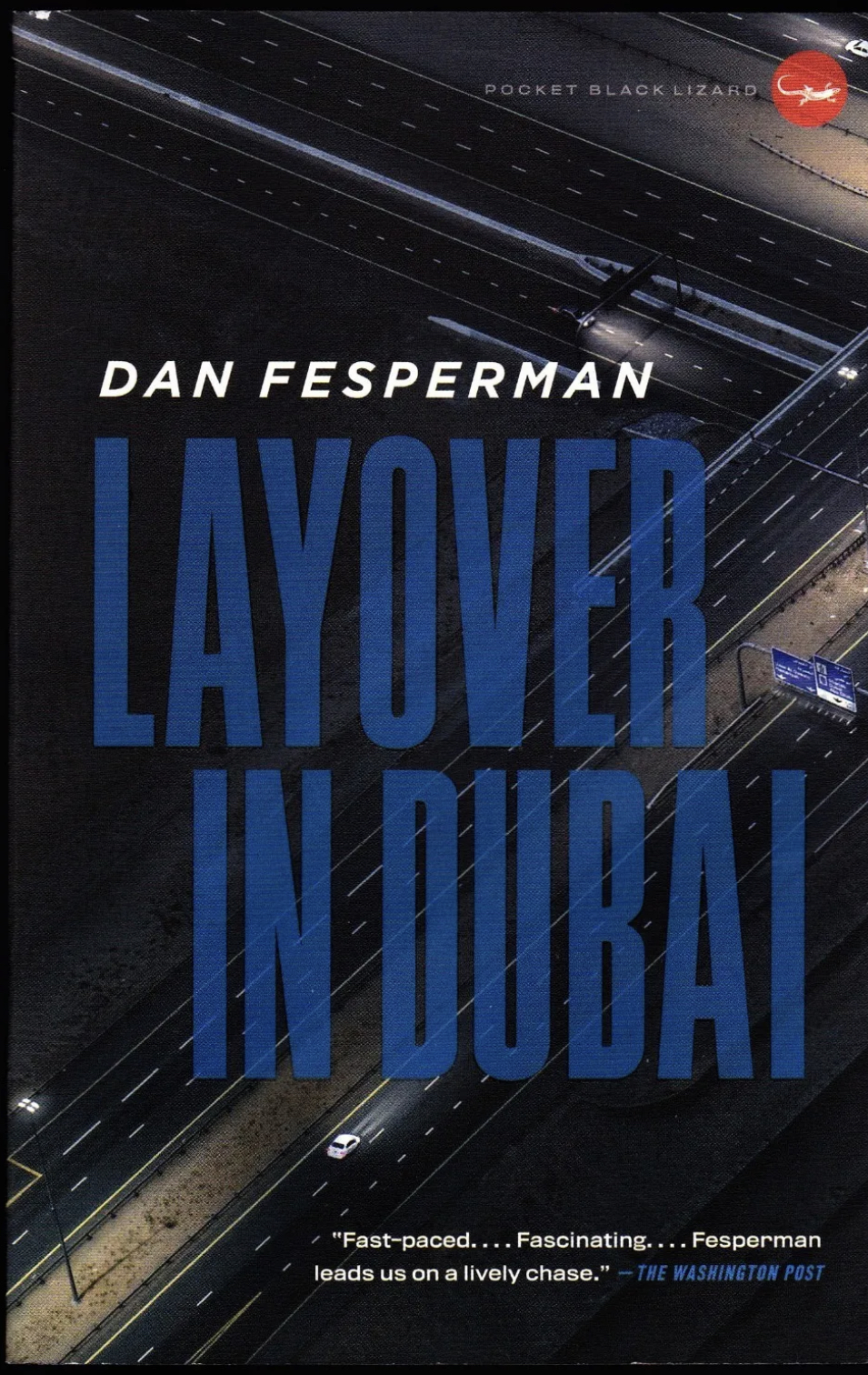
Layover in Dubai

Former Baltimore Sun reporter Dan Fesperman was a foreign correspondent who travelled the world covering international events. He’s been racking up genre fiction awards since he became a novelist in 1999 drawing upon his knowledge of far-flung locales. My first exposure to his work was his 2010 thriller, Layover in Dubai

The novel begins in April 2008 as we join 28 year-old American corporate auditor Sam Keller at a crowded bar in Dubai during a layover with a colleague en route to Hong Kong. The bar is filled with hookers from every nation propositioning him for sex, and Sam finds the whole scene rather glum instead of erotic. 

Sam is a conservative and an analytical fellow with a lust for adventure. His employer is a big Pharma company similar to Pfizer. Sam is traveling with an older colleague named Charlie. In a Chapter One flashback, we learn that the Corporate Security Director has pressured young Sam into spying on Charlie during this overseas trip during the Dubai stopover.

Things go sideways pretty quickly when a gruesome murder occurs. Sam knows more than he’s willing to share with the police until his corporate masters arrive to provide guidance and support. We also meet two rival Dubai police detectives who are the best characters in the novel.  

Throughout the paperback, Fesperman’s plotting is generally solid, but drags a bit in the middle. He doles out relevant facts judiciously through a combination of flashbacks and investigative revelations. Young Sam is not the only character with a hidden agenda driven by a large, shadowy bureaucracy, and the gamesmanship of the various characters was a pleasure to read. There’s a lot of interesting cultural tidbits sprinkled throughout the novel. You walk away from the book with a better understanding of cosmopolitan Dubai culture and the battle between modernity versus Emirati tradition. 

Layover in Dubai successfully straddles a corporate thriller with a straight-up murder mystery enhanced by the modern, exotic setting in the Arab world. The young executive swept up in workplace intrigue recalls John Grisham’s The Firm in a foreign land. If the interesting setting for a modern-ish thriller appeals to you at all, you’re sure to enjoy this one. Recommended. 

Buy a copy of the book HERE.

Friday, September 9, 2022

Hawkwood

Andrew P. O'Rourke (1933-2013) was a judge and County Executive of Westchester Country, New York, He was also the Republican candidate for New York governor in 1986, eventually losing to Mario Cuomo. Along with his political aspirations, O'Rourke pursued a short writing career in the 1980s. He authored two men's action-adventure novels, The Red Banner Mutiny (1985) and Hawkwood (1989). Discovering the latter novel at a used bookstore, I was intrigued enough by the artwork to tackle this 275 page Bantam novel. 

The novel's opening chapter is one of the more suspenseful sequences I've read in a long time. The set-up is that a man and his family have been targeted by Mob killers. These opening pages play out as a cat-and-mouse game where the assassins are in the man's house hunting the family from room to room. But, the man has a trap door that leads through the walls to a hidden staircase. In an attempt to escape with his family, they are caught in the basement and systematically murdered. 

Next, a Vietnam veteran named Gerald H. Wood is on a plane recalling his most recent assignment, disabling an alarm system. Readers quickly put together that Wood clipped the electronic system so the Mob assassins could kill their target. Through a backstory that runs about 50 pages, readers are introduced to this titular hero. Wood graduated from college earning an engineering degree. Rather than pursue that lucrative career, he enlisted in the military and attended Officer Candidate School. Later, he became a Green Beret and gained himself 15 months in Vietnam. In the military he met and fell in love with a kingpin's daughter. Welcome to the family.

Hawkwood becomes a rather epic, sweeping character study when Wood becomes disenchanted with the Mob lifestyle. His wife wants a divorce, but Wood realizes divorce to the Mafia is more like death. In a convenient way, Wood is transporting four-million bucks on a commercial airliner when the plane crashes. Wood barely escapes death, but finds the disaster the perfect cover to flee the Mob. Using the cash, Wood takes the name of John Hawkwood, a historically famous Englishman turned mercenary. The book's second-half deposits Hawkwood in Argentina, and through a wild series of events, he's thrust into a war between Argentina and England in the Falkland Islands. 

Obviously, there is a lot to unpack in Hawkwood. The origin portion of the novel is similar to Mark Roberts' introduction of Mark Hardin, the protagonist of The Penetrator series. There are some similarities with that title as well as James Dockery's presentation of Bucher in The Butcher series. The idea of a man on the run from the Mob is a popular one and O' Rourke does it well. The author is able to bridge together a number of major storylines, as well as transition the novel from a vigilante style, containing a few typical genre tropes, to a mercenary military adventure. Those are all positives.

The only negative aspect to Hawkwood is a deep transition into a type of Tom Clancy tech-thriller with time spent on analysis of the Argentina/English war and some of the military history associated with the highly contested Falkland Islands. I felt this removed Hawkwood from the action, and displaced a lot of the momentum and character building. I also found the ending fitting, but it certainly was a finale that could have created a series. The character's transformation, and setup, would have made for a sequel and future series installments if the author or Bantam wanted to pursue a continuation. 

Hawkwood should appeal to fans of 70s and 80s action-adventure titles like Death Merchant, The Butcher, and The Penetrator. While slightly more literary, it has all of the genre tropes that those hefty series titles possessed. Recommended. 

Buy a copy of this book HERE

Thursday, September 8, 2022

Joe Broderick's Woman

In the 1970s, Hollywood became fascinated with the large transport truck, aka “big rig”, “18-wheeler”, “tractor-trailer” or simply “Mack”. Films like Smokey and the Bandit (1977), White Line Fever (1975), Breaker! Breaker! (1977), and Convoy (1978) captured the heart and soul of the blue-collar truck-driving man, albeit with plenty of zany, over-the-top action hijinks that elevated the profession into a type of comic book heroism. The genre swerved into the men's action-adventure lane on occasion, prompting series titles like William W. Johnstone's Rig Warrior (1987) and Bob Ham's Overload (1989). 

Manor Books published an action-adventure-trucker novel titled Joe Broderick's Woman. It was released in 1978 and was authored by a possible “one 'n done” author named John H. Arbor. My internet search produced no other results for the author. Based on the quality of the book, I was hoping Arbor had written more. 

Joe Broderick is the owner and operator of a trucking company in Baltimore called Broderick Lines. Joe is former military and now lives a peaceful and successful life delivering the goods to a hard-earned book of business. In the novel's opening pages, readers gain a glimpse of the trucker lifestyle as more of a business with a secretary, driving crew, and various clients adding shipments to schedules. Not exactly Lincoln Hawk stuff (Over the Top, 1987).

Unbeknownst to him, Joe is married to a mobster's former mistress, a nice woman named Aletha. The two met a few years ago after Aletha successfully escaped the clutches of Sartorius Roth, a New Jersey kingpin. Aletha created a new life for herself, but warned Joe that she has a shady past and that someday her past may catch up to her. Now, pregnant, domesticated, and totally in love, Aletha is finally found by Roth's hired hands. While Joe is at work, the goons break into his house and capture Aletha. 

Arbor's narrative is a three-way presentation consisting of the inner workings of Roth's empire and his right-hand man attempting to unseat him. This presentation also includes Roth's reunion with Aletha and the sentence he serves her. There's some graphic violence and rape as Aletha is thrown to the wolves as a sex servant for Roth's men, ultimately losing her sanity in the torture and abuse. The second presentation is that of Roth's current mistress, a woman named Rosalyn. She is skeptical of Roth reuniting with Aletha and wants to keep her position of power. The third storyline is Joe's hunt for Roth and his plans to rescue Aletha.

As a B-grade action novel, Joe Broderick's Woman wins on all levels. It has a great storyline that isn't far removed from the typical vigilante stories we all love – The Executioner, The Revenger, etc. It's brutal when it needs to be, emotional at the right times, and hard-hitting as a Mack truck when the bullets start to fly. I really liked Joe's character and his progressive relationship with a former mob girl named Darla as well as his team-up with a former military veteran named Hap. The vengeance angle never seemed forced to me, which is a testament to Arbor's patient writing style. It all comes to fruition in due time. 

Whether John H. Arbor is a real guy or not remains to be seen. His style is reminiscent of Jon Messmann, but I don't believe Arbor was a pseudonym he used. With Manor publications, unmasking the identity of authors and artists is like trying to locate an honest representative in Congress. We may never find the answer. But don't let the mystery keep you from enjoying Joe Broderick's Woman. It's an entertaining 1970s beat 'em up that crosses lanes with trucker pop-culture. Recommended. 

Buy a copy of this book HERE

Wednesday, September 7, 2022

The Hunting Shack

James Dickey's 1970 outdoor-survival novel Deliverance was adapted into a film by the same name in 1972. Both were widely successful and prompted numerous imitations. In the publishing world, it was books like Hunter's Blood (1977), Shoot (1973), Deer Hunt (1976), and Wilderness (1979) that carried out the suspenseful cat-and-mouse chase through the wilds of North America. These books typically challenged the American male, average or otherwise, with extreme, barbaric situations in the wilderness. There were a lot of 1970s books with this same premise, and I always try to pick them up when I spot one in the wild. Thankfully, I stumbled on The Hunting Shack, a 1979 paperback published by Dell authored by Gunnard Landers.

The book is set in the rural, icy landscape of a Wisconsin winter. Six average men venture into the wilderness for an annual, weeklong hunting trip. They have a small shack they utilize as lodging, and there's a rivalry between the men on who can land the biggest buck and drink the most alcohol. Midweek, the guys head to the closest town and bed down prostitutes as a way to escape the boring nine-to-five suburbia Hell. But, one of these six men does a little something different every few years.

Throughout the book's 220 pages, readers are thrust into the mind of Glenn, a dentist that joins his five friends each year for the hunting trip. But, Glenn journeys out on his own, away from the other hunters, and routinely kills another hunter. The narrative mentions two hunters being killed in the area in the past, and, as the book begins, Glenn is targeting another hunter. This time, his prey is one of his friends, an experienced hunter named Norm. 

Author Gunnard Landers often used harsh, rural landscapes as a backdrop for his novels. Landers, a Wisconsin native, rancher and Vietnam War veteran, authored a series of books starring an undercover game warden named Reed Erickson. These books take place in places like Minnesota and Alaska. With Landers' skills as a storyteller richly embedded in this sort of sportsman escapism, The Hunting Shack excels in a lot of different ways. 

The novel serves the survival-horror genre with its psychotic portrait of a deranged killer. The concept of a murderer among friends, collectively facing a rugged forest and snowy blizzard, was really entertaining. As a character study, the book centers on Glenn and Norm, two men who are both tiring of their tameness and bridled lifestyle. But, the book is also a wild and crazy look at a lot of stereotypical horny men just simply breaking rank and having a good time. There is a copious amount of sex and drinking, often graphic, as well as some of the typical juvenile banter between middle-aged hunting buddies. There is also a focus on two young prostitutes prospering with their good fortunes over the course of one sweaty, hot evening at the shack. 

The end result is that The Hunting Shack was a pleasurable reading experience that provided plenty of escapism, and presented some fun, although disgusting, beer-belching deer slayers. The book's finale was worth the price of admission and, overall, certainly possesses a Deliverance vibe. Highly recommended. 

Buy a copy of this book HERE