Friday, October 14, 2022

Flaw

Before he was crime-fiction royalty, John D. MacDonald was a prolific, multi-genre author of short stories and novellas for the pulp magazines. His output included many science-fiction stories, including “Flaw” from the January 1948 issue of Startling Stories.

The year is 1964, and our narrator Carol Adlar is sadly looking back to 1959. That was the year she met and fell in love with an astronaut named Johnny Pritchard when she was working as a clerk at the Arizona Rocket Station. Johnny was committed to outworking his colleagues to earn the chance to go into space and eventually help colonize a new planet.

Love sometimes happens at inopportune times, and leaving the planet for 14 months is a helluva time to embark on a new romance. Nevertheless, Carol and Johnny fall madly in love with plans to marry upon his return to Earth. Unfortunately, five years has now passed with no sign of Johnny’s return flight home.

MacDonald’s writing is beautiful and heartbreaking as he assumes the melancholy longing of Carol’s narrative voice. He wrings every ounce of emotion from the loneliness and worry of an astronaut’s sweetheart. The downside is that the story’s punchline has been overtaken by our modern understanding of the solar system and space travel — facts we take for granted that were open to speculation in 1948. However, the emotional core of “Flaw” remains evergreen.

“Flaw” was reprinted in a MacDonald collection of his short science-fiction stories called Other Times, Other Worlds, available HERE.

Wednesday, October 12, 2022

One Just Man

James Mills (born 1932) was a reporter and editor for Life Magazine who wrote eight stand-alone novels exploring how the seamy underbelly of urban America interacts with our imperfect criminal justice system. One Just Man was his third novel, originally released in 1974.

Interestingly, there’s nothing on the paperback’s back cover or inside flap that gives the reader any inkling of the novel’s plot. You’re forced to glean what you can from the chaotic and violent cover art. The paperback begins with a first-person narrator in the middle of a New York City riot. The scene then jumps forward to the same character rotting away in a cell in Attica prison. You’ll have no idea what’s happening, but the writing is so crisp and vivid, you’ll soldier on.

Things begin to take greater shape in the extended flashback that forms much of the main narrative. We learn that our narrator is Allan Dori, an independently-wealthy Legal Aid defense attorney who has dedicated his life to defending indigent (and mostly guilty) criminals. He recognizes the criminal justice system is broken because all he ever does is negotiate plea bargains for his clients with no regard for the actual guilt or innocence of the accused. None of the system’s incentives involve forcing the government to rise to its burden of proof.

Through these extended flashbacks, you begin to get the picture exactly how he landed in the slammer. I won’t spoil it here, but Dori devises a clever plan to turn the structure of the urban criminal justice system on its ear — with unintended societal consequences to follow. The idea is deceptively simple, and the ripple effect is huge.

This is a smart, but very grim, novel. It’s not the fun escapist story that the illustrated Pocket Books cover would have you believe. It’s basically a novelized thought experiment about what it would take to make the structure of the criminal justice system collapse as a precursor to the collapse of society. One Just Man is compelling, but no fun, if that makes sense. I also found the ending to be a bit abrupt.

Should you read this novel? Sure. If you are into the criminal legal procedural genre you’ll also find it to be an interesting read. If you’re looking for a post-apocalyptic shoot-‘em-up, it’s probably best to take a pass. 

Buy a copy of this book HERE

Monday, October 10, 2022

To the Stars #01 - Homeworld

Science-fiction author Harry Harrison gained fans with his character Stainless Steel Rat in 1957. The character appeared in 12 total books. Additionally, Harrison wrote the novel Make Room! Make Room!, the basis for the 1973 film Soylent Green. My first exposure to Harrison's writing was Planet of the Damned, the first of two novels starring an Olympic-styled athlete that works for a peacekeeping interstellar agency. Anxious to read more of Harrison's novels, I selected the first in a three part trilogy titled To to the Stars. The novels were Homeworld (1980), Wheelworld (1981), and Starworld (1981). 

Homeworld is set in the 23rd century and explains to readers that tremendous gains were made in the areas of development and space travel. Earth's one-world government was able to journey out beyond the stars to other planets for cultivating, scavenging, and manufacturing. With the 20th century's economy a distant past, Earth now lives in two classes – the elites and the proles. 

The residents, like main character Jan Kulozik, exist on Earth in a privileged manner. They have the very best life has to offer with higher educations and a posh existence. Jan works as an engineer with an experienced background in computer networks, chips, and communications. He's a rich nerd from a generation of rich nerds. 

The proles are Earth's slaves, working around the clock in manufacturing, mining, serving, etc. But, people like Jan don't realize that in essence, they are slaves to their privileged existence. They aren't aware that this system is dominated by a deceitful government that firmly establishes the two levels of civilization. It's a class-based existence with no hope for anyone born as a prole. 

When Jan runs into an Israeli woman named Sara, he realizes that the government has lied. For decades the government has told its citizens that Israel doesn't exist. However, Sara is Israeli, and she educates Jan that in her country they are completely independent and free. Soon, Jan finds himself joining this resistance despite the fact that his brother-in-law is a prominent member of the government. Will Jan break the ties that bind and bring education to the people?

Homeworld is a fun book and mirrors many of the Dystopian-styled concepts that we've all read or watched. Jan's relationship with Sara is similar to Guy meeting Clarisse in Ray Bradbury's Fahrenheit 451. I imagine that this series debut is setting up a more action-oriented sequel as the story goes completely off-world. While it is science-fiction, Homeworld plays like a cat-and-mouse spy game as Jan works small assignments for Sara's government. There's a cross-country skiing adventure through the snow to free a prisoner and a space mission to disable a satellite. These things help to distract from the tight, cumbersome narrative of Jan just dodging government surveillance. 

Both Homeworld and the other two installments were packaged in one omnibus under the title To the Stars. I'm on board to read the next installment to determine how Jan's adventures continue (considering the ending of this book). An off-world prison colony seems to be the next destination, but Harrison may throw something else in the mix. While I can't speak for the whole trilogy, Homeworld is definitely recommended. 

Buy a copy of this book HERE

Friday, October 7, 2022

The Girl in 304

Harold R. Daniels (1919-1987) enjoyed a successful career as a technical writer and specialist in the metal industry. For 14 years he was the editor of the magazine Metalworking, but he also authored short stories for Ellery Queen Mystery Magazine and wrote six full-length novels. His first, In His Blood (1955), was nominated for an Edgar and hailed by the NY Times as the “best detective story of 1955”. The House on Greenapple Road (1966) was adapted into a film which spawned the short-lived Lt. Dan August television show starring Burt Reynolds. Thankfully, Stark House Press subsidiary Black Gat Books has published a new edition of his second novel, The Girl in 304. It was originally published by Dell in 1956 and now exists as an affordable paperback and ebook. 

The Girl in 304 reads like a really good John Ball novel, emphasizing small-town politics while creating an engaging, thought-provoking narrative. These ideas were nearly perfected by Ball in his novels In the Heat of the Night and Police Chief. But, many authors like Harold R. Daniels (and William Fuller for example) were using this formula at least a decade earlier. 

Edward Masters, the Sheriff of Clay County, Georgia (real place) and his deputies are called when a young boy discovers the corpse of a partially nude young woman in a heavily forested area. The woman received multiple stab wounds that led to her violent death. Rocked by this homicide, Masters immediately shifts into high-gear and notifies the state police for a lab technician and places the city's police department (his rival, county versus city) on alert. By page 25, readers are thrust into this engaging, irresistible murder investigation. 

Daniels absolutely nails the procedural investigation, pulling his reader into interviews with suspects and the victim's co-workers, family members, and acquaintances. There's a deep dive into the girl's past, leading into some really dark places. The motive and killer was easy to identify early in the novel, but I think that was the point. It was Daniels' purpose to present an imperfect hero, a noble sheriff that is determined to find answers, but continually misses the clues to break the case. It's not a criticism of law-enforcement or of Masters, who is ultimately triumphant, but a look at just how difficult the cases are when faced with a number of suspects with sketchy alibis. There is also the resistance from the city's force to assist the county, a theme touched on most recently by Lee Goldberg in his fantastic crime-fiction novel Lost Hills (2020). 

If you love crime-fiction with police procedural elements, then The Girl in 304 is definitely a must read. It has a tight story, swift pace, and doesn't lose itself completely in the details. With Daniels remarkable storytelling skills, this novel is a smooth, extremely enjoyable reading experience. Highly recommended. 

Buy a copy of the book HERE.

Wednesday, October 5, 2022

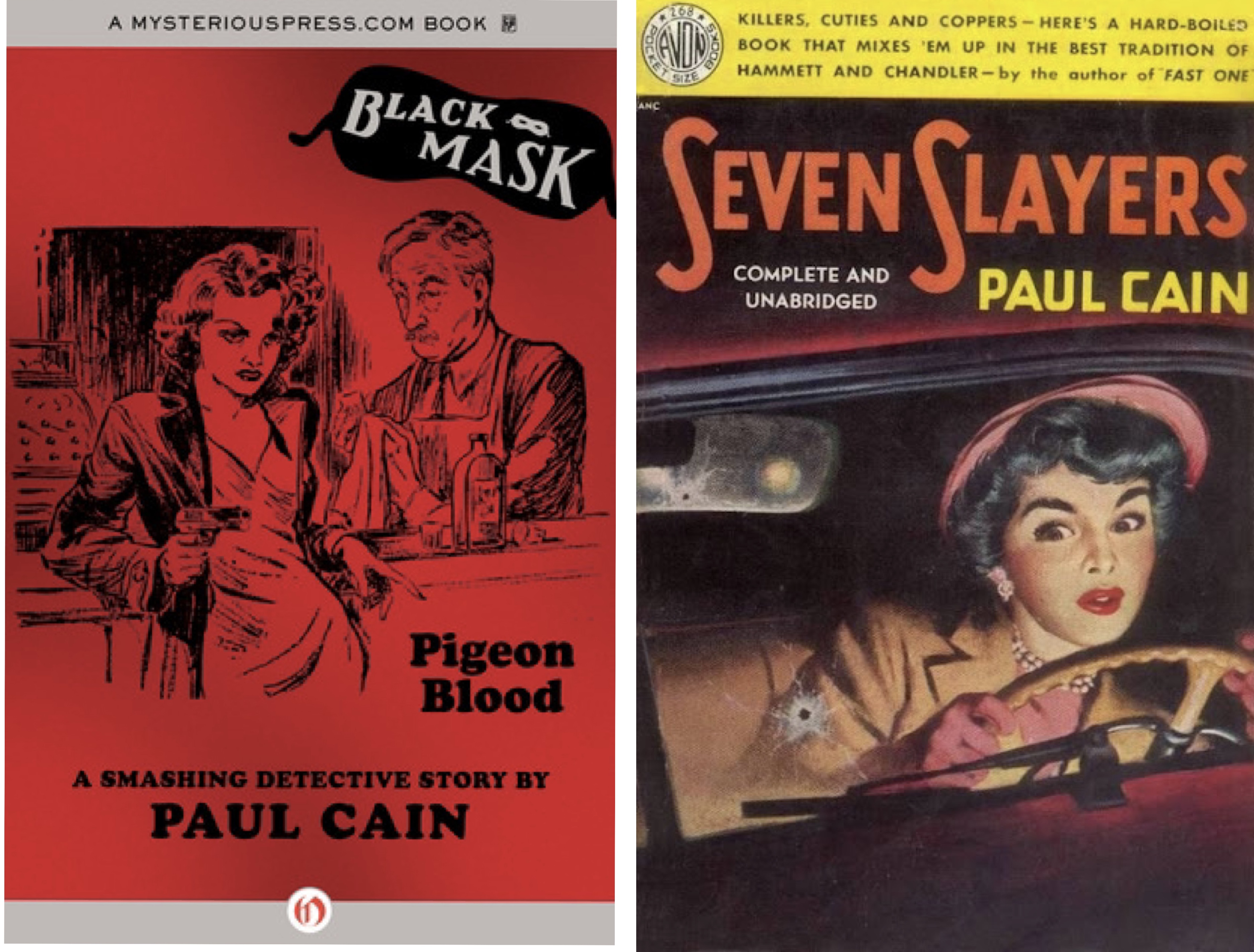
Pigeon Blood

George Sims (1902-1966) wrote screenplays as Peter Ruric and pulp fiction as Paul Cain. Seven of his 1930s works from Black Mask Magazine were compiled into the book Seven Slayers in 1946, including his most famous tale, “Pigeon Blood”, from 1933.

The novella opens with Mrs. Catherine Hannan driving from Long Island to Manhattan as thugs fire shots at her car. She’s the wife of oil millionaire Dale Hannan, and she got herself in some trouble with her own gambling debts. In order to cover her losses, Catherine partnered with a mobster to orchestrate the theft of her own rubies in an insurance fraud scheme. It now appears that the racketeer has double-crossed her and wants the socialite dead.

Her wealthy husband intervenes to save his pain-in-the-ass wife by hiring a resourceful fixer named Druse to recover the rubies and neutralize the threat on Catherine’s life. Druse is a great character who effectively takes control of the situation and determines that maybe this whole affair is not what it seems.

There are some plot twists in “Pigeon Blood” that I didn’t see coming and Cain’s writing is never boring. However, I had some issues with the convoluted conclusion that detracted from the story’s otherwise fun ride. Overall, I give “Pigeon Blood” a passing grade, but I’m not particularly inspired to dig deeper into Cain’s other stories. 

Buy a copy of this book HERE.

Monday, October 3, 2022

Paperback Warrior Episode 101 - Steve Frazee

It's a new era as Paperback Warrior storms into the next 100 episodes. #101 features a look at western and action-adventure author Steve Frazee's life and career in the pulps and paperbacks. Tom explains to listeners his cash-grab scheme using his local library and Eric discusses his recent western paperback acquisitions. Additionally, horror author Ronald Malfi, crime-fiction author Lionel White, and sci-fi writer Robert Silverberg. Watch the show's video HERE, stream audio and video below, or download the audio directly HERE.

Listen to "Episode 101 - Steve Frazee" on Spreaker.


Friday, September 30, 2022

Skin

Before his death in 2006, Mickey Spillane told his wife to give all of his unfinished manuscripts to Max Allan Collins with the assurance, “He’ll know what to do.” Since then, Collins has polished, edited, and completed several of these novels and stories for publication. “Skin” is a 36-page Mike Hammer story that Spillane began in 2005 and was finally published in 2012 after completion by Collins.

The novel opens with Mike Hammer driving back from instructing at an upstate New York Police Academy with his best friend, NYPD Officer Pat Chambers. Interestingly, the authors have aged Mike and Pat and placed the old men in a modern setting with cell phones and computers.

While driving home, Mike notices the remains of a dead body along the side of the road. He stops and sees that the body is completely pulverized with nothing but a human hand intact. It’s almost as if the body fell out of an airplane or was gnawed into pulp by wild animals.

The hand in the pile of guts begins Mike’s journey to find the killer - even finding a sexy, nightgown-clad client in the hunt. As Mike approaches the truth, the authors employ some fairly terrifying horror-fiction elements. The climax is a bloodbath of brutal violence and street justice - the most exciting conclusion I’ve read in ages.

“Skin” is an edge-of-your-seat suspense thriller starring a famous aged detective still capable of making the pages fly by for the reader. As a fan of Collins’ work, I definitely saw his fingerprints all over the prose, and I’m genuinely curious what the division of labor was between these two crime fiction legends in this unlikely collaboration.

Leaving aside the mystery of primary authorship, “Skin” is one of the most satisfying pieces of ultra-violent fiction I’ve read this year. It’s an easy entry-point for those unfamiliar with Mike Hammer, yet there are plenty of series Easter eggs for long-time fans to enjoy. “Skin” is simply a masterpiece of short crime fiction. I promise you won’t be disappointed. Highest recommendation. 

Buy a copy of this book HERE.