Friday, January 6, 2023

Red Sonja #02 - Demon Night

Created by Roy Thomas Jr. and Barry Windsor Smith, Red Sonja made her debut in Conan the Barbarian #23 in 1973. The fiery red-headed barbarian was placed in Robert E. Howard's Hyborian Kingdom as a companion to Conan, but she flourished as a lone hero in comics, magazines, graphic novels, and other pop-culture. She also appeared in a six-book series of Ace paperbacks in the 1980s. I read and enjoyed the series debut, 1981's The Ring of Ikribu, and was gifted four more of the paperbacks by my wife as an anniversary present. I celebrated by reading the series second installment, Demon Night, published in 1982.

Red Sonja is in Eastern Zamora when she awakens to find she is the prime suspect in the assassination of Captain Voss. In reality, Lieutenant Keldum killed Voss to gain one more rung of power, setting up the strange flame-haired warrior as the fall girl. Escaping the posse, Sonja journeys into the desert and rides upon a mysterious city called Elkad. Outlining the city's gateway are the bodies of six women, clearly tortured, mutilated, and very dead. 

Sonja is welcomed into the city and learns that the Elkad are a primitive people that sacrifice virgins to an ancient alien race called the Earth-Folk. Learning of this sort of nonsense, Sonja quickly leaves (in a roundabout way) and heads into the nearby mountains to find a magician that has some control over the Earth-Folk. Aside from a few events, this is really where Sonja's portion of the story leaves off.

I enjoyed the book, but my complaint would be that it was really about a young virgin named Tiamu, an Elkad servant. When Keldum and his henchmen pursue Sonja to Elkad, they enter the city and begin throwing around their weight. Tiamu is fearful that she may be the next sacrifice to the Earth-Folk (a horrible way to die), but is raped by Keldum's rival, and second-in-command. In a sequence of events that mirrors Sonja's origin (raped and then supernaturally gifted), Tiamu begins a reign of terror on Elkad and the invading military. We're talking Carrie at the prom sort of terror. She also has a love interest with a magician's apprentice. 

Demon Night is a weird book that incorporates a lot of sorcery and fantasy elements. I'm not a fan of magic, preferring sheer, sharp-edged violence to battle the monsters and dastardly villains of the Hyborian Kingdom instead. I kept picturing the Earth-Folk aliens, buried in their mountain hideaway, as an L. Ron Hubbard creation right out of Scientology 101. Not my thing, but it didn't detract from the narrative. The authors meander a bit here and there, but overall it's a satisfactory adventure tale worth the investment and exploration. Recommended.

Wednesday, January 4, 2023

The Monster from Earth's End

William Fitzgerald Jenkins (1896-1975) was a prolific writer of early 20th century fiction, including numerous science-fiction, adventure, and western stories for the pulps. He used pseudonyms like William Fitzgerald, Fitzgerald Jenkins, and Louis Carter Lee. Some of his science-fiction and pulp literary work was written under the pen name Murray Leinster. My first experience with the author is his 1959 Fawcett Gold Medal paperback, The Monster from Earth's End, written by Jenkins as Leinster. In 2019, it was reprinted by Gateway as an affordable ebook.

Gow Island (not a real place) lies just 600 miles from the Antarctic ice-cap. Because of its location, the island serves as a supply depot for researchers, scientists, and employees stationed in the Antarctic. Gow Island's population of 19 people are employees that re-supply, stock, and fuel vessels that make sporadic layovers en route to their destination. Visitors arrive on a weekly basis, but normally leave within an hour. Thus, these few island inhabitants live a rather slow, sheltered life under the guidance of the island's administrator, and book protagonist, Drake. 

In the opening pages, Gow Island receives a radar message that a plane housing seven passengers and three crewmen will be arriving from Gissell Bay, Antarctica to refuel before heading back home. On board the plane are items retrieved from the icy surface – several penguins, soil samples, and some vegetation. However, Drake and company receive a disturbing, terrifying call from the plane as it approaches the island – someone, or something, is attacking the crew and gun shots are fired. For several moments there is radio silence, then the plane lands on Gow Island's airstrip on its belly. When Drake and co-workers approach the plane they hear one lone gunshot. Opening the plane's door, they are shocked to discover the pilot shot himself in the head on the runway and the rest of the crew has simply vanished. 

The Monster from Earth's End works well as a survival horror novel. The personnel on the island contend with moving the plane off of the airstrip, but also what exactly happened to create these strange circumstances. The pilot's body is moved to a warehouse, but later than night Drake hears something moving inside the building and discovers the pilot's corpse is missing. There are twigs on the plane that seem to possess some form of intelligence. As the crew's dogs begin to die horrible deaths, and an employee goes missing, the power to the island is cut. Something wants to kill its prey in the dark, far from the light. 

I can vividly recall watching John Carpenter's 1982 horror classic The Thing when I was a kid and being absolutely petrified with fear. That film was a remake of the 1951 movie The Thing from Another World which was based on the science-fiction novella "Who Goes There?" by John W. Campbell (written as Don A. Stuart). In many ways, The Monster from Earth's End sort of fits into that same universe. So much that a Wildside Press collection called Short Things featured shorts written by a selection of authors that tie into The Thing storyline. One of those short stories was "The Monster at World's End", authored by Allan Cole, which was obviously a nod to this novel. 

If you enjoy this sort of survival horror, then The Monster from Earth's End is surely a must-read. I was a little underwhelmed by the “monster”, but the pace and atmosphere of the story kept me firmly entrenched in the novel's narrative. There are some truly creepy moments, but often I felt the book hadn't aged well over the course of 60 years. Your mileage may vary, but I recommend reading the book to make up your own mind on its longevity and legacy.

Buy a copy of this book HERE.

Tuesday, January 3, 2023

Say it was Murder

Stephen Mertz (b. 1947) is a mystery, action-adventure, and short-story writer that has contributed, or created, series titles like M.I.A. Hunter, Kilroy, Cody's Army, and the wildly successful Cody's War. He cut his teeth in the literary world as a Don Pendleton protegee, penning 12 novels in the hit series titles The Executioner/Mack Bolan from 1982-1986. He's utilized pseudonyms like Cliff Banks, Jim Case, Stephen Brett, and Jack Buchanan. But, perhaps his most descriptive name is “Mojo”, a moniker that friends and family (one in the same) use to describe Mertz through the lights, heat, and haze of a blues bar on the edges of a middle-of-nowhere Arizona town. In fact, the author's newest book is a love letter of sorts, an outlet to profess his love for the magical place he resides in.

In Say it was Murder, published in 2022 as a revised version by Rough Edges Press, Mertz describes Cochise County as Big Sky country. This slice of Southeastern Arizona paints the U.S. and Mexico border, a beautiful 100-miles stretch of open prairie and rugged mountains not to be confused with The Grand Canyon, Phoenix, or Tucson. Mertz places his private-eye protagonist, a fellow named McShan, in Bisbee, the real-life, neo-hippie small-town that he frequents. Mertz, through his fictional hero, experiences a profound connection with the area:

The desert will either chew you up and spit you out or will touch you in ways that are as deep and mysterious as they are difficult to express.

The fondness that Mertz fosters of the land and its lush beauty is only rivaled by one thing, his sincere love for crime-noir. In Say it was Murder, the author steps into the shoes filled by his literary heroes like Mike Hammer and Ed Noon. In fact, Mertz's private-eye, McShann could be a nod to private-eye Rex McBride, authored by Cleve Adams and Mike Shayne, created by Davis Dresser using the name Brett Halliday.

Like Mertz's other private-eye, Kilroy, McShan operates out of Denver, Colorado, a city that also holds a special place for the author. McShan is employed by Honeycutt Personal Services, a large agency with offices in every state specializing in detectives, cybersecurity, bodyguards, and kidnapping protection. This enterprise of ex-military and law-enforcement is ran by Miss Honeycutt, a 63-year old heavyset woman that inherited the agency from her father.

McShan's newest assignment is aiding a client named Marna, a divorced mother that hired the Honeycutt agency to find her missing daughter. When McShan arrives in Cochise County, he learns that the woman's daughter, Janine, has joined a mysterious religious sect. As McShan digs into the case, he learns more about Janine's step-father, a wealthy entrepreneur with a very violent streak. Connecting the dots, the case leads into energy and land development, illegal human-trafficking, incest, and the weird cult-like organization that has a grasp on Marna's family. 

Comparisons are made to Ross MacDonald's fantastic Lew Archer series, and that may be valid, but I felt that Mertz's characters were wilder and more diverse. McShan contends with a deadly lesbian biker and her maniacal brother, the town's barber. I also felt McShan was more reserved in his approach, keeping the dialogue, brief and more directly linked to the case. There is a sexy smoothness to Mertz's inclusion of a blonde bombshell, a potential – seemingly obligatory – love interest for the gumshoe hero. 

With its sturdy, well crafted plot, vivid locale, surprise twist, and shocking ending, Say it was Murder is a brisk, highly-satisfying crime-thriller by one of the genre's best storytellers. 

Buy a copy of this book HERE.

Monday, January 2, 2023

Monty Nash #01 - The Bloody Medallion

According to Spy Guys and Gals, Richard Telfair was a pseudonym used by Richard Jessup (1925-1982). Jessup authored westerns, pulp stories, and espionage, but was mostly known for his novel The Cincinnati Kid, which was adapted to film starring Steve McQueen and Edward G. Robinson. My first experience with Jessup is The Bloody Medallion. It was the first of five spy-fiction novels starring Montgomery Nash, a U.S. operative working for the Department of Counter Intelligence. The Bloody Medallion was originally published in 1959 by Fawcett Gold Medal and has since been reprinted in both digital and paperback versions. 

It is explained to readers that Nash works in the European section of the DCI and has a background as an attorney and WW2 veteran. This European section is made up of two-man teams that blanket the continent taking the war to the people who would make war with the US. His partner is a guy named Paul Austin. In the early pages, Nash receives a cryptic phone call from Austin with map coordinates and an odd message. Later, the DCI pulls Nash in and explains to him that Austin has changed sides and defected to the Soviet Union. As Nash digests this shocking news, he discovers that the agency has targeted him as a possible collaborator in Austin's defection. Grabbing a gun and a hostage, Nash escapes the agency to clear his name while also attempting to learn more about Austin's betrayal.

Nash tracks Austin's last known whereabouts to a mistress named Helga. With her, Nash learns of a secret society that fought the Nazis in Poland with the help of the Russian army. Each member of the society wears a special medallion that contains a piece of cloth that was dipped in the blood of their fallen comrades in a fateful battle. This secret society now fights international enemies of Russia, with America and other European allies being their chief targets. Just like Austin, Nash falls for Helga and decides to infiltrate the society to learn more about Austin's fate. Jessup's narrative is captivating as Nash learns the society's secrets while also agreeing to assist them in a plot to destroy a drug czar. But, to accomplish the mission he needs to dodge the DCI hitmen and place trust in Helga, a woman who holds a number of valuable secrets. 

I really enjoyed my first experience with Monty Nash. He writes in a hard-boiled, pulpy way which is unusual considering this is a spy-fiction novel. Nash is extremely violent, and I was left awe-inspired when he obliterated a maid's skull with a .45 bullet. His methods are heavy-handed, and not far removed from some of the savage tenacity possessed by Donald Hamilton's Matt Helm. If you love espionage thrillers with double-crosses, dastardly villains, sexy women, and Cold War hysteria, then the Monty Nash series is a mandatory read. I'm anxious to read the next installment. 

Buy a copy of this book HERE.

Thursday, December 29, 2022

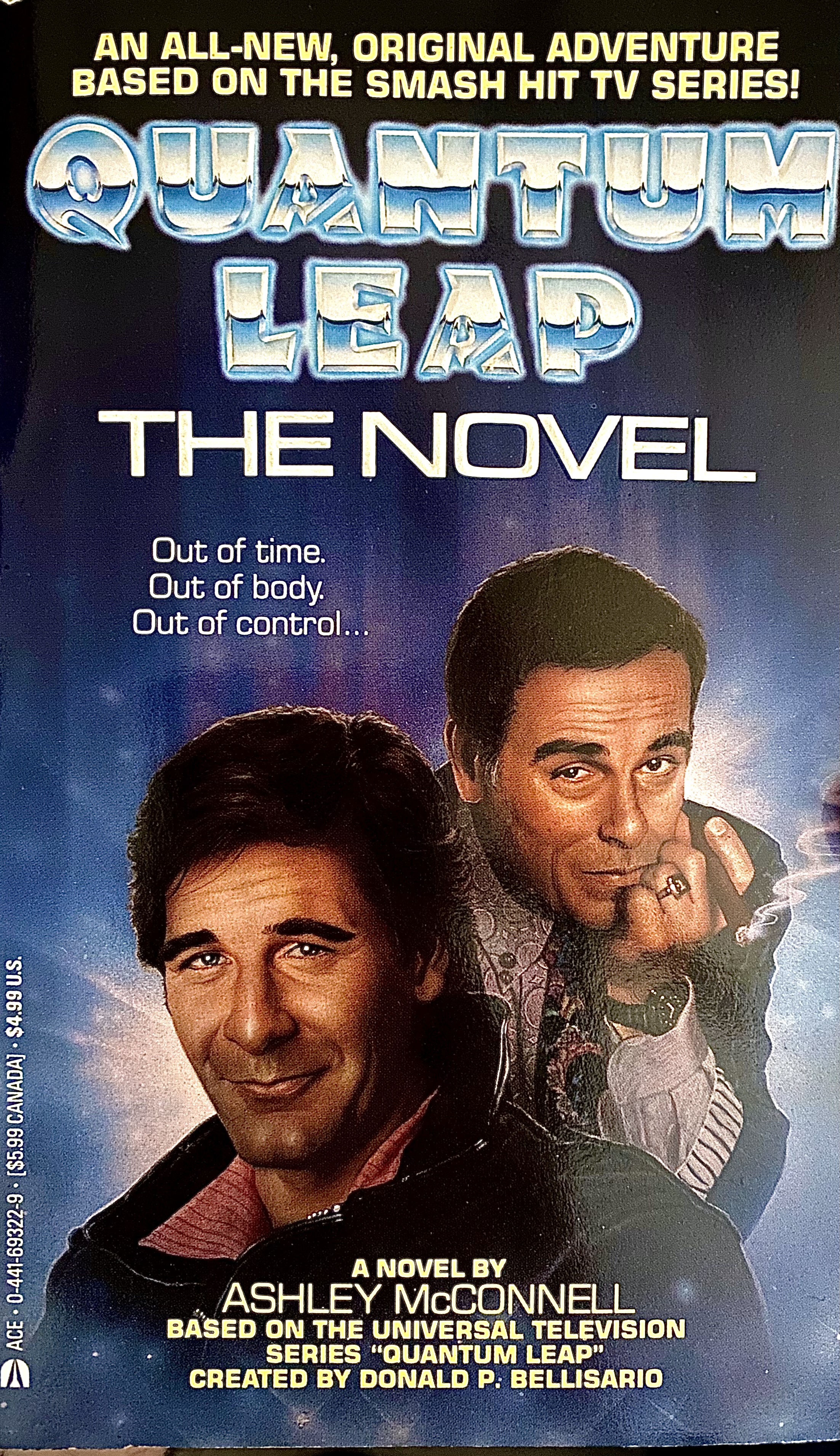
Quantum Leap #01 - The Novel (aka Carny Knowledge)

It's summer 1992, I'm 16 years old, and taking summer driving school lessons in the bible belt. I can remember it like it was yesterday. I got home around 9pm to a sweltering hot house (we had no AC), turned on our brand new, state-of-the -art Zenith 25” cabinet television with full color and a remote control. I settled into a couch potato mood, pointed the clicker at the screen, and...there's nothing on television that interests me. I'm forced to watch summer syndication, the epitome of boredom. Although it began airing on NBC in 1989, I had never watched Quantum Leap up until that moment. NBC was running a special summer week of show reruns hoping to boost ratings going into a new season in the Fall. There I was with that memorable theme song, the blue lights, Sam Beckett electrifying and morphing into some static time traveling energy. My first experience with Quantum Leap. Oh boy. 

Quantum Leap was created by Donald P. Bellisario, the television mastermind of hit shows like Magnum P.I. and N.C.I.S. He pitched a science-fiction time-traveling show to NBC and it grew into a sensation, spawning comics, paperbacks, conventions, and five wildly entertaining seasons of television that remain in rotating syndication to this day. The show even gained a reboot in the Fall of 2022 with a new cast. 

The idea is rather simple. Dr. Sam Beckett created a time-traveling program, the Quantum Leap Accelerator, ran by a supercomputer deemed "Ziggy". The program is funded by the U.S. Government and housed in the New Mexico desert. The technology is supervised by a whiz named Gushie and a medical doctor named Tina. But, the most charismatic part of the show is Al, an Admiral that partners with Sam during the time travel. In the first episode, Sam steps into the accelerator and vanishes. He awakens to find himself in the past and controlling another person's body. Al can only appear to Sam as a hologram, but provides useful information from a colorful device called Handlink, which is a glorified smart phone. 

The accelerator transports Sam into the past, but some sort of supernatural intelligence is perceived to have taken over the whole program. Each episode, Sam learns that the person he is inside of will either die, cause others to die, or experience some sort of tragedy. His job is to avoid these events from happening - righting the wrongs. His insight is that Al can provide odds that whatever he is altering will correct the issue. Once he “fixes” the problem, Sam leaps through time and into another life. But, if he fails to correct the issue, there's a high probability that he will die in the event or be forced to live the remainder of his life as that person. While Sam is controlling the body of the person in the past, that same person is flung into the present day and remains in a waiting room inside of Sam's body. After all of this is fixed, things go back to normal and that person never realizes their course of life was altered. But, each leap Sam makes he is hopeful that he will return to himself, back to his real life, back home. 

There are several men's action-adventure novels that have the same vibe as Quantum Leap. Casca, Time Raider, and Richard Blade immediately come to mind. These are fun paperback series titles that create unique adventures with very little backstory required – hero simply solving the problem and moving to the next one. It only made sense for Universal to commission Berkley to create paperbacks affiliated with the show under their imprint Ace. These paperbacks feature different writers, freely able to create new adventures for Sam to leap into. Beginning in 1990, the first of 20 novels was published, although the first two were simply novelizations of television episodes and published separately through Corgi. 

The first of the Ace titles (18 total) was published in 1992 and simply called The Novel (aka Carny Knowledge in the UK). It was authored by Ashley McConnell, an American author that contributed to other television tie-in paperback novels in series titles like Buffy the Vampire Slayer, Stargate SG-1, and Highlander. As a fan of the show, and avid paperback reader, I gained a good deal on a Quantum Leap lot of 17 total books, including the The Novel. I thought I would leap into the series with what I consider the first original Quantum Leap paperback story. Thus, the #1 is attributed to the title. 

McConnell begins the book like the television show, with Sam glowing blue and awakening to find himself in the body of a 20-something male named Bob Watkins. Sam learns from Al that he is in a small town in Oklahoma during the summer of 1957. Bob Watkins works at a family owned amusement park that has seen its better days. He's sort of a loner, an oddball that many find different and strange. These character attributes will later play a part in the overall plot development. But, for now all Sam learns is that the park's brand new roller coaster will soon derail and seven people die. He's there to somehow prevent this from happening. 

The author provides an adequate explanation of the Quantum Leap concept and the characters involved. Additionally, she provides some unique insight into the things happening in the present with Al, Gushie, and Tina when Ziggy begins to malfunction. I thought this additional storyline helped diversify some of the narrative into different thought processes and character perspectives. However, the most unnerving perspective is that of the unknown killer, a man that apparently has some knowledge of the roller coaster and how to modify it into a murder machine. Several separate chapters feature perspective's from the killer's point of view and his memories of prior attacks. This reminded me of Mary Higgins Clark or Charles Runyon's shifting perspective into the mind of a killer.

While the day-to-day activities are slightly tedious – Sam fixing amusement park machines and rides, the park owner's struggles financially, family history accounts – the build-up into the seemingly inevitable accident was exciting. I really enjoyed McConnell's knowledge of the show, specifically citing prior television episodes and Sam's fixation on avoiding a mental hospital (a possible repercussion if he can't avoid the accident). This was really strong storytelling with a noticeable nod to the fans.

McConnell also authored series installments 2-4, and 7 and I'm looking forward to reading those. If you are a die-hard, a casual fan, or completely new to the show, this debut novel is an entertaining crime-fiction read. I love all of the vintage crime-noir pertaining to carnivals and circus acts, and with this story set in 1957 in a sleepy amusement park town, the noir element is easily replicated. The Novel is an easy recommendation. 

Buy a copy of this book HERE.

Wednesday, December 28, 2022

Drop Into Hell

Lou Cameron (1924-2010) mastered so many genres of written entertainment from comic books to westerns to mysteries and so on. Drop Into Hell was a 1976 WW2 combat adventure “in the breathtaking tradition of Allistair MacLean” released by Fawcett Gold Medal.

The year is 1944 and Paratrooper Captain David Evans has been given a secret mission. Hitler has developed a new super-tank and fighter jet that could cause some real problems for the Allied Forces. The plan? Hit Germany’s fuel refinery capabilities, leaving the Kraut’s new war machines with their gas tanks on empty.

The specific target is a refinery that shares space with a Red Cross Hospital housing injured American and British POWs. Conveniently for the novel, the hospital/refinery is right next door to a Concentration Camp filled with Jews and Gypsies working as slave labor in the refinery. Bottom line: Bombing the refinery into the stone ages isn’t an option.

Enter Paratrooper Dave and his crew of commandos, which includes the mandatory American Indian soldier. Their mission is to parachute into Nazi turf, sabotage the refinery, and get back across the lines safely into the warm embrace of the Allied forces. The problem? No one really has any idea how to get the saboteurs out of Germany once the damage is done.

The entire paperback is a very smooth and easy read as the cast of characters tackle problems and obstacles along the way. However, the novel‘s action lagged a bit in the middle. For my money, I think Len Levinson’s The Sergeant series is a stronger choice, but if you’re looking for Allistair MacLean Lite, this paperback will more than suffice. 

Buy a copy of this book HERE.

Monday, December 26, 2022

Conan - Black Colossus

“Black Colossus” is a Robert E. Howard story starring Conan the Cimmerian. It originally appeared for the first time in Weird Tales, June 1933. It was reprinted in the 1954 Gnome Press collection Conan the Barbarian with edits made by author L. Sprague de Camp. The website spraguedecampfan points out that de Camp's edits were very minor. Additionally, the de Camp's edited version appeared in the Lancer collection Conan the Freebooter (1968) and subsequent printings by Sphere, Prestige, and Ace. Howard's original version, without de Camp's edits, appeared in Black Colossus (1979), The Conan Chronicles Vol. 1 (2000), Conan of Cimmeria Vol. 1 (2003), and The Weird Writings of Robert E. Howard Vol. 1 among others. The comic adaptation appears in Savage Sword of Conan #2

Shevatas is a legendary thief that readers are introduced to in the early pages. He possesses a special combination that will open a long sought after room in an ancient, abandoned Stygian temple. Once inside, Shevatas is nearly blinded by the glare of gold, silver, and heaps of diamonds. But, a recurring theme in Howard's books, is that the thief never gets the precious goods. In this case, a primeval Stygian sorcerer named Thugra Khotan awakens from a 3,000 year slumber and readers are left to their own conclusions that Khotan kills the thief.

By saying his last name backwards, Khotan takes on the name Natohk (clever, right?) and begins building an evil empire. He crushes and conquers Hyborian nations one by one, amassing their armies into his. The next destination is Khoraja, a country that is led by a brother-sister combination. The king becomes a prisoner in nearby Ophir and the queen, a beauty named Yasmela, hits the streets and pubs seeking a new military leader based on the wisdom she receives from her god Mitra. 

Yasmela, spiritually guided, locates a very drunk Conan at a local bar and convinces him to follow her back to her family's castle. There, she offers Conan the job of leading her royal armament, military, and commanders into a fierce battle with Natohk's controlled forces. A Lord Thespides (a general), is shocked by Yasmela's choice in Conan. Thespides defiantly contends Conan's leadership, but the entire military might of Khoraja soon arrives at the Well of Altaku to battle Natohk's forces. In grand fashion, the field of battle spills onto the page as Howard describes the chaos of the fight and the technical aspects of this confrontation. 

“Black Colossus” is a near-masterpiece of extraordinary battle scenes, large-scale invasion, and a classic showdown between Conan and the evil Natohk. Howard's imagination runs wild with vivid imagery, exceptional descriptions of these barbaric, iron-clad warriors, and a sense of quick plot development considering the short length. I can imagine “Black Colossus” as a full-fledged 500+ pager. 

There are a couple of interesting aspects to the story. The first is Howard's use of Biblical history, particularly Moses. In this story, Natohk throws a spear or staff on the ground and it transforms into a serpent. This mirrors the account in Exodus when the Lord asks Moses to throw his staff to the ground. When Moses obliges God, the staff turns into a serpent. On a much higher level, I believe Howard used Exodus as a blueprint for this story. When Yasmela asks Conan to lead Khoraja's military, the muscular hero questions her choice. He's a lone-wolf, inexperienced leader and the most unlikely military commander. The same could be said for Moses. God asks Moses, an unlikely leader lacking experience, to lead the nation of Israel. The similarities are striking. 

As an enjoyable reading experience, “Black Colossus” provides plenty of action-adventure, sorcery, chase sequences, and steel-meets-steel rallies. It's nearly perfect, flawed only by complicated character names and unnecessary backstory. Further, it is Conan's early development as an emphasis of the story. This work is forming the origins of Conan's eventual rise to King of Aquilonia, so it's important to the overall Conan mythos. Just as a stand-alone story, with no inkling of past or future events, it's still a rip-roaring good time. 

Buy a copy of this book HERE.