Saturday, January 21, 2023

Conan - Wolves Beyond the Border

I questioned whether to place “Wolves Beyond the Border” in the Conan category. Technically, it's in the same fictional universe and mentions the hero, but Conan doesn't actually appear in the story. Yet, it first appeared in the 1967 Lancer paperback Conan the Usurper, alongside other Conan classics like “The Scarlet Citadel” and “The Phoenix on the Sword”. By association alone, it seems mandatory. In fact, Howard began the story in the 1930s, but it went unfinished and unpublished. It was located in 1965 by Glenn Lord and then passed to L. Sprague de Camp to finish writing the story based on Howard's notes and summaries.

“Wolves Beyond the Border” takes place along the Pictish border. For Hyborian Age rookies, the Picts are similar to the Native American tribes of the North American continent in the 1500-1800s. If you read early frontier novels by the likes of James Fenimore Cooper (Leatherstocking Tales) or later, traditional westerns by Zane Grey (his Border Trilogy for example), the narratives mostly consist of early settlers and pioneers struggling to live in the same territorial regions as Native American tribes. So, Robert E. Howard used this as a blueprint when creating Conan stories like “The Treasure of Tranicos” and “Wolves Beyond the Border”. The Pictish borders are similar to the surrounding areas of North America's early Ohio River Valley.

This story is told in first-person narrative by a border ranger. In the early pages, this ranger (unnamed and referred to as Gault Hagar's son) witnesses a bizarre ritual by the Picts, where they torture a man and then magically place him in the body of a snake. It is a disturbing, horrific passage that surpasses even the mad-scientist terrors lurking in “The Scarlet Citadel”. This ranger sees that an Aquilonian named Lord Valerian is conspiring to secretly ally with the Picts. This is important because the story is set during a time when Conan was attempting to overthrow Aquilonia's leaders and become the new king. An alliance of Picts and Aquilonian noblemen doesn't promise success for Conan. 

At nearly 60 paperback pages, the story becomes bogged down and convoluted in the middle. The ranger hero confronts Lord Valerian and Pictish leaders at a swamp cabin and there's a fight and a capture. The beginning and end are exciting skirmishes and chase sequences, but overall I found the story to be of middling quality. From what I understand, Howard wrote the story up to the cabin meeting, and then the reigns were handed to de Camp to complete the manuscript from there. 

In the big picture of the Conan mythos, “Wolves Beyond the Border” is like the Star Wars film Rogue One. It is a separate story without the major heroes like Skywalker and Solo, but adds to the trilogy that began with Star Wars. Same principle here. While Conan isn't around, this is a behind-the-scenes political/military strategy that contributes to the events leading to Conan capturing the Aqulonian throne. If that's your type of story or if you are a Conan collector, then I'm sure there is plenty of enjoyment to be found here. Otherwise, skip it.

Friday, January 20, 2023

M.I.A. Hunter #10 - Miami Warzone


M.I.A. Hunter was a series of men's action-adventure novels published by Jove in the 1980s and early 1990s. The series was created by Stephen Mertz (Cody's War, Kilroy) and featured his outlines and editing with a revolving door of authors including Joe Lansdale, Arthur Moore, and Mike Newton. Crime-fiction author and popular blogger Bill Crider (1941-2018) contributed as well with his series debut, Miami Warzone. It is the 10th installment, originally published in 1988 and existing today in digital format through Wolfpack Publishing

Miami Warzone is the first domestic appearance of Mark Stone, Terrence Loughlin, and Hog Wiley, the three-man retrieval team effectively known as “M.I.A. Hunter”. The series began with dangerous missions into Southeast Asia to rescue American prisoners held captive from the Vietnam War. Stone's team was working without permission from the U.S. Government, therefore their activities were highly illegal and placed them on a C.I.A. hitlist. But, the American government caught on to Stone's skills in the same way that they caught on to The Executioner. If you can't beat them, join them. So, a U.S. Senator (Harler I think?) in book seven liberates the three hunters and places them on the federal payroll working out of Fort Bragg. You're all caught up now.

In this 10th installment, Crider introduces readers to Jack Wofford, a former teammate of Stone's during the Vietnam War. He even helped to save Stone's life during a nasty firefight at a seemingly abandoned village. In a terrific backstory, Crider tells of how Wofford's brother succumbed to drug addiction and eventually died. To avenge his brother's loss, Wofford went vigilante and began running his own one-man vice-squad. Eventually, he had enough intel and dirt on some of America's most powerful drug dealers. The D.E.A. were impressed with Wofford's talents and placed him on the payroll, similar to what happened with Stone and the C.I.A. But, on a recent undercover buy, Wofford is caught and becomes imprisoned as collateral during a Cuban and Columbian drug war. 

Stone receives a call from Wofford's wife stating that the D.E.A. isn't doing enough to free her husband. The trio takes the job to track down Wofford's whereabouts while also attempting to destroy the drug importing operation devouring Miami. The narrative has a tremendously high body count as the locations include park battlefields, a wild Everglades romp, the ultimate barfight, a mansion blowout, and even a shootout at an airport. 

M.I.A. Hunter isn't Hemingway and never professed to be. Instead, it's a rip-roar, ass-kicking team commando series with explosive action and a slight dose of testosterone humor (Hog is a riot!). As much as I loved the old fashioned “bring 'em back alive” Vietnam rescue missions, the idea of Stone and company working domestically is a nice change of pace. The last two novel locations, the Soviet Union and Nicaragua, were both excellent choices to move this series into another dynamic. Crider's writing style is ultra-violent, but also balances out with a quality story laced with crime-fiction elements, sex, and a buddy cop camaraderie. In other words, this one is a series standout. 

Buy a copy of this book HERE.

Thursday, January 19, 2023

Five Decembers

The 2022 Edgar Award for Best Novel went to our friends over at Hard Case Crime for an original work called Five Decembers. The author is a successful contemporary novelist named Jonathan Moore using the pseudonym James Kestrel.

It’s Thanksgiving, 1941 and Honolulu Police Homicide Detective Joe McGrady has no idea that Japanese planes will soon be headed his way to bomb Pearl Harbor and change the world forever. McGrady spent some time in the U.S. Army before becoming a patrolman in Honolulu. Four years later, he’s a new detective who just caught his first murder case.

And what a case it is! A young man and woman are found slaughtered in a dairy farm shed on Oahu’s windward side in a bloodbath not for weak stomachs. The dairy farmer is politically-connected and one of the victims has ties to local Navy brass. McGrady is under a ton of scrutiny from his bosses, and he’s feeling the pressure to solve this thing quickly and with minimal fanfare in the news.

The author’s writing mimics the style of James Ellroy in his Los Angeles Quartet/American Tabloid period - a hardboiled cop doing his best to solve a murder case in the shadow of world-changing events — namely World War 2.

It’s a pretty standard hardboiled police procedural with international implications that receives a giant boost of storytelling nitro when the Pearl Harbor attack occurs and the war with Japan commences. At that point, this good book becomes a great one.

The fictional events that transpire during the war and thereafter were among the most creative and unexpected plots that I’ve ever read in crime-fiction. You want heartbreak and romance? It’s there. You want bone-crunching hardboiled violence? You got it. You want a clever espionage thriller? Here you go.

Don’t let anyone spoil this novel for you. It’s not just the Best Mystery Novel of 2022, it’s the finest book I’ve read in 20 years. Essential reading for paperback genre fiction fans. Highest recommendation.

Buy a copy of this book HERE.

Wednesday, January 18, 2023

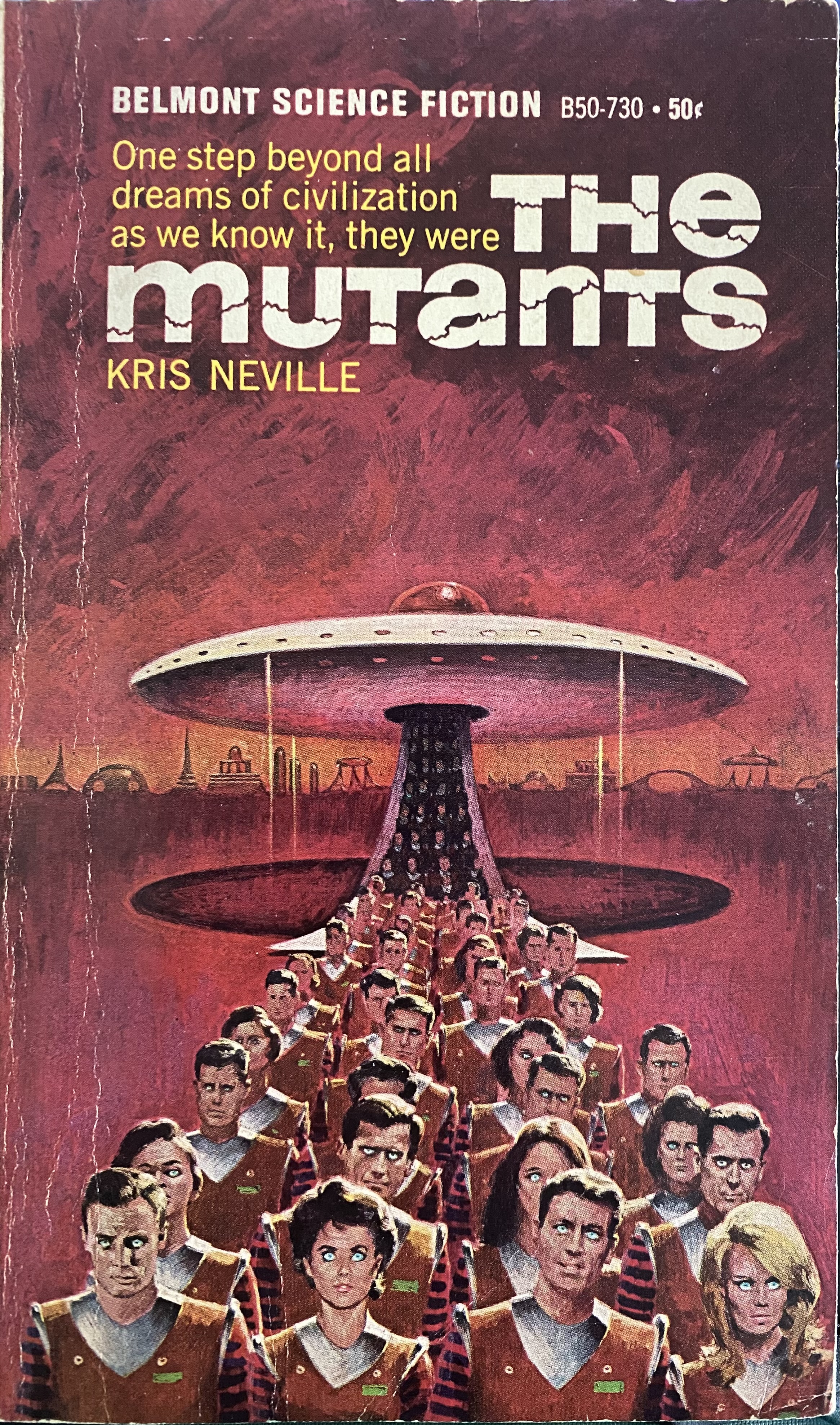
The Mutants

Kris Neville (1925-1980) was a St. Louis native and author that wrote a half-dozen science-fiction novels, contributed to anthologies, and authored numerous short stories for magazines and digests. My first introduction to the author is his 1966 Belmont paperback novel The Mutants. This was originally published at a shorter length as Earth Alert!, a novella that appeared in the February, 1953 issue of Imagination with artwork by W.E. Terry. Now, the good folks at Armchair Fiction have reprinted the novel as a double with Poul Anderson's The Virgin of Valkarion

Many miles outside of the moon's orbit, a space station sits in waiting as nine aliens prepare for Earth's destruction. This space station maintains a cloaking device that shields it from Earth's observation and detection. Inside, these aliens have bred a thousand male and female hybrids of alien and human life forms, referred to as mutants. Their mission is to utilize these mutants to assist in decimating Earth's population after a deadly frequency is broadcast that will turn humans against one another. The mutants will act as a “seek and destroy” crew cleaning up all the leftover humans. 

On Earth, the aliens detect one of their own hybrids, a woman named Julia. This woman discovers that she has a form of telekinesis and can talk with the aliens in her mind. Sensing the aliens' plans, she plans on contacting the U.S. Government to warn them of the incoming invasion. The aliens, hoping to stop the warning, send one of their own alien hybrids, Walter, to intercept Julia and kill her.

There really isn't much to this 150 page paperback beyond the Julia character alerting the authorities of the alien attack. The tentacled aliens in space fill a small portion of the narrative, but overall remain mysterious and unimportant to the reader. The author maintains a frantic pace, which helps elevate the lifeless plot, but there just isn't enough here to really keep anyone interested. Think of The Mutants as a cross between a tepid Terminator flick and Disney's very safe Escape to Witch Mountain. Avoid this one.

Buy a copy of this book HERE.

Tuesday, January 17, 2023

The Devil's Daughter

We really have gained some mileage out of Stark House Press's Lion Trio 3. This recently released omnibus features new editions of three rare, long out of print Lion paperbacks. We covered Sin Pit (Lion Book #198, 1954) by Paul Meskil HERE and HERE. Also, we covered Dark the Summer Dies (Lion Book #138, 1953) by Walter Untermeyer Jr. HERE. This review is for the third and final book in the collection, The Devil's Daughter. It was authored by Peter Marsh, a pseudonym for Alan Williams (1890-1945), and published as Lion Book #16, 1949. The omnibus is prefaced with an insightful article by Paperback Parade's Gary Lovisi detailing the history of these novels and reasons that they remain classics of dark crime-noir. 

The Devil's Daughter is a unique book, told in a conversational way between two people, Michael Perry and Laura. This storytelling style isn't something new, most recently having been used by Stephen King for the Hard Case Crime novel Colorado Kid (2005). Generally speaking, one would think reading a conversation shouldn't be an edge of the seat thrill-ride. However, if done well, the characters in the present day – the mood, emotions, character development – should progress to match the dark history, suspense, excitability of the past events they are presenting. In that regard, Williams is an absolute scholar and creates two dynamics, the mysteries unfolding in the past through this conversation and also the two characters adapting to each other's account as they slowly begin to change emotionally. It's a superb reading experience. 

Michael Perry runs a nightclub and resides in a posh apartment above it. He's a corrupt character that routinely uses cameras to spy on the women's restroom and microphones to listen to patron's conversations at the bar and nearby tables. While the reader can speculate that Michael is into a lot of bad stuff, on paper he is mainly just a drug dealing pervert. Laura, a stunning beauty, catches his eye and eventually he invites her upstairs to his apartment. It's here that Laura discovers mirrors on the ceiling, different types of cigarettes for drug “moods”, and the not so discreet cameras and microphones. Michael, wrought with desire for Laura, confesses he likes to have a good time. 

Before Laura agrees to fool around, she wants Michael to hear a story. Taking the bait, Michael agrees and this is how the reader is submerged into both characters' histories. Through the course of the conversation, Michael realizes he does know Laura, and that she was a part of his shady criminal past. When Laura explains that she has systematically seduced and murdered many of Michael's former allies, the novel takes a bleak, but enjoyable, turn into some really violent events. It is a race to the end as the body count stacks (in Laura's tale). Will Michael suffer the same fate?

The Devil's Daughter is a unique book for all of the storytelling techniques I've alluded to already. However, as a reading experience, the author pulls no punches. There are a lot of elements in this novel that are somewhat uncommon for 1949. The time-period was a pivotal point in crime-fiction. The 1940s was the birth of the paperback original, but also as the decade came to a close, Mickey Spillane's 1947 smash hit I, the Jury really pushed the boundaries of what writers could say and do within the context of their story. 

Williams injects the gritty, violent determination of prohibition era bootleggers and the extreme nature of their business practices smoothly into the book's narrative. It is punctuated by a captivating, unforgettable scene that is written in a tremendously violent way. It's nearly an unprecedented chapter that wasn't typical of a consumer “everyday” paperback. This culmination into ruthless aggression was an obligatory portion of the plot's development, another staple that binds these characters together in a turbulent way. 

If you enjoy clever, well-written novels that stray from the path of least resistance, then The Devil's Daughter will certainly be an entertaining, worthwhile investment. Combining this novel into a collection with the exceptional Sin Pit makes the price of admission an easy expenditure. Stark House Press has outdone themselves again. 

Buy a copy of this book HERE.

Monday, January 16, 2023

South Pacific Affair

We've covered a lot of Ed Lacy's (Leonard Zinberg) crime-fiction, but his rare adventure novels have mostly gone unnoticed. I discovered a $2 ebook on Amazon called South Pacific Affair, originally published by Belmont in 1961. With a fistfight, a beautiful woman, and a boat on the cover, I was hoping this nautical adventure would provide me with an excellent escape from my average suburbia.

Lacy's first-person narrative begins rather haphazardly with protagonist Ray debating marriage with an islander girl named Ruita. They are both on the fictional South Pacific island of Numaga. After the conversation, readers are left puzzled as Ray gets intoxicated, pursues a nude fat woman, and is then punched by his co-worker/friend Eddie. It infuriates me when books begin without an explanation or clue of what the Hell is happening.

Through dialogue, readers learn that Ray and Eddie sail a small shipping vessel in the South Pacific. Their main gig is obtaining and selling copra, which is essentially the insides of a coconut. It isn't a lucrative business and the duo realize that most of their proceeds are spent on supplies, women, and booze. But, Ray is disgruntled with his life after discovering his wife having an affair with a Hollywood film producer. Disgusted with love, marriage, and the 9-5 life, he partnered with Eddie to become a seaman. Then, he met Ruita and fell in love. The issue is commitment, which sometimes isn't completely embedded in the male DNA. He's been burned already and doesn't want to make the same mistake again. 

Unfortunately, that is really all that Lacy has going for him in this book. Ray and Eddie get involved in various shipments, fight with a rival, much larger crew, and have a small bout with a ship carrying natives infected with smallpox. This isn't riveting stuff and I was expecting the narrative to develop into some semblance of an adventure story or, at the very least, incorporate some sort of crime-fiction element. These things never come to fruition and the end result is an absolute dud of a novel. Stay away. There are so many better Lacy novels.

Buy a copy of this book HERE.

Friday, January 13, 2023

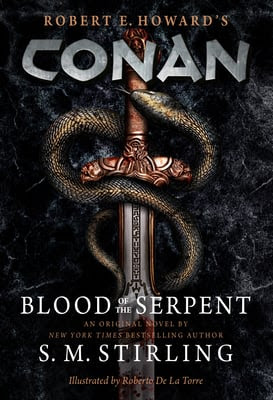
Conan - Blood of the Serpent

S.M. Stirling (Stephen Michael Stirling, b. 1953) is a Canadian-American science-fiction and fantasy author. His literary work includes the Draka, Fifth Millennium, Shadowspawn, and Emberverse series titles. He also co-authored The General series with David Drake and teamed with Jerry Pournelle for two Falkenberg's Legion books. My first experience with Stirling is his recent Conan novel, Blood of the Serpent, published by Titan Books in 2022. It is the first official Conan novel since 2011's novelization of Conan the Barbarian

Blood of the Serpent takes place after the events in Conan the Buccaneer and before the novella “Red Nails". Conan, in his late 30s, has joined up with the Free Companions working for the leader, Zarallo. In the book's opening pages, Conan is in a bar in the southwestern portion of Stygia. It's here that he first sets eyes on Valeria, a female privateer in the Red Brotherhood. After Conan saves a gambling man's life, Valeria herself runs afoul of a reckless Stygian commander. In quick fashion, Valeria wins the fight and embarrasses the leader. 

The book's first adventure has Conan, Valeria and other mercenaries guiding a Stygian shipment of supplies and slaves to one of their massive mines. In an odd twist, Conan and Valeria must protect the Stygians when the slaves revolt, kill off their masters and run the mercenaries off. Conan admits that if he were enslaved, he would have done the same. With the slave uprising, the Stygian command is fragmented, making a perfect getaway for Conan and Valeria to conduct a gold heist. After some fights with crocodiles and other reptiles and animals, the gold heist doesn't quite work out. But, this sets up the next part of the narrative when Valeria is forced to kill the Stygian commander she skirmished with earlier. She then flees on her own, but Conan learns that the commander's brother is going to trail her, hoping for a vengeful surprise kill away from prying eyes and allies. 

The second half of the novel has Conan battling Abomean warriors deep in the jungle. He makes love to a native, frees her people, and then aligns with the Abomeans. There's also battles with apelike creatures that were right out of an Edgar Rice Burroughs novel, but I received vibes that closely compared with that of Thak, the ape-man creatures that Conan fought in “Rogues in the House”. There were some odd moments with Conan and the native girl swinging on vines through the jungle, but eventually the book pairs right up to the opening paragraphs of “Red Nails” with Conan finding Valeria. 

Many have compared this novel to the Robert Jordan (James Oliver Rigney Jr.) Conan books, and that might be a fair comparison. But, Stirling is rougher around the edges, incorporating lots of gore and ultra-violence. He's far from Robert E. Howard (isn't everybody?), but still can tell a quality story that has the overall feel of Conan. I would have preferred the titular hero to do less talking, have a little more bravado compared to Valeria, and be more authoritative. I don't believe de Camp, Howard, or Carter's versions of Conan would have a return of the gold, but instead would have involved some way for the hero to lose it in a self-serving, selfish attempt to get rich quick.

I enjoyed Stirling's flashbacks to classic Conan adventures from the past. Conan recounts events from “Rogues in the House” and “Tower of the Elephant”, and I also really liked the purposeful continuity right into Howard's “Red Nails” novella. It is seamless, and maintains the same pace and formula that made that story so outstanding. As a bonus, the book even has “Red Nails” at the end to preserve one long story. If you bought the hardcover, there are also illustrations by Roberto De La Torre included. If you wanted to finish this particular portion of Conan's life, Roland Green's Conan and the Gods of the Mountain completes this story arc and dismisses Valeria's future participation. 

Buy a copy of this book HERE.