Tuesday, January 4, 2022

The Whisper Man

Steve Mosby is a British author that specializes in crime-fiction and psychological suspense. He's often compared to Scandinavian writer Jo Nesbo with his emphasis on grisly serial killers and rapists. Since 2003, Mosby has authored 11 stand-alone novels, but in 2019 he also began using the pseudonym Alex North. After seeing the North name in retail stores like Target, I finally decided to read The Whisper Man. It was published in 2019 by Penguin and exists in physical, digital, and audio formats. 

What's interesting about The Whisper Man is that it blends first and third-person perspectives into the narrative. Further, it focuses on two murders that happen 20 years apart. These elements expand the storyline and allow for some interesting ideas and plot twists. It isn't a standard crime-thriller because Mosby uses the Alex North pseudonym to purposefully add a supernatural aspect to his stories. 

20 years ago, the British village of Featherbank was terrorized by a child killer deemed “The Whisper Man.” The killer, Frank Carter, gained infamy by whispering to children at their bedroom windows. Eventually, a homicide detective named Pete cracked the case, sending Carter to prison for life and all of the bodies recovered except one. Over two decades, Pete has tried to find the body to no avail. He frequently visits Carter in prison in a cat and mouse chess match to learn where the body is. Carter's superiority as the prison's pseudo-leader gives him an arrogance that Pete can't break. Thus, two decades of mental battles have left Pete semi-retired, divorced and recovering from alcoholism. 

Now, a homicide detective named Amanda has been handed a new case that has the characteristics of the Whisper Man murders. A young boy was killed and dumped near a rock quarry in Featherbank. In questioning his parents, Amanda learns that the boy told his mother that he heard whispers outside of his window the week before. In looking into Carter's case, Amanda asks Pete to join the investigation as a consultant based on his experience with the killings. 

While this is happening, a recent widow named Tom moves to Featherbank with his young son Jake. After settling into the new house, Tom starts to notice that Jake is having conversations with an imaginary friend. From Jake's perspective, readers learn that this imaginary friend is a young girl who may have ties to the house and its original owners. Things get creepy when Jake tells Tom about “the boy in the floor.” When Tom hears strange whispers in the house, he begins to suspect that someone is after his son.

Obviously, there's a lot going on in The Whisper Man. The book's opening act explains the current mystery and the murders from 20 years ago, so I felt fully invested in how these were connected. Tom's backstory with the emotional death of his wife and his insecurity in raising Jake as a single dad was really effective. When Pete is introduced, readers gain perspective from his vantage point as well. I wanted to learn more about Amanda, but North quickly shifted her to a supporting character. 

As a horror novel, the author succeeds in creating some extremely unsettling scenes. The whispers in the house, Jake's “imaginary friend”, the boy in the floor mystery as well as the whole idea of a serial killer preying on children from their window were truly terrifying. As a crime-thriller, in the vein of James Patterson, it's mostly just a pedestrian by-the-books investigation – interview the families, look into the past homicides, interview key characters in prison, and introduce flawed characters looking to redeem themselves. It's nothing you can't find on any prime-time network television show. But, it works well when combined with the concept of something supernatural taking place.

Based on my reactions to this book, I plan on reading more of Steve Mosby's stand-alone thrillers as well as his other Alex North novel, The Shadows (2020). He's a good storyteller and at the end of the day, that's really what we are looking for. 

Buy the book HERE.

Monday, January 3, 2022

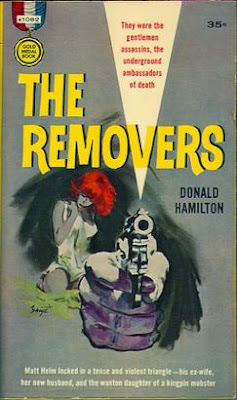
Matt Helm #03 - The Removers

Ian Fleming's mega-star James Bond influenced a number of spy fiction titles, including Assignment and Nick Carter: Killmaster. One of the most popular is the Matt Helm series authored by Donald Hamilton. It ran from 1960-1993 with 27 total books. I was lukewarm on the series first two installments, but the character still intrigued me enough to warrant further pursuit. I grabbed a copy of The Removers, the third installment of the Matt Helm series. It was originally published by Fawcett Gold Medal in 1961 and remains readily available today in audio, digital and physical reprints.

In Death of a Citizen, the series debut, Helm is married to a woman named Beth and has three children. He's a former OSS agent (the early CIA) that established a writing career and a sense of normalcy after retirement. But, events drag him back into the spy business and he rejoins his former department. I didn't particularly like the book, despite its enormous popularity, and felt that it was incomplete. The idea that Helm simply left his wife and kids (and has an affair nonetheless) didn't sit well with me. Thankfully, The Removers circles back to his family and completes the origin tale in its entirety.

The Removers begins by explaining that Beth Helm is now remarried and lives on a cattle ranch in Reno, Nevada with her kids. She's now Mrs. Lawrence and her husband is a British chap that has a shadowy past. Helm receives a letter from Beth asking him for a favor. Thus, the opening chapter has Helm in Reno preparing for an uncomfortable meeting with his ex-wife. However, Helm also receives word from his boss Mac that a young agent is working an assignment in Reno and may need a light assist. 

Helm learns from Beth that her husband was involved in a prior business similar to Helm's. Because of some sort of past event, shady people are threatening the family. Helm takes it all with a grain of salt until he meets Beth's husband Logan. Helm's theory is that Logan isn't really British, but is legitimately some sort of skilled professional capable of defending Helm's kids and ex-wife. In fact, Logan politely, but sternly, advises Helm to leave the ranch and never look back. 

The star of the show is Moira, a young and sexy woman that physically distracts Helm. The two get it on, and in doing so Helm learns that Moira is the daughter of Big Sal Fredericks, a Reno mobster. Fredericks is employing a foreign spy/enforcer named Martell, a man that Mac warns Helm about. After learning that Logan Lawrence is a former gun for Fredericks, Helm begins to connect the dots. Logan left the business, but Fredericks needs him for one more run to Mexico to recapture stolen heroin. Logan refuses, thus the not-so-gentle rub.

All of this ties in beautifully and creates a really engaging story. Helm engages in some awesome dialogue, never comically witty, but maintaining a hard-edged coolness. The action scenes are fairly swift and keep the narrative flowing into a much longer finale that is soaked with violence. Oddly, it was told with a sense of western traditionalism. The hero rides to the rural cabin in the woods to fight the unruly bad guys that have raped and captured his woman. But, that hero isn't really Helm. 

In a clever way, Hamilton mirrors Helm's origin story by telling a similar tale with Logan Lawrence. In this case, Lawrence is the one married to Beth and is called back into action after violent events begin to intrude into his retirement. Arguably, Logan is the real hero.

My main beef with Matt Helm is that he personifies the hardened tough guy. He talks tough, his first-person perspective is menacing, and he genuinely has old war stories or missions that he shares to validate his callous command. But, he never actually does much fighting. In the first two books, Helm doesn't really get the job done and people unexpectedly die. In this book, Helm watches Moira get abused by two women until her own dog makes the save and kills the would-be-rapists. Helm is knocked in the head outside of his motel room and then captured by Martell and Fredericks. 

In the finale, Logan is shot in the leg and placed on the sofa. Helm is tied up and has to listen to his ex-wife being raped in the next room. He has the audacity to question why one-legged, bleeding Logan isn't doing anything about it. The book's rowdy conclusion has Logan saving Helm's life. But, for whatever reason it all just works and Hamilton's prose is so damn cool. I loved the timeline and pacing, the brilliant conclusion of Moira (the obligatory spoiled sex kitten), Beth's neediness, the escalated violence, and Logan's expertise in disposing of the bad guys. Helm should have been the hero (and maybe he is somehow?), but I can settle for him as a co-partner.

I've already started the fourth volume, The Silencers. In the opening chapters, Helm is sent on a mission to Mexico to save a female agent. Wouldn't you know it...she's stabbed to death in front of him. But, it's written so well that I don't even care how inept the hero is. I'm sure an alternate hero will rise to the occasion. Buy a copy of the book HERE

Friday, December 31, 2021

Rambo: First Blood Part II

In 2016, Gauntlet Press, in collaboration with Borderlands Press, re-printed David Morrell's novelization of Rambo: First Blood Part II. What's interesting about the reprint is the author's lengthy, detailed explanation of how he became involved in the project. I highly recommend reading, or listening to the audio book edition, if you love books. You don't need to be a Rambo enthusiast or fan. It's a spellbinding commentary if you love the films as much as I do, but for a casual reading fan Morrell's involvement and writing experiences about creating a novelization of the script was just so captivating. 

Morrell authored First Blood in 1972, the book from which the 1982 blockbuster film was derived from. That book is much different than the film, as I explained in my review. Mostly, Rambo is a more arrogant, cocky kid in the novel and at the end of the book ***spoiler alert*** Rambo dies. In the film, he doesn't. 

In the author's introduction of Rambo: First Blood Part II, Morrell explains that he had no idea a film sequel was in development until he read it in the newspaper (authors seem to be the last to know). Shortly after, the film's development team, Tri-Star Pictures, contacted Morrell about writing the novelization of the film. Back then, films were seen at the cinema or on network television. Streaming didn't exist and VHS/laser disc wasn't mainstream (or affordable). Novelizations became important because they presented that middle ground between theatrical release and the “Sunday Movie of the Week.” The average consumer may have missed the theatrical release, so reading a novelization was an appealing alternative.

Morrell politely turned the project down because he was already writing a novel, 1984's Brotherhood of the Rose, and his version of the character ***spoiler alert *** died. But, Tri-Star kept encouraging Morrell to get out in front of the film because it was going to be BIG. Tri-Star had no other option than Morrell simply because contractually no one else at the time could write a Rambo related novel.

Needless to say, Morrell became involved (a decision that included a conversation with his friend Max Allan Collins), but was only presented a VHS tape with one scene from the film. Finding it impossible to write a novel based on a film he's never seen, Tri-Star provided Morrell a rough draft of the script written by both Sylvester Stallone and James Cameron (Terminator). That draft is what Morrell used to write the novelization. However, that draft was heavily modified by Stallone due to creative differences with Cameron. Thus, Morrell's book is an alternate version, one that I had never seen before. As a fan of the franchise, reading this book seemed mandatory.

In the novel, John Rambo is in a prison labor camp breaking rock by day and huddling in the dark shadows of his cell at night. His former Commander, Col. Sam Trautman, pays Rambo a visit to offer him a deal. The U.S. government has authorized a mission into Vietnam to take photos of a prison camp reportedly containing American P.O.W.s. With the Vietnam War over, the public had become infatuated with the idea that these P.O.W.s were still alive and being held as political collateral. The unit running this solo mission is a contracting company led by a guy named Murdock. 

Rambo later learns that this Vietnamese prison camp is the same one he was held at. This was the home of pain, a horrific place where Rambo was tortured. Because he was able to escape, the contracting company feels that Rambo is the best operative for the job. He knows the area, the camp layout, and other important details. Soon, Rambo is piloting a chopper into Thailand to meet up with Murdock and Trautman. He's provided a sophisticated portable satellite and a camera (ancient tech today), but Rambo wants weapons and the chance to break the prisoners free. This is strictly forbidden, and Murdock explains that the photos will be used to authorize a clandestine Delta Force unit to retrieve the prisoners.

Mostly all of this follows the final film version, but once Rambo enters Vietnam, it changes. After surviving a parachute fiasco, Rambo enters the thick jungle to meet up with an undercover Vietnamese ally named Co. Together, the two of them negotiate a boat ride up river to gain an access point to the camp. The romantic spark between Rambo and Co isn't the same as the film. Co does ask Rambo to take her back to the U.S., but it isn't based on a romantic interest. 

Once Rambo and Co have a vantage point to the camp, Rambo advises Co that the camera was lost and that the new deal is to rescue a prisoner found tied to a cross. It's here that Morrell absolutely shines. The author provides a brief history on archery, how the weapon has evolved over the centuries and why Rambo prefers the weapon over a more capable tool like an M-16 or AK-47. I found this so intriguing and Morrell's detailed explanation of the importance of archery, and Zen, helped define the hero even more. There's also some history on Rambo's upbringing, his abusive father, and Native American heritage. Again, these are book details that really made Rambo a more dynamic character as opposed to film.

When Rambo is captured by the Vietnamese, there's a brief backstory on a torturer named Tey, the same soldier that tormented him years ago. Obviously, the two have a heated rivalry, but the main antagonist is a Soviet interrogator named Podovsky. The torture sequences are mostly parallel to the movie - slime pit, leeches, and electric shock. The book's finale is similar to the film, but Co's importance and the dealings with a double-dealing pirate captain are modified. The film's intensity, rugged action sequences, and overall violence transcend to the printed page in the same fashion. Morrell brilliantly conveys the movie's emotion and exhilaration. 

If you love the film or if you're just a casual fan, David Morrell's novelization is a thrilling action-adventure experience. In my opinion, it really just exists on its own. Details regarding the movie or franchise aren't important in the grand scheme of things. Rambo: First Blood Part II is just an awesome story and a pleasurable reading experience. If nothing else, I highly recommend reading the author's introduction. It's an introspective revealing of what goes into creating a novelization and a must read for anyone interested in the concept.

Buy a copy of this book HERE.

Thursday, December 30, 2021

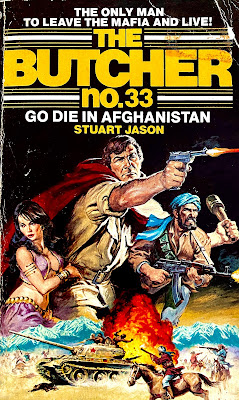
The Butcher #33 - Go Die in Afghanistan

Here is The Butcher score so far. On a scale of 1 to 10, 1 being “burn the book now” and 10 being “use PTO and read it in one sitting.” 

#07 Death Race is a 1. Seriously, it is that bad. 
#23 – Appointment in Iran is like...a 7. It's a lot of fun. 
#01 – Kill Quick or Die is a 3. 
#12 - Killer's Cargo shuffles in at a 6.
#35 – Gotham Gore is a 1. 

Using the skills I acquired in Mrs. Miller's 6th grade math, that's an average Butcher score of 3.6. That's filthy ugly. But, my problem is that I own the whole series. I hope you don't.

Go Die in Afghanistan is supposedly a series stand-out. It was published by Pinnacle in 1982 and authored by Michael Avallone. It also has a great painted cover by the esteemed Earl Norem. At just shy of 200-pages, the premise has Butcher, aka “Iceman”, in Afghanistan to rescue a NASA nuclear missile expert from those pesky Soviet invaders. He knows he's never accepted a more crucial challenge. I know I just want to avoid placing a metal fork between the pages and microwaving the book.

The narrative begins with Butcher planning a departure from Tel-Aviv. After receiving a call from White Hat (a U.S. spy agency), Butcher is advised that his next mission starts right now. But first, he shoots an old villain named Peanut Man Pennzler and stuffs him in a hotel closet. Then, the hero heads to Afghanistan to rendezvous with the rebel forces opposing Soviet occupancy.

The rebels are intensely infatuated with Butcher and are well educated on his prior exploits with the mob. A fierce, sexy rebel named Tzippora advises Butcher that her “juices flow for him.” In a rather gross sex scene, Tzippora advises Butcher that it's that time of the month, but can't suspend her desires. Butcher admits that this “birds and the bees” encounter with Tzippora will be unlike anything he's ever experienced before. 

Eventually, Butcher and Tzippora are captured by the Soviets and harshly interrogated. Butcher uses the old explosive chewing gum routine (chew it, then throw it, kaboom!) and escapes. But, before the final dash, Butcher shoots his P38 from the hip and precisely places a bullet down the barrel of a Soviet's gun. Avallone describes Butcher as the equivalent of Robin Hood, Davy Crockett and Sergeant York. Then, all of the supporting characters die, Butcher returns home. The end.

As silly as this all sounds, and believe me its totally bonkers, Go Die in Afghanistan is still fun. At this point, I have to start treating The Butcher title as a modern pulp. His silly, over-the-top, completely impossible antics are no different than say...Black Bat or Masked Detective. It's zany 1930s and 1940s pulp hero nonsense, but more dirty and violent. 

I can't think of The Butcher as a serious spy series on par with Matt Helm or Nick Carter. It's the wrong way to look at this series. Suspend disbelief, put your mind into a pulp magazine, and then read The Butcher. It  may be the only way to gain any sense of enjoyment. If not, then you'll end up with an exploding microwave. 

Go Die in Afghanistan is a 6, bringing the average score up to...4. Yikes.

Wednesday, December 29, 2021

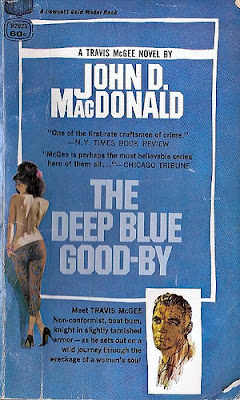
Travis McGee #01 - The Deep Blue Good-by

Crime-fiction author John D. MacDonald began the Travis McGee series with three novels, including The Deep Blue Good-by, originally published in 1964 by the powerhouse publisher of the time, Fawcett Gold Medal. The novel introduces McGee as a salvage consultant that helps clients recover stolen funds. The deal is that if McGee can successfully make the recovery, he keeps a percentage plus additional funds to cover expenses accrued. MacDonald's niche is that McGee performs most of these jobs in and around the Floridian coast on his houseboat, the Busted Flush. I've enjoyed MacDonald and wanted to explore this popular character a little more. I'm starting with the “official” series debut, The Deep Blue Good-by.*

In the book's opening chapters, McGee's newest lady “friend” asks what he does for a living. McGee explains the nature of his business to her and soon gains a referral in the form of a young, voluptuous dancer named Cathy Kerr. McGee's new client is rather reserved and quiet, but explains that her father served in WW2 and had been sentenced to prison for killing another soldier. Prior to his capture, Cathy feels that her father buried something valuable in the building materials of his house in the Florida Keys, but it was stolen by a man named Junior Allen. Her father is now dead, the valuable thing is still missing and Cathy is dancing for peanuts. McGee explains the terms of the deal and becomes involved in an enthralling mystery.

The search leads McGee to Lois Atkinson, a woman who was abused and robbed by Junior Allen and left in a near-death state. McGee, with the aid of the good doctor, nurses Lois back to heath and learns even more about this dubious Mr. Allen. McGee and Lois eventually form an emotional bond that spills over into sex – Lois requiring security and McGee seemingly recovering from some ailments of the past (the series will later hint at his military career, lost loved ones, etc.). 

McGee embraces the mantle of the noble hero, bent on punishing Junior Allen for the atrocities he's committed and the young lives he's ruined. McGee's investigation is multifaceted - what is the valuable thing, how did Cathy's father obtain it, where is it now? The job combs a great swath of area from Florida to New York and points in between. The more McGee learns, the more vicious and terrifying Allen becomes. The inevitable confrontation leads to a boat chase and a spectacular fight scene on board.

Like James Bond, or any popular fictional hero, one can jump into numerous rabbit holes online to learn more about the character and the series (movies, color scheme, boat, etc.). We even covered the character on a podcast episode here, so there's a lot to explore if you are interested. I went into the novel thinking it would be a fun, sexy splash in the water with comparisons to a more violent Shell Scott. I couldn't have been further off. 

This was more like Lawrence Block's early Matthew Scudder novels, just a little more sexy. Junior Allen proved to be a calculated, sick psycho with a penchant for power grabs. McGee's clients are victims, some more scarred and disgruntled than others. I truly felt a sense of obligation to these victims, as if McGee was righting a personal wrong for me. The ending was an emotional roller coaster that left me gutted. The closing scenes with McGee and Cathy had such an impact, and set the tone for the character. He's the hard-boiled hero, but thankfully it's complex. 

Sexy, violent, captivating, and mysterious, The Deep Blue Good-by is a masterpiece that you need to read right now. Or, reread it again. There's an obvious reason for the fuss...Travis McGee is the real deal. 

* MacDonald authored the first three Travis McGee novels in quick succession and submitted all of them to the publisher at the same time. To my knowledge, no one really knows which was the very first. 

Buy a copy of the book HERE

Tuesday, December 28, 2021

World's Scariest Places #01 - Suicide Forest

Jeremy Bates is a Toronto horror-fiction author that has won both an Australian Shadows Award and a Canadian Arthur Ellis Award. He's published two very unique series titles – The World's Scariest Places and The World's Scariest Legends. With these books, Bates spins his own original stories based on popular myths and folklore. After reading his 2019 novels Mosquito Man and The Sleep Experiment, both of which are part of The World's Scariest Legends, I was anxious to try one of his World's Scariest Places entries. I borrowed a friend's copy of Suicide Forest, originally published in 2014 and now available in both audio, physical and digital versions.

Suicide Forest is based on the very real “suicide forest” in Aokigahara, Japan (also known as the Sea of Trees). Sadly, under this tranquil, dense canopy of trees, over 100 people take their own life each and every year. Bates uses this bizarre magnetism to construct this survival-horror novel. 

Ethan and his girlfriend Mel are American teachers working temporarily in Japan. After agreeing to hike Mt. Fuji, the couple is joined by Mel's high school friend John, a co-worker named Neil and Ethan's best friend Tomo. When the book begins, the group of friends is near the entrance of Aokigahara debating on a hiking /camping in the forest after heavy rains delay their climb. After meeting two Israelis, Ben and Nina, the whole group embarks on a hiking trip into the “suicide forest”. 

After a few hours, the group finds a corpse hanging from a tree, an old abandoned car, and a thick atmosphere of doom and gloom (obviously!). The group eventually camps and awakens to find Ben dead and hanging from a tree. Thinking he committed suicide, the friends attempt to hike back out of the forest to find the police. Soon they become lost and Neil develops a traumatic case of the runs. Lost, with a corpse and stacks of diarrhea, the friends begin hearing noises in the forest. After Tomo is found dead (another hanging corpse!) and John is nearly killed, Mel and Ethan discover that the “suicide forest” has quickly turned into the hills of homicide.

At 350-pages, Suicide Forest never really feels bloated or overextended. In some ways it reminded me of another tight survival thriller, The Ruins by Scott Smith. Ethan's jealousy of Mel and John's relationship, John's military experiences in Iraq, Tomo's Japanese humor and Nina's sexuality all play important roles in keeping the narrative interesting and propulsive. The forest killers (or supernatural entities) are truly scary and Bates walks the balance beam on revealing just enough to keep readers guessing on what is really happening in these dark woods. 

Like my prior experiences with Bates, his stories continue to have a unique flavor. With over 20 published horror novels, this author still maintains quality over quantity. He's really something special and I can't wait to read more of his work (translation: I'm going to raid more of my friend's Jeremy Bates collection). Buy a copy of the book HERE

Monday, December 27, 2021

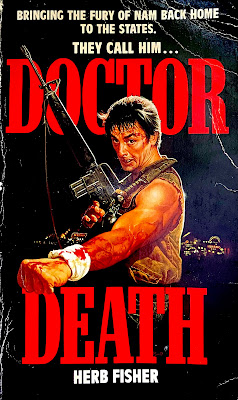
Doctor Death #01 - Doctor Death

Author Herb Fisher (1932-2001), a North Philadelphia native, began writing as a sports editor for his high school. On a football scholarship, Fisher attended Temple University and majored in journalism. Nicknamed Herbie or Fish, the author gained employment at Cherry Hill's East and West high schools as an English and Drama teacher while also coaching football. 

Beginning at age 55, Fisher had enjoyed writing so much that he wrote five screenplays, a novel and two television scripts. His agent suggested that one of the screenplays would be better suited as a book. The screenplay, Doctor Death, was whittled down to an epic novel. Eventually, that was trimmed and edited into a four book series of men's action-adventure paperbacks published by Berkley. The first novel, simply titled Doctor Death, was published in 1988 with misleading cover art and blurb. After reading it, I feel strongly that Herb Fisher deserved better treatment from his publisher.

Upon first glance, Doctor Death appears to be a late 80s cash grab targeting Mack Bolan fans. The concept of a Vietnam vet returning home to become a vigilante had become stale by the late 1970s. Dozens of movies and hundreds of books utilized the formula and most of them are all entertaining to a degree. But, after reading the first 100-pages of Herb Fisher's book, I began to understand that this isn't a cookie-cutter, “law in your own hands” styled action-adventure. It's much better than that.

The book's 18-page prologue takes place in the green jungles of the Mekong Delta in 1969. Army Special Forces (Green Beret) Sergeant Kyle Youngblood is fiercely defending an American camp as a large Vietcong battalion attack. As his fellow soldiers die, Kyle experiences a range of emotions from shock to raw, animalistic anger. Using grenades, mortars, wire, and guns, Kyle is able to hold the line while bleeding from a leg wound. When a backup platoon arrives, they find Kyle unconscious and nickname him “Doctor Death.”

The first chapter places the narrative in the present day where Kyle is now a farmer in Silver Lake, Nevada. He's living a happy, quiet small town existence with his wife and two young children. Everyone in town is fond of Kyle and considers him a hometown hero. In the opening chapters, readers are introduced to the Fallon family. They reside 25-miles west of Kyle and control a large portion of the Las Vegas underworld. In a backstory, it's explained that Marty Fallon was shot by rival mobsters and paralyzed from the waist down. He controls the action from a wheelchair in his posh, enormous mansion. His sons are screw ups, but they maintain a portion of the mob action. The youngest, Buddy, is Marty's pride and joy. But, Buddy is a wild man, sort of a juvenile delinquent right out of a 1950s crime-noir. He's a buck-wild drinker, gambler, and womanizer partying through life with his father's endless supply of money.

On Kyle's trip into town to purchase supplies, he makes a poor decision to stop in Andy's Place for a quick drink. Buddy is inside, backed by two enforcers, drinking and talking smack to anyone who will listen. Surprisingly, Kyle ignores all of it as a promise to his wife that he won't fight again. But, when Buddy's Lincoln and Kyle's beat-up pickup truck collide in the parking lot, all Hell breaks loose. Kyle is happy to swap insurance cards, but Buddy wants to swap fists. Provoked into the fight, Kyle ends up injuring the two enforcers and killing Buddy. The town sheriff is owned by the mob, so Kyle is jailed even though the fight was self-defense.

The court releases Kyle on bond, but he can't escape the trouble. When Marty learns that Buddy is dead, he places a hit on Kyle and his family. Several enforcers attempt to kill his family, but Kyle survives. In the book's third act, Kyle and his family are thrown to the wolves by the local law enforcement. They allow a mob army to descend on Kyle's farm to obliterate everything standing. The book's finale has Kyle defending the farm in the same manner as he did in Vietnam. But, instead of Army supplies, Kyle is left to make an unusual defense using farming tools and household items. The final battle is nothing short of spectacular. 

Herb Fisher gets everything right with Doctor Death. Kyle is an admirable protagonist and his willingness to sacrifice himself for his family transcends from the printed page to the beating heart. I cared about these characters and raced to the end just to learn of their fates. But, it's the little details that Fisher includes that make all of the difference.

So many books and films miss key moments to build small side-stories that will later become important events later. Fisher gets it. In the beginning, Kyle learns that the store owner doesn't have the ammo he needs. Instead, he has to settle on an undesirable caliber. This will play a large role in the book's finale. Or, something as simple as Kyle aiming a rifle, but placing extra shells between each of the fingers on his left hand for easy reloading. This reinforces battlefield experience. It's a statement that Kyle is a believable hero. Fisher even adds in the fact that the sheriff doesn't remove his hat when talking with Kyle, but the deputy does. It solidifies a good relationship, an alliance, between the deputy and Kyle. These little things are important. 

While I'm sure Fisher was delighted that his books were published by Berkley, the publisher misled the consumer. Kyle isn't the “M-16 vigilante of Vegas” like the cover suggests. I recently acquired the second and third books of the series and they have equally frustrating covers. While I enjoy The Vigilante, Sharpshooter, The Executioner, and so forth, Doctor Death isn't that type of debut. It's a different presentation and style, a screenplay to the extent that it fits into a novel. In other words, make an appointment with Doctor Death and take your damn medicine. 

Buy a copy of the brand new edition HERE