Tuesday, July 19, 2022

Penetrator #03 - Capitol Hell

We've covered the first two Penetrator novels, authored by Mark K. Roberts (odd numbered installments) and Chet Cunningham (even numbered installments) using the pseudonym Lionel Derrick. This was a long-running men's action-adventure series published by Pinnacle in the style of The Executioner and The Butcher (among others). Mostly, this is just fun escapism that's completely disposable. The series is available in audio book format through Books in Motion, narrated by Gene Engene or Kevin Foley, which is typically how I enjoy this series, and in digital by Wolfpack.

In the series third novel, Capitol Hell, Mark Hardin (The Penetrator) witnesses a car crash involving a Mob goon. The criminal's dying breath whispers the word “SIE”, which leads Hardin to a special Washington D.C. club called Societe International d'Elite. This reminded me of Ian Fleming's Moonraker, when James Bond is invited to join the posh club at Blades in London. Hardin not only wants to learn more about the club and its relation to the dead mobster, but also who assassinated the press secretary to the President of the U.S., which just so happened to be Hardin's buddy. 

There's an oddball cast of club members that have established a secret club within the club. They dress in robes, partake in weird chants, and have obligatory plans to take over the world. This club nonchalantly provides hypnotic drugs to the VP and have a strategy to blow-up Airforce One, which is utterly ridiculous. Also, once the club takes control of the U.S. (and I guess the Speaker of the House, Senate leader, and Secretary of State) they will force more military chaos in Latin America to increase their profits.

For the most part, Capitol Hell is a fun ride filled with outrageous moments of unintentional hilarity and wild action-adventure. Hardin is nearly indestructible, gets laid by two women, and fights this clandestine cult-club on a golf course and in old Williamsburg, Virginia. His tools of the trade are his trusty Colt Commander .45 and a dart gun (1 dart for sleepy, 2 for death!). These books tend to connect to each other in small ways, and Capitol Hell connects to the last two events in Los Angeles and Vegas. It isn't necessary to read them in order I suppose, but why not? If you are taking the trouble to track down the series, buy them in sequential order. 

Get the eBook HERE.

Monday, July 18, 2022

Matthew Scudder #04 - A Stab in the Dark

It is revealed in A Stab in the Dark (1981), Lawrence Block's fourth Matthew Scudder installment, that a psycho-killer wielding an ice pick savagely murdered eight young women. Scudder recalls the murders, a killing season that paralleled Scudder's own service with the New York Police Department. But, nine years have passed, Scudder is now an unlicensed, unemployed private-eye doing investigative work for favors or money. He's surprised when the murders are brought to his attention again by a stranger named Charles London.

London approaches Scudder in a diner and introduces himself using a reference from Detective Francis Fitzroy, one of Scudder's previous co-workers on the force. London explains that his daughter, Barbara, was the sixth victim of the “Ice Pick Murderer”. London reminds Scudder that recently a criminal was retrieved by the police that confessed to being the killer. He possessed enough pertinent information about the crimes to legitimately be the infamous killer. However, he presented enough testimony to convince the police that he did not kill Barbara.

In mournful fashion, London advises to Scudder that he is grieving again, as if her murder just happened considering the negative identification of her killer. He expresses that he feels a deep remorse for the way her investigation was treated, and how he has been blindly shuffled to different departments about re-opening her cold case. The police suggest there isn't enough evidence to warrant a new investigation, but London is experiencing mental anguish knowing that someone else killed Barbara for a reason that's simply unknown. He pays Scudder to look into it despite Scudder's warning that this could be a waste of time.

Scudder's trail is ice-cold, and weaves in and out of Barbara's prior life – former neighbors, husband, employer, and friends. It's a slow-pace, with a tepid action scene mixed in, but these Scudder novels emphasize mood, a certain darker ambiance than your typical gumshoe fisticuffs. Block drapes the novel in darkness and a bleak atmosphere that envelopes Scudder's own revered past and its similarities to another ex-cop named Burt. There is also brief comparison to a female artist named Jan, who suffers from alcoholism and a strained relationship with her kids.

A Stab in the Dark is another outstanding installment in the Matthew Scudder series and further proof that Lawrence Block is one of a kind. His character shading, plot development, and crime methodology are superb. If you aren't reading Block...well then you just aren't reading. 

Buy a copy of this book HERE.

Friday, July 15, 2022

Sabotage

Cleve Adams (1895-1949) was originally a pulpster that broke into writing in the 30s, along with contemporaries like Raymond Chandler and Cornell Woolrich. Adams was the co-founder of a Hollywood literary club called The Fictioneers, made up of other authors like Erle Stanley Gardner, Richard Matheson, and Frank Bonham. Adams transitioned from the pulps into paperback original novels. His serialized pulp story Sabotage, starring private-detective Rex McBride, was converted into a novel version in 1940. It has been reprinted several times, including this 1957 Signet reprint with cover art by Robert Schulz. It can also be found as a trade paperback offered by Altus Press.

The Alliance of Southwest-Pacific Underwriters, which is an insurance company, hire McBride to investigate a high number of costly incidents in Palos Verde, California. The company has insured a construction company to build a large dam. The problem is that the company is bleeding money now due to workers being killed on the job, faulty machinery, and numerous other expensive setbacks. 

McBride is considered one of the most repugnant heroes of detective-fiction, with many readers and literary scholars pointing to Adams' racist, fascist, rude, and disparaging characteristics. In Sabotage, McBride gets black-out drunk, quits the job after nearly dying (sort of), and makes passes at every female character. However, Adams presents it in a non-abrasive way that came across innocently enough as nothing more than a humorous flavor. 

Unlike the shining stars of detective-fiction, often mantlepieces of brave perfection, McBride is an average guy that routinely gets beaten, arrested, and caught – with his pants down. I think this heavily flawed, often hilarious character is a shining star of imperfection, thus making him immensely enjoyable. His abstract investigation leads through a spiral-network of shady characters and brutish town cops, but somehow makes sense by the book's conclusion. 

Sabotage is over-the-top, pulpish, and completely unnecessary. That's why it's a necessity to read if you love this era of crime-fiction. Recommended. 

Buy a copy of this book HERE.

Thursday, July 14, 2022

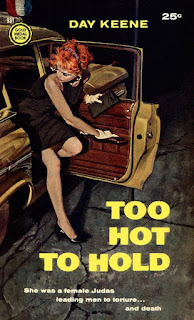
Paperback Warrior Primer - Day Keene

Along with the likes of Gil Brewer, Talmage Powell, Charles Williams, and Lionel White, Day Keene is considered a staple of mid-20th century crime-fiction literature. Keene was one of the most prolific authors of that era and authored a slew of paperback originals during the 1950s and 1960s. His body of work is still respected today, evident with the number of reprint houses clamoring for his estate or orphaned novels. In this Paperback Warrior Primer, we are presenting an overview of his life and career:

Day Keene's parents arrived in the U.S. as immigrants from Sweden. Gunart Hjerstedt was born shortly after in Chicago in 1903. Hjerstedt would later use a modified version of his mother's maiden name of Daisy Keeney to establish his legal name as Day Keene.

Keene became a traveling stage actor in the 1920s, performing under the names of Keene and his Hjerstedt name. His notable role was Rosencranz in a traveling production of William Shakespeare's Hamlet. In 1931, Keene was living in New York and sold his first story to the pulp magazines. His first sales were to Detective Fiction Weekly and West magazine. He returned to Chicago later in the 1930s and started writing for radio shows, including Little Orphan Annie and Kitty Keene, Inc., a program about a female private detective that first aired on CBS and later the Mutual Radio Network from 1937-1941. 

In 1938, Keene relocated from Chicago to St. Petersburg, Florida with his second wife, Irene, who had been a Chicago school teacher. For a while, Keene attempted writing radio scripts remotely, but eventually shifted all of his creative energy to penning stories for the pulp magazines. Keene's writing slowed for a time in 1942 when he enlisted in the U.S. Army in Pinellas County, Florida.  

During his pulp fiction era of 1940 to 1952, Keene authored 250 published short stories. He sold another 16 short stories to the digests after the pulp magazines died off in the 1950s. He used the pseudonym John Corbett for stories when there was already a Day Keene story appearing in the issue. Ramble House has a number of Day Keene's short stories compiled into trade paperbacks. You can get them HERE. In the late 1940s, Keene relocated to Los Angeles and subsequently bounced between there and St. Petersburg. 

The birth of the paperback original was a catalyst for Keene to switch from short stories to full-length novels. Keene's first novel, Framed in Guilt, originally released as a hardcover - but then quickly re-released as a paperback from Graphic Books. As an aside, Framed in Guilt was released in Great Britain under the title Evidence Most Blind and remains in print today from Stark House Press. In 1951, Keene collaborated with Gil Brewer to write the published novel Love Me and Die

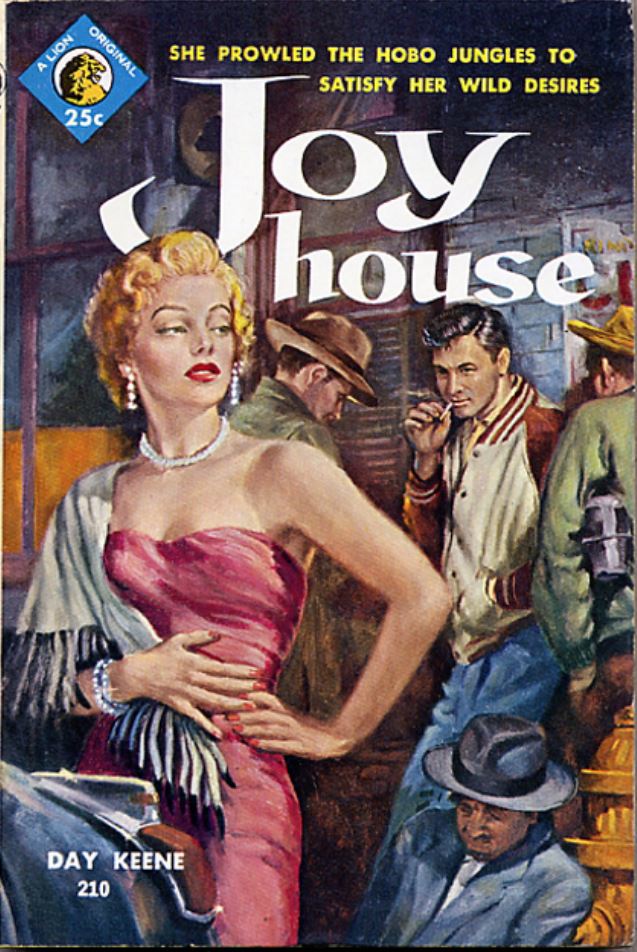
The recycling and expansion of short stories into full novels was common during that time. Keene sold a story called “She Shall Make Murder” to Detective Tales in November 1949. That became the basis for the Keene novel, Joy House, that was written in 1952, rejected by multiple publishing houses, and finally published in 1954 by Lion Books. The novel has also been reprinted by Stark House Press and remains available today. The editor of the novel at Lion Books was none other than Arnold Hano, and our review of that book is HERE. His story "Wait for the Dead Man's Tide" was featured in the August 1949 issue of Dime Mystery. It was later re-worked into the novel Dead Man's Tide, which was reprinted by Stark House Press.

Early in his career as a writer, Keene signed on with a literary agent named Donald MacCampbell, who also represented a fellow St. Petersburg, Florida author named Harry Whittington. Keene and Whittington became lifelong friends and socialized in the same Florida writing clique as Gil Brewer and Talmage Powell. Using MacCampbell, Keene's novels were first offered to Fawcett Gold Medal, who had right of first refusal. If they declined the novel, it would be shuffled down the hierarchy to other publishers like Lion, Ace, Avon, Pyramid, and Graphic Books. In the 1960s, Keene switched from shorter crime-fiction novels to denser, more mainstream novels like L.A. 46 and Chicago 11.

Keene died in North Hollywood, California on January 9, 1969. 

In his life he wrote about 50 novels, over 250 short stories, and 1500 radio scripts. Thanks to reprint houses like Stark House Press, Armchair Fiction, and Wildside Press, many of his greatest hits are still available today.

You can read all of our reviews of Day Keene's novels, including our podcast feature, HERE. For further reading, we recommend Cullen Gallagher at Pulp Serenade. Gallagher wrote an excellent introduction called "Run for Your Life: Day Keene's Wrong Men" for a Stark House Press reprint, which was the source material for this Primer.

Wednesday, July 13, 2022

Masked Rider Western #07 - Iron Horse Gunsmoke

Donald Bayne Hobart (1898-1970) began his career writing song lyrics and poems for romance magazines. His most popular literary work was the 19-year run of Whistling Waddy stories in Argosy. But, Hobart also wrote many novellas for the western pulp Masked Rider Western. My first experience with Hobart is his novella “Iron Horse Gunsmoke”, which appeared in Masked Rider Western, July 1938. The novella was also released as a paperback by Curtis Books in 1965 with a Steve Holland cover. Thankfully, Bold Venture Press has made many of the Masked Rider Western issues available today as affordable reprints. In their series order, this novella is in Masked Rider Western #07 (2022).

Wayne Morgan is the former cowpoke turned masked vigilante that fights the typical western criminals like outlaws, cattle thieves, and land barons. He rides a horse named Midnight and partners with a Native American named Blue Hawk.

In “Iron Horse Gunsmoke”, the bad guys are buried in a feud between the railroad and the ranchers. The C.W. Railroad is clanging steel across the dusty mesa as modern ingenuity tames the wild, wild west. Like all of the traditional beef ranchers, they are opposed to bringing in the trains. However, the two factions benefit from each other. Trains make the beef sell faster and can deliver supplies quickly. The railroad needs cargo to haul, thus the ranchers are valuable. Each gain something from the other. 

In an effort to create abrasion, elevate hostilities, and stall work, someone leading a team of masked raiders is inflicting casualties and damage to the railroad and the Bar O. Each party feels that the other is responsible, thus a war brews between these two industries. Hoping to settle the feud and find the culprit, Morgan goes undercover as a cowpoke for the Bar O. As a covert operative, the fast-draw, eagle-eyed gunslinger can hopefully save the day.

Like Norman Daniels, Johnston McCulley, Gunnison Steele, and Walter Tompkins, Hobart proves he can write a Masked Rider Western tale with the best of the pulpsters. There's a lot of over-the-top action, brawls, and tough-guy talk to sop up the story, which in itself is just a traditional pulp told numerous times with different characters. 

“Iron Horse Gunsmoke” never slows down, racing through the narrative from the opening run 'n gun scene through the book's finale. If you like western pulps, then you'll love what Bold Venture Press is doing with these classic Masked Western Rider novellas. 

Buy a copy of the book HERE.

Tuesday, July 12, 2022

Street Hawk #01 - Street Hawk

Street Hawk was an ABC television show that aired 14 total episodes in 1985. Many considered it to be Knight Rider on a motorcycle, but that isn't entirely accurate. As a mid-season insert in January, the show had to compete with powerhouse prime-time soap Dallas, which spelled its doom. Despite broadcasting in 42 countries, and possessing a robust, crossover line of toys and merch, the show majorly flopped. But, this isn't TV Warrior, we cover books. 

Target Books of London acquired the licensing of Street Hawk in 1985, and published four paperback novels:

1. Street Hawk by Jack Roberts
2. Cons at Large by Jack Roberts
2. Golden Eyes by Charles Gale
3. Danger on Target by David Deutsch

I was just nine when the original Street Hawk premiered, and while I remember watching it (infatuated with the intro music) and owning the toy cycle, I don't remember any of the particulars. So, Roberts novel, which is an adaptation of the show's pilot episode, was fresh and new to me. The books are somewhat hard to find, but I was ecstatic to find the first paperback at a used bookstore.

Jesse Mach is a motorcycle cop that runs daredevil competitions in his spare time. Mach and his partner are in a California desert when they ride upon a drug trafficking operation. Mach's partner is killed and Mach becomes disabled and loses his mobility. Forced to take a desk job for the police department, Mach is motivated to find the drug runners that ruined his life and murdered his partner. 

Mach's chance for revenge is introduced by a research engineer named Norman Tuttle, who works for the Federal Institute of Law Enforcement Technological Development. Tuttle explains to Mach that he is overseeing Operation Streethawk and Mach has been chosen by the institute to be the test driver. He invites Mach to a clandestine laboratory in the inner-city. It is here that he has developed a sophisticated all-terrain vehicle that, upon first glance, resembles a motorcycle. The vehicle can travel up to 300mph and has laser cannons. The bike's accessory is a high-end helmet that has cameras and GPS. Additionally, Mach is adorned with wrist cannons and the institute properly heals his leg.

In pulpy fashion, Mach has a day job in the department's public relations office and contends with a manager named Sandy that was once a journalist. But during his free time, he investigates the drug running operation and its connections to corruption within the department. Sandy and Mach form an investigative team, but she isn't clued into Street Hawk. By the book's finale, Mach has mastered the machine and can successfully use it to fight crime.

There's really nothing to dislike about this short action-adventure paperback. If you loved the 80s “super vehicle” shows like Knight Rider, Airwolf, and Blue Thunder, then you'll bring out your fan-boy soul by reminiscing about Street Hawk. The book has enough character development and crime-fiction elements to make it enjoyable. I liked the love interest hints between Sandy and Mach and the humorous “mad scientist” predictability of Tuttle. Overall, this was just a lot of fun and totally unnecessary. That's why it is great. 

Buy a copy of this book HERE

Monday, July 11, 2022

Paperback Warrior Podcast - Episode 97

On Episode 97, Eric and Tom collaborate for a comprehensive feature on Jon Messmann, the prolific author and creator of The Trailsman series, The Revenger, The Handyman, and numerous Nick Carter: Killmaster novels. Eric also reviews Messmann's stand-alone action-adventure novel, Bullet for the Bride. Tom reviews a vintage crime-fiction paperback called The Mob Says Murder by author Marvin Albert and Eric offers insight on his new projects with Brash Books and Cutting Edge. Listen on any podcast app, paperbackwarrior.com or download directly HERE.

Listen to "Episode 97: Jon Messmann" on Spreaker.