Thursday, July 14, 2022

Paperback Warrior Primer - Day Keene

Along with the likes of Gil Brewer, Talmage Powell, Charles Williams, and Lionel White, Day Keene is considered a staple of mid-20th century crime-fiction literature. Keene was one of the most prolific authors of that era and authored a slew of paperback originals during the 1950s and 1960s. His body of work is still respected today, evident with the number of reprint houses clamoring for his estate or orphaned novels. In this Paperback Warrior Primer, we are presenting an overview of his life and career:

Day Keene's parents arrived in the U.S. as immigrants from Sweden. Gunart Hjerstedt was born shortly after in Chicago in 1903. Hjerstedt would later use a modified version of his mother's maiden name of Daisy Keeney to establish his legal name as Day Keene.

Keene became a traveling stage actor in the 1920s, performing under the names of Keene and his Hjerstedt name. His notable role was Rosencranz in a traveling production of William Shakespeare's Hamlet. In 1931, Keene was living in New York and sold his first story to the pulp magazines. His first sales were to Detective Fiction Weekly and West magazine. He returned to Chicago later in the 1930s and started writing for radio shows, including Little Orphan Annie and Kitty Keene, Inc., a program about a female private detective that first aired on CBS and later the Mutual Radio Network from 1937-1941. 

In 1938, Keene relocated from Chicago to St. Petersburg, Florida with his second wife, Irene, who had been a Chicago school teacher. For a while, Keene attempted writing radio scripts remotely, but eventually shifted all of his creative energy to penning stories for the pulp magazines. Keene's writing slowed for a time in 1942 when he enlisted in the U.S. Army in Pinellas County, Florida.  

During his pulp fiction era of 1940 to 1952, Keene authored 250 published short stories. He sold another 16 short stories to the digests after the pulp magazines died off in the 1950s. He used the pseudonym John Corbett for stories when there was already a Day Keene story appearing in the issue. Ramble House has a number of Day Keene's short stories compiled into trade paperbacks. You can get them HERE. In the late 1940s, Keene relocated to Los Angeles and subsequently bounced between there and St. Petersburg. 

The birth of the paperback original was a catalyst for Keene to switch from short stories to full-length novels. Keene's first novel, Framed in Guilt, originally released as a hardcover - but then quickly re-released as a paperback from Graphic Books. As an aside, Framed in Guilt was released in Great Britain under the title Evidence Most Blind and remains in print today from Stark House Press. In 1951, Keene collaborated with Gil Brewer to write the published novel Love Me and Die

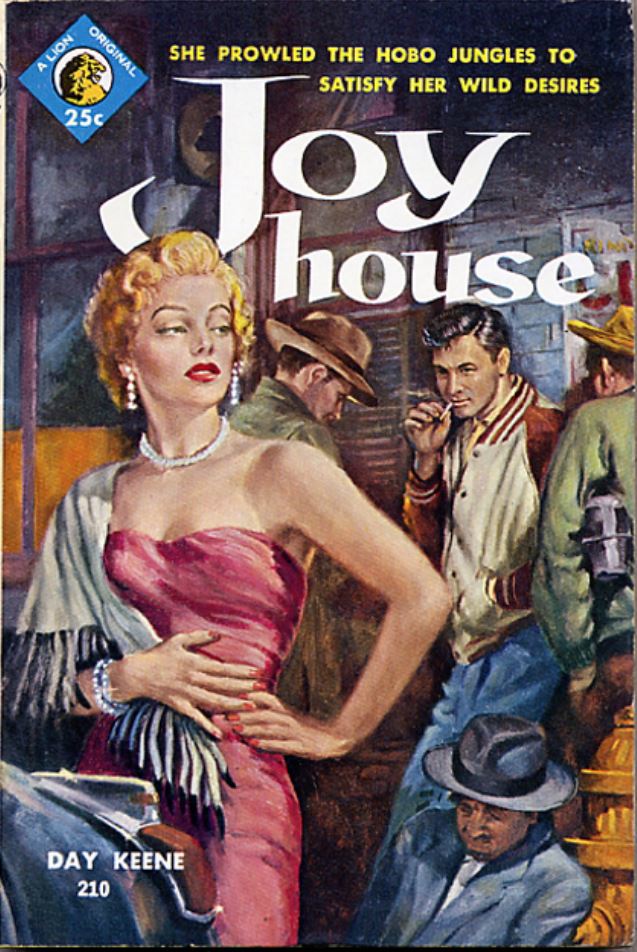
The recycling and expansion of short stories into full novels was common during that time. Keene sold a story called “She Shall Make Murder” to Detective Tales in November 1949. That became the basis for the Keene novel, Joy House, that was written in 1952, rejected by multiple publishing houses, and finally published in 1954 by Lion Books. The novel has also been reprinted by Stark House Press and remains available today. The editor of the novel at Lion Books was none other than Arnold Hano, and our review of that book is HERE. His story "Wait for the Dead Man's Tide" was featured in the August 1949 issue of Dime Mystery. It was later re-worked into the novel Dead Man's Tide, which was reprinted by Stark House Press.

Early in his career as a writer, Keene signed on with a literary agent named Donald MacCampbell, who also represented a fellow St. Petersburg, Florida author named Harry Whittington. Keene and Whittington became lifelong friends and socialized in the same Florida writing clique as Gil Brewer and Talmage Powell. Using MacCampbell, Keene's novels were first offered to Fawcett Gold Medal, who had right of first refusal. If they declined the novel, it would be shuffled down the hierarchy to other publishers like Lion, Ace, Avon, Pyramid, and Graphic Books. In the 1960s, Keene switched from shorter crime-fiction novels to denser, more mainstream novels like L.A. 46 and Chicago 11.

Keene died in North Hollywood, California on January 9, 1969. 

In his life he wrote about 50 novels, over 250 short stories, and 1500 radio scripts. Thanks to reprint houses like Stark House Press, Armchair Fiction, and Wildside Press, many of his greatest hits are still available today.

You can read all of our reviews of Day Keene's novels, including our podcast feature, HERE. For further reading, we recommend Cullen Gallagher at Pulp Serenade. Gallagher wrote an excellent introduction called "Run for Your Life: Day Keene's Wrong Men" for a Stark House Press reprint, which was the source material for this Primer.

Wednesday, July 13, 2022

Masked Rider Western #07 - Iron Horse Gunsmoke

Donald Bayne Hobart (1898-1970) began his career writing song lyrics and poems for romance magazines. His most popular literary work was the 19-year run of Whistling Waddy stories in Argosy. But, Hobart also wrote many novellas for the western pulp Masked Rider Western. My first experience with Hobart is his novella “Iron Horse Gunsmoke”, which appeared in Masked Rider Western, July 1938. The novella was also released as a paperback by Curtis Books in 1965 with a Steve Holland cover. Thankfully, Bold Venture Press has made many of the Masked Rider Western issues available today as affordable reprints. In their series order, this novella is in Masked Rider Western #07 (2022).

Wayne Morgan is the former cowpoke turned masked vigilante that fights the typical western criminals like outlaws, cattle thieves, and land barons. He rides a horse named Midnight and partners with a Native American named Blue Hawk.

In “Iron Horse Gunsmoke”, the bad guys are buried in a feud between the railroad and the ranchers. The C.W. Railroad is clanging steel across the dusty mesa as modern ingenuity tames the wild, wild west. Like all of the traditional beef ranchers, they are opposed to bringing in the trains. However, the two factions benefit from each other. Trains make the beef sell faster and can deliver supplies quickly. The railroad needs cargo to haul, thus the ranchers are valuable. Each gain something from the other. 

In an effort to create abrasion, elevate hostilities, and stall work, someone leading a team of masked raiders is inflicting casualties and damage to the railroad and the Bar O. Each party feels that the other is responsible, thus a war brews between these two industries. Hoping to settle the feud and find the culprit, Morgan goes undercover as a cowpoke for the Bar O. As a covert operative, the fast-draw, eagle-eyed gunslinger can hopefully save the day.

Like Norman Daniels, Johnston McCulley, Gunnison Steele, and Walter Tompkins, Hobart proves he can write a Masked Rider Western tale with the best of the pulpsters. There's a lot of over-the-top action, brawls, and tough-guy talk to sop up the story, which in itself is just a traditional pulp told numerous times with different characters. 

“Iron Horse Gunsmoke” never slows down, racing through the narrative from the opening run 'n gun scene through the book's finale. If you like western pulps, then you'll love what Bold Venture Press is doing with these classic Masked Western Rider novellas. 

Buy a copy of the book HERE.

Tuesday, July 12, 2022

Street Hawk #01 - Street Hawk

Street Hawk was an ABC television show that aired 14 total episodes in 1985. Many considered it to be Knight Rider on a motorcycle, but that isn't entirely accurate. As a mid-season insert in January, the show had to compete with powerhouse prime-time soap Dallas, which spelled its doom. Despite broadcasting in 42 countries, and possessing a robust, crossover line of toys and merch, the show majorly flopped. But, this isn't TV Warrior, we cover books. 

Target Books of London acquired the licensing of Street Hawk in 1985, and published four paperback novels:

1. Street Hawk by Jack Roberts
2. Cons at Large by Jack Roberts
2. Golden Eyes by Charles Gale
3. Danger on Target by David Deutsch

I was just nine when the original Street Hawk premiered, and while I remember watching it (infatuated with the intro music) and owning the toy cycle, I don't remember any of the particulars. So, Roberts novel, which is an adaptation of the show's pilot episode, was fresh and new to me. The books are somewhat hard to find, but I was ecstatic to find the first paperback at a used bookstore.

Jesse Mach is a motorcycle cop that runs daredevil competitions in his spare time. Mach and his partner are in a California desert when they ride upon a drug trafficking operation. Mach's partner is killed and Mach becomes disabled and loses his mobility. Forced to take a desk job for the police department, Mach is motivated to find the drug runners that ruined his life and murdered his partner. 

Mach's chance for revenge is introduced by a research engineer named Norman Tuttle, who works for the Federal Institute of Law Enforcement Technological Development. Tuttle explains to Mach that he is overseeing Operation Streethawk and Mach has been chosen by the institute to be the test driver. He invites Mach to a clandestine laboratory in the inner-city. It is here that he has developed a sophisticated all-terrain vehicle that, upon first glance, resembles a motorcycle. The vehicle can travel up to 300mph and has laser cannons. The bike's accessory is a high-end helmet that has cameras and GPS. Additionally, Mach is adorned with wrist cannons and the institute properly heals his leg.

In pulpy fashion, Mach has a day job in the department's public relations office and contends with a manager named Sandy that was once a journalist. But during his free time, he investigates the drug running operation and its connections to corruption within the department. Sandy and Mach form an investigative team, but she isn't clued into Street Hawk. By the book's finale, Mach has mastered the machine and can successfully use it to fight crime.

There's really nothing to dislike about this short action-adventure paperback. If you loved the 80s “super vehicle” shows like Knight Rider, Airwolf, and Blue Thunder, then you'll bring out your fan-boy soul by reminiscing about Street Hawk. The book has enough character development and crime-fiction elements to make it enjoyable. I liked the love interest hints between Sandy and Mach and the humorous “mad scientist” predictability of Tuttle. Overall, this was just a lot of fun and totally unnecessary. That's why it is great. 

Buy a copy of this book HERE

Monday, July 11, 2022

Paperback Warrior Podcast - Episode 97

On Episode 97, Eric and Tom collaborate for a comprehensive feature on Jon Messmann, the prolific author and creator of The Trailsman series, The Revenger, The Handyman, and numerous Nick Carter: Killmaster novels. Eric also reviews Messmann's stand-alone action-adventure novel, Bullet for the Bride. Tom reviews a vintage crime-fiction paperback called The Mob Says Murder by author Marvin Albert and Eric offers insight on his new projects with Brash Books and Cutting Edge. Listen on any podcast app, paperbackwarrior.com or download directly HERE.

Listen to "Episode 97: Jon Messmann" on Spreaker.

Friday, July 8, 2022

Johnny Liddell #06 - Bare Trap

Inspired by the countless private-eye novels and shorts, original paperbacks (and some hardcovers) began appearing featuring heroic detectives solving the outrageous cases. There was Mike Shayne, Mike Hammer, and Lew Archer leading the way. Frank Kane's New York private-eye Johnny Liddell was among the publisher's top echelon, The series ran a total of 29 novels and a multitude of short stories, beginning with 1947's About Face (aka Fatal Foursome). I've read a handful of the novels and mostly enjoy them. I have a slew of the series paperbacks, so I picked Bare Trap to read next. It is the series sixth installment and was originally published in 1952. It was later reprinted in 1965 by Dell with different cover art. 

Liddell is finishing up a case in San Francisco when he receives a phone call from series staple and love interest Mugsy. She asks if Liddell can take on a new case in Los Angeles before he flies back home to New York. A young actor named Shad has gone missing and his agent wants the investigation to be hush-hush. If they hire a local PI, the missing kid could make the papers and create a career misstep. With a chance to visit Mugsy in LA, Liddell takes the case.

Shad's agent is a guy named Richards, a fat loudmouth that explains that Shad is set to inherit a ton of money when he reaches the age of 21. There's hints that the kid is in some trouble, but Liddell thinks the disappearing act will solve itself. A few hours later, Liddell finds the kid riddled with bullet holes in the back. 

Liddell's case transforms from a missing person's gig to a murder investigation. With the assistance of Mugsy, a local inspector, and a prolific columnist, Kane's hero runs a convoluted gauntlet of blackmail and deception. The road leads to Richards running a badger scheme where he uses a local honey to photograph high-profile Hollywood celebs. He then uses extortion tactics to push the celebs into writing IOUs, which Richards then turns into gambling debts to repay back the mob to settle his own sheets. Got it? 

Frank Kane was notorious for recycling plots and Bare Trap is no different. In the series debut, About Face (Fatal Foursome), Liddell is hired to find a missing actor in Hollywood and receives help from a journalist and a coroner. The 'ole extortion bit using photographs or videos is an overly used genre trope, most notably Mickey Spillane's third Mike Hammer novel, Vengeance is Mine. Yet, there's a really abrasive tone to the novel – actresses with cut throats, multiple beatings, numerous fist and gun fights, a knife attack, and tons of shady characters - to keep the reader fully invested. While never particularly dense, I still had to consult a short list of characters to remember who everyone was. 

Detective stories can be run of the mill, familiar, and stereotypical, but they still provide a lot of enjoyment for crime-fiction fans. Bare Trap is no exception. 

Buy the eBook HERE.

Thursday, July 7, 2022

Stolen Tongues

Stolen Tongues is a 2017 horror novel by California native Felix Blackwell. The novel was an outgrowth of a serialized story on the NoSleep Reddit page, and has become a viral hit thanks to fans raving about his work on social media. There’s also a film adaptation and a prequel novel in the works. 

The book opens with a prologue that will scare your pants off (pants required). Our narrator is a writer named Felix Blackwell and he is house sitting in a remote cabin with his girlfriend, Faye. While at the cabin, they are menaced by an unseen force in a tension-filled scene. Because the novel doesn’t end with the prologue, our protagonist couple lives to fight another day. Bottom line: Don’t skip the prologue. 

Chapter one begins with the same couple, now engaged, headed to another remote cabin atop a Colorado mountain (these people never learn!) for a romantic getaway. The thick woods behind the cabin has plenty of hiking trails that crisscross the frozen mountain jungle. The whole thing sounds legitimately lovely and genuinely romantic until you remember you’re reading an acclaimed horror novel. 

The nearby town of Pale Peak is rich in Rocky Mountain Native American history and traditions. The tales of the tribes that once inhabited Pale Peak are rooted in mystery and mysticism. They were a ritualistic people who have disappeared from modern life, leaving only their artifacts behind. 

Of course it takes no time at all before the happy couple starts hearing ghostly voices being carried by the wind outside the cabin. Nothing menacing, at first — but you just know it’s going to escalate. The author also effectively and terrifyingly plays with the idea that night terrors, sleep walking and sleep talking can be used as conduits for malevolent entities to infiltrate your life. 

The haunting continues after the setting changes, and Felix is determined to get to the bottom of things — even if it means a crash course in Native American mysticism. As is often the case, the paranormal explanations for the haunting are way less satisfying than the haunting itself. 

I’d say the first two “haunted cabin” sequences in Stolen Tongues may have been the scariest prose I’ve read in decades. The rest of the novel exploring the source of those two haunts was fine, but nowhere near as compelling or terrifying as the novel’s twin openers. In any case, the author has placed himself on the map as a horror novelist to watch in the future. I look forward to seeing what he does next. 

Buy a copy of this book HERE.

Wednesday, July 6, 2022

Nude in the Sand

The 1950s and 1960s publishing industry experienced a trend of authors and readers embracing swamp-noir, a concept that features the average man being tempted by a seductress in the backwoods of a rural southern town. Charles Williams and Harry Whittington both excelled in this type of storytelling, which led countless other low to mid-echelon authors to try their hand. Louisiana author and WW2 veteran John Burton Thompson (1911-1994) authored these types of novels. As expensive collectors items now, these vintage paperbacks demand a hefty dollar. 

Thankfully, Cutting Edge Books have gained the rights to Thompson's literary work and have made a number of his novels into new editions for an affordable price. After enjoying his 1962 novels Kiss or Kill and Swamp Nymph, I decided to take another swig with Nude in the Sand. It was originally published by Beacon in 1959. 

The most entertaining aspect of Nude in the Sand is that there isn't a main character. Instead, Thompson uses the novel to tell many different stories about the backwoods shenanigans of several different characters that have merely six degrees of separation. By the book's end it all wraps together cohesively in a satisfying conclusion that crosses these mini-stories over (and under) each other. 

Lecia is a 20 year old vixen living with her mother on a run-down farm. Hope and aspiration are shooting stars rarely glimpsed and never caught. In a bid for money, Lecia's mother sells her off to a wealthy man named Alex who takes the two to his sprawling estate. Lecia is destined to be the despondent, pregnant housewife pushing out babies to create Alex's dynasty. The problem is that Lecia despises Alex due to his violent sexual craving and his affairs with a black slave.

Across the fields is Abe, a retired wealthy man of nobility that has a young black lover named Charline. Readers learn Abe's history with Charline, how he funded her college education, cared for her needs, and is now secretly engaged in a relationship with her. Abe and Charline frequent a hunting cabin where the two intimately share their love. But, Abe understands the age difference and the fact that the town will be thrown in a violent upheaval if their interracial love affair were to be exposed. 

Abe's nephew Merrit is a college graduate and artist that hasn't quite found his footing yet. Abe allows Merrit to live on his estate and find himself. Instead, Merrit finds an imprint in the sand made by the nude Lecia. Over time, Merrit becomes obsessed with the imprints and starts to make a bronze statue of this unknown woman. Lecia doesn't realize that her daily visits to this jungle swimming hole are being captured by the imprints she makes in the sand. Eventually, Merrit and Lecia learn of one another and are connected through Abe. When Lecia's husband Alex begins making moves on Charline, the narrative becomes more complex and enticing – Abe vs Alex over Charline. Merrit lusting for Lecia despite her marriage to Alex. There's also another side story of a male slave that hates Alex for raping other slaves. 

With this many moving parts, it would be hard for any author to excel at all of these concepts and designs. But, Thompson is such a great writer and purposefully develops this plot into a burning bed of affairs, relationships, violence, and raging sex. The novel certainly possesses enough tropes to make it a swamp-noir, but at the same time it also works as a plantation novel, or what some refer to as a “slave gothic”. Alex's violent encounters with the strong, more domineering slave named Bruce makes for a humorous, albeit savage, thread in the story's web of self-pursuit and sexual gratification. Abe's relationship with Charline is nurturing, but is laced with strong dialogue that reflects the civil unrest of a country at war with itself in the mid 20th century. 

Nude in the Sand is a riveting, hot-blooded account of sexual affairs running rampant in the Deep South. With colorful characters and multi-faceted, interlocking storylines, John B. Thompson creates a whirlwind suspenseful romance novel ripe with violence and racial unrest. Fans of Charles Williams, Harry Whittington, and Erskine Caldwell should find plenty to like. Recommended. 

Buy a copy of the book HERE.