Tuesday, January 17, 2023

The Devil's Daughter

We really have gained some mileage out of Stark House Press's Lion Trio 3. This recently released omnibus features new editions of three rare, long out of print Lion paperbacks. We covered Sin Pit (Lion Book #198, 1954) by Paul Meskil HERE and HERE. Also, we covered Dark the Summer Dies (Lion Book #138, 1953) by Walter Untermeyer Jr. HERE. This review is for the third and final book in the collection, The Devil's Daughter. It was authored by Peter Marsh, a pseudonym for Alan Williams (1890-1945), and published as Lion Book #16, 1949. The omnibus is prefaced with an insightful article by Paperback Parade's Gary Lovisi detailing the history of these novels and reasons that they remain classics of dark crime-noir. 

The Devil's Daughter is a unique book, told in a conversational way between two people, Michael Perry and Laura. This storytelling style isn't something new, most recently having been used by Stephen King for the Hard Case Crime novel Colorado Kid (2005). Generally speaking, one would think reading a conversation shouldn't be an edge of the seat thrill-ride. However, if done well, the characters in the present day – the mood, emotions, character development – should progress to match the dark history, suspense, excitability of the past events they are presenting. In that regard, Williams is an absolute scholar and creates two dynamics, the mysteries unfolding in the past through this conversation and also the two characters adapting to each other's account as they slowly begin to change emotionally. It's a superb reading experience. 

Michael Perry runs a nightclub and resides in a posh apartment above it. He's a corrupt character that routinely uses cameras to spy on the women's restroom and microphones to listen to patron's conversations at the bar and nearby tables. While the reader can speculate that Michael is into a lot of bad stuff, on paper he is mainly just a drug dealing pervert. Laura, a stunning beauty, catches his eye and eventually he invites her upstairs to his apartment. It's here that Laura discovers mirrors on the ceiling, different types of cigarettes for drug “moods”, and the not so discreet cameras and microphones. Michael, wrought with desire for Laura, confesses he likes to have a good time. 

Before Laura agrees to fool around, she wants Michael to hear a story. Taking the bait, Michael agrees and this is how the reader is submerged into both characters' histories. Through the course of the conversation, Michael realizes he does know Laura, and that she was a part of his shady criminal past. When Laura explains that she has systematically seduced and murdered many of Michael's former allies, the novel takes a bleak, but enjoyable, turn into some really violent events. It is a race to the end as the body count stacks (in Laura's tale). Will Michael suffer the same fate?

The Devil's Daughter is a unique book for all of the storytelling techniques I've alluded to already. However, as a reading experience, the author pulls no punches. There are a lot of elements in this novel that are somewhat uncommon for 1949. The time-period was a pivotal point in crime-fiction. The 1940s was the birth of the paperback original, but also as the decade came to a close, Mickey Spillane's 1947 smash hit I, the Jury really pushed the boundaries of what writers could say and do within the context of their story. 

Williams injects the gritty, violent determination of prohibition era bootleggers and the extreme nature of their business practices smoothly into the book's narrative. It is punctuated by a captivating, unforgettable scene that is written in a tremendously violent way. It's nearly an unprecedented chapter that wasn't typical of a consumer “everyday” paperback. This culmination into ruthless aggression was an obligatory portion of the plot's development, another staple that binds these characters together in a turbulent way. 

If you enjoy clever, well-written novels that stray from the path of least resistance, then The Devil's Daughter will certainly be an entertaining, worthwhile investment. Combining this novel into a collection with the exceptional Sin Pit makes the price of admission an easy expenditure. Stark House Press has outdone themselves again. 

Buy a copy of this book HERE.

Monday, January 16, 2023

South Pacific Affair

We've covered a lot of Ed Lacy's (Leonard Zinberg) crime-fiction, but his rare adventure novels have mostly gone unnoticed. I discovered a $2 ebook on Amazon called South Pacific Affair, originally published by Belmont in 1961. With a fistfight, a beautiful woman, and a boat on the cover, I was hoping this nautical adventure would provide me with an excellent escape from my average suburbia.

Lacy's first-person narrative begins rather haphazardly with protagonist Ray debating marriage with an islander girl named Ruita. They are both on the fictional South Pacific island of Numaga. After the conversation, readers are left puzzled as Ray gets intoxicated, pursues a nude fat woman, and is then punched by his co-worker/friend Eddie. It infuriates me when books begin without an explanation or clue of what the Hell is happening.

Through dialogue, readers learn that Ray and Eddie sail a small shipping vessel in the South Pacific. Their main gig is obtaining and selling copra, which is essentially the insides of a coconut. It isn't a lucrative business and the duo realize that most of their proceeds are spent on supplies, women, and booze. But, Ray is disgruntled with his life after discovering his wife having an affair with a Hollywood film producer. Disgusted with love, marriage, and the 9-5 life, he partnered with Eddie to become a seaman. Then, he met Ruita and fell in love. The issue is commitment, which sometimes isn't completely embedded in the male DNA. He's been burned already and doesn't want to make the same mistake again. 

Unfortunately, that is really all that Lacy has going for him in this book. Ray and Eddie get involved in various shipments, fight with a rival, much larger crew, and have a small bout with a ship carrying natives infected with smallpox. This isn't riveting stuff and I was expecting the narrative to develop into some semblance of an adventure story or, at the very least, incorporate some sort of crime-fiction element. These things never come to fruition and the end result is an absolute dud of a novel. Stay away. There are so many better Lacy novels.

Buy a copy of this book HERE.

Friday, January 13, 2023

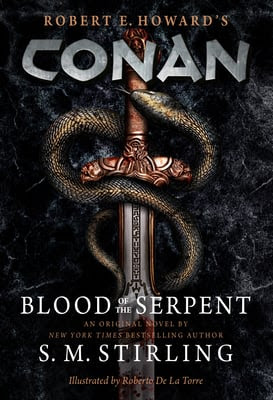
Conan - Blood of the Serpent

S.M. Stirling (Stephen Michael Stirling, b. 1953) is a Canadian-American science-fiction and fantasy author. His literary work includes the Draka, Fifth Millennium, Shadowspawn, and Emberverse series titles. He also co-authored The General series with David Drake and teamed with Jerry Pournelle for two Falkenberg's Legion books. My first experience with Stirling is his recent Conan novel, Blood of the Serpent, published by Titan Books in 2022. It is the first official Conan novel since 2011's novelization of Conan the Barbarian

Blood of the Serpent takes place after the events in Conan the Buccaneer and before the novella “Red Nails". Conan, in his late 30s, has joined up with the Free Companions working for the leader, Zarallo. In the book's opening pages, Conan is in a bar in the southwestern portion of Stygia. It's here that he first sets eyes on Valeria, a female privateer in the Red Brotherhood. After Conan saves a gambling man's life, Valeria herself runs afoul of a reckless Stygian commander. In quick fashion, Valeria wins the fight and embarrasses the leader. 

The book's first adventure has Conan, Valeria and other mercenaries guiding a Stygian shipment of supplies and slaves to one of their massive mines. In an odd twist, Conan and Valeria must protect the Stygians when the slaves revolt, kill off their masters and run the mercenaries off. Conan admits that if he were enslaved, he would have done the same. With the slave uprising, the Stygian command is fragmented, making a perfect getaway for Conan and Valeria to conduct a gold heist. After some fights with crocodiles and other reptiles and animals, the gold heist doesn't quite work out. But, this sets up the next part of the narrative when Valeria is forced to kill the Stygian commander she skirmished with earlier. She then flees on her own, but Conan learns that the commander's brother is going to trail her, hoping for a vengeful surprise kill away from prying eyes and allies. 

The second half of the novel has Conan battling Abomean warriors deep in the jungle. He makes love to a native, frees her people, and then aligns with the Abomeans. There's also battles with apelike creatures that were right out of an Edgar Rice Burroughs novel, but I received vibes that closely compared with that of Thak, the ape-man creatures that Conan fought in “Rogues in the House”. There were some odd moments with Conan and the native girl swinging on vines through the jungle, but eventually the book pairs right up to the opening paragraphs of “Red Nails” with Conan finding Valeria. 

Many have compared this novel to the Robert Jordan (James Oliver Rigney Jr.) Conan books, and that might be a fair comparison. But, Stirling is rougher around the edges, incorporating lots of gore and ultra-violence. He's far from Robert E. Howard (isn't everybody?), but still can tell a quality story that has the overall feel of Conan. I would have preferred the titular hero to do less talking, have a little more bravado compared to Valeria, and be more authoritative. I don't believe de Camp, Howard, or Carter's versions of Conan would have a return of the gold, but instead would have involved some way for the hero to lose it in a self-serving, selfish attempt to get rich quick.

I enjoyed Stirling's flashbacks to classic Conan adventures from the past. Conan recounts events from “Rogues in the House” and “Tower of the Elephant”, and I also really liked the purposeful continuity right into Howard's “Red Nails” novella. It is seamless, and maintains the same pace and formula that made that story so outstanding. As a bonus, the book even has “Red Nails” at the end to preserve one long story. If you bought the hardcover, there are also illustrations by Roberto De La Torre included. If you wanted to finish this particular portion of Conan's life, Roland Green's Conan and the Gods of the Mountain completes this story arc and dismisses Valeria's future participation. 

Buy a copy of this book HERE.

Thursday, January 12, 2023

Men's Adventure Quarterly #05

I can remember watching all of the old war films on TBS as a kid. My father had them on and I always camped out on the living floor to watch all of the action. I can remember repeated watches of The Dirty Dozen, The Wild Geese, Attack Force Z, and Devil's Brigade. Heck, my parents just celebrated their 50th wedding anniversary and “their song” is Mike Curb Congregation's “Burning Bridges”, the closing credits theme music of Kelly's Heroes. Needless to say, the team-based, do-or-die missions was ingrained into my childhood.

I was happy to learn that Bob Deis and Bill Cunningham's fifth issue of Men's Adventure Quarterly (MAQ) was dedicated to the team-combat “Dirty Mission” sub-genre of military-fiction and men's action-adventure. 

In the issue's opening pages, Deis traces the history of the concept, citing the 1965 novel and 1967 movie The Dirty Dozen as a possible catalyst for the numerous stories that appeared in men's adventure magazines. As Deis illustrates, the story that inspired The Dirty Dozen, “The Filthy Thirteen”, was published in 1944 in True: The Man's Magazine. Deis's opener is punctuated by glorious vintage artwork by Frank McCarthy, Norm Eastman, and popular Spanish comic book artist Vincent Sagrelles. 

The magazine's opening pages also features a short article by Bill Cunningham. He spotlights various films that featured unusual, unfortunate heroes partaking in dangerous military missions. Kudos to Cunningham for including one of my favorites, Uncommon Valor

Paperback Warrior is a big fan of Justin Marriott's magazines focusing on vintage books, pulps, comics, and more. One of his most recent projects is a series of fanzines dedicated to the British war comics and comic strips of the mid to late 20th century, Battling Britons. Using simple terms, he explains that the bigger British comic companies were Fleetway IPC and DC Thomson. These are like the Marvel and DC companies in the U.S. One of the things I found most interesting is that British monthly publications featured “pocketbooks”, 64-page stories that were sometimes written by military veterans. This provided a sense of realism and technical detail. Marriott's article is laced with spectacular comic panels from the likes of Battle Picture Weekly and Warlord as well as covers of Commando

The bulk of MAQ5 is dedicated to Eva Lynd, an iconic model that posed for MAM artists like Al Rossi, James Bama, and Samson Pollen. One of her most popular pairings was with artist Norm Eastman, which is a working relationship that Deis expands upon. There are numerous art panels and magazine covers to feast your eyes upon, including several that feature both Lynd and iconic male model/actor Steve Holland. In addition, Deis also briefly covers Lynd's work with artist Al Rossi, which was something I honed in on as a paperback fan. Book covers include Orrie Hitt's Women's Ward, Don Bartell's Strange Lovers, and one of the best books I read in 2022, Nude in the Sand, by John Burton Thompson. I really enjoyed the inclusion of fake movie posters portraying Lynd and Holland in action-packed military yarns. These are “fan” movie posters created by Vance Capley and David Goode, originally featured on a now defunct blog called Goode Stuff. Personally, I'm dying to see Fortress of the Damned. But, one can only dream of a film matching the power and vivid imagery of the faux poster.

Glorious Trash blog superstar Joe Kenney offers up a unique insight into his childhood. Kenney explains how he was submerged into the men's action-adventure genre, specifically MAMs and how they spawned his undying love for late 20th century paperbacks. I enjoy Kenney's blog and it was interesting to learn more about his life and what brought him to this wild dance. 

Most of the book's second half is dedicated to outrageous dirty mission stories, a majority featuring scantily-clad women. Stories like “The Captive Stalag”, “Lace Panty Guerillas”, “The Wild Lace Panty”, “Death Doll Platoon”, and the “Nazi Sex Circus”. The vivid artwork from Fernando Fernadez, Bruce Minney, and Gil Cohen enhances these stories and articles. These tales also feature female models like Lisa Karan, Carole Landis, and contemporary photographer/model Mala Mastroberte.

I seem to say the exact same thing after reading each new issue of MAQ: This is their best issue! I don't know where Cunningham and Deis find the time, energy, and dedication for all of these vintage magazines, artwork, reference material, books, the MAM CULTURE, to be featured in such a classy, professional way. This duo has side-projects, blogs, their own enjoyment, and families to tend to on top of what appears to be a full-time job creating these MAQ volumes. My hat remains tipped to their labors of love. MAQ #5 is...well Hell, it's their best issue yet! 

Buy a copy of this book HERE.

Wednesday, January 11, 2023

The Cheaters

Ledru S. Baker Jr. served in the U.S. Army Air Corps during WW2. In 1951, his short literary career began with the bestselling Fawcett Gold Medal paperback And By My Love. He followed with three more novels before his death in 1967. Cutting Edge Books has released nearly all of Baker's works, including The Cheaters, originally published by Fawcett Gold Medal in 1952. The book is available in both digital and physical editions as a stand-alone or as part of the Ledru Baker Jr Reader, an omnibus also containing Brute Madness and And Be My Love

Orchestra musician and bandleader Jack Griffith works at a posh Hollywood night club that is controlled by the Syndicate, specifically a Mafioso named Moss Morrison. One evening, Griffith is summoned to a meeting with Morrison and offered a peculiar proposal. Morrison wants to divorce his wife, a hot ticket named Mardi, but needs something on her to avoid a huge payout in alimony. Sensing his wife's attraction to Jack, Morrison offers Jack a large sum of money if he can swindle Mardi into a romantic fling. Griffith accepts the deal, but after meeting Mardi he falls in love with her. 

Just when you think Baker's smooth prose is surely leading into the overused “innocent man on the run” formula, the talented author switches the narrative entirely. Instead, Griffith figures out the whole setup while falling in love with a clever and sexy waitress. When she's taken captive by the Mob, Griffith recalls his WW2 days of fighting the Italians in brutal, bloody combat. With an iron-fisted vengeance, Griffith takes the fight to the Mob.

Baker's writing is exceptional and injects a heavy dose of realism and violence for a 1952 novel. The Cheaters mixes the grit and grime of Donald Hamilton (Matt Helm) with the sarcastic afterglow of Mickey Spillane (Mike Hammer). Baker's writing is just so engaging and produces a strong, emotional reaction. An example:

    They looked up, and their startled faces gave me all the time I needed. I shot the first one through the head; his skull and hair rose magically. I snarled and turned to the other one as the noise and blast of the gun, the smell in the room and the power I received from the recoil took me away from Los Angeles and threw me back to the Po Valley.

    I swung the gun toward the other one. He had risen, and his hand was pawing inside the coat when I said: “Hell's waitin'! Good-by!” at the same instant that I fired.

    The first shot threw him back into the chair. The second one caught him in his throat and ripped out the back of his head. I guess it did, because there were little pieces of bone on the window like flys trapped on flypaper. 

If you have a penchant for strong, “fight or die” heroes forced into inevitable violence, then The Cheaters will surely hit you like a ton of bricks. This is uncompromising, unwavering crime-fiction.

Buy a copy of this book HERE.

Monday, January 9, 2023

Carnival Girl

Cutting Edge Books has performed a marvelous job preserving mid-20th century fiction. The publisher's new editions of classic titles by the likes of Howard Hunt, Ovid Demaris, Ralph Dennis, and March Hastings position these vintage, sometimes expensive literary works, into the spotlight for a whole new generation of crime-fiction and mystery fans. 

One of the authors that Cutting Edge has focused on is Stuart James, an underrated crime-noir author that also served as a staff writer and sports reporter for magazines and newspapers. James also became an editor for Midwood Books, a subsidiary of paperback powerhouse Tower Publications. I thoroughly enjoyed the Cutting Edge editions of James' novels Frisco Flat (1960) and Judge Not My Sins (1951). I was happy to discover another Cutting Edge title, Carnival Girl, authored by Max Gareth, a pseudonym employed by James. The novel was originally published in 1960 by a small, low-budget publishing house called Chariot Books, home of other underrated novelists like Arthur Adlon and John Burton Thompson

Norma is a gorgeous Midwestern girl raised by an alcoholic single mom. When she's nearly raped by her drunken stepfather, Norma runs away from home. In the book's opening pages, readers find Norma at an Indiana diner using her last dime for food and coffee. Thankfully, the waitress displays some pity, and arranges for her to catch a ride “west” with a truck-driving customer. However, Norma doesn't realize that the waitress earned an extra tip by selling her to the highest bidder. On a lonely stretch of blacktop, the trucker rapes Norma before she escapes to a nearby farm. After being sized-up by a farm laborer, she manages to escape what is perceived as an attempted rape by flagging down two people traveling with the carnival.

The carny duo (slang for employees of a carnival) convinces Norma that she can make it in the carnival as a stripper. Back then, a fan favorite at rural, small town carnivals is the peep show, where men and boys with enough coins could enter a tent to watch naked women dance. Norma learns a few tricks and before long she is the carnival's number one attraction. But, she draws the attention of three specific men.

Speed is the good guy daredevil that performs motorcycle tricks. He falls in love with Norma, but she doesn't have the same feelings for him. Instead, Norma is lusting after Lee, the bad boy carnival drummer. There's also a man named Frank, who pitches Norma a lot of cash to come to St. Louis to work his nightclub. But, she later learns that Frank is in deep with the Mob and if she takes his job, she'll be passed around as a prostitute making a meager living lying on her back for criminals. It's a twisty, hot triangle with innocent Norma caught in the middle. 

With Carnival Girl, Stuart James completes a vivid, often disturbing character study of this young, unfortunate woman and her abrupt, violent end of innocence. Like Judge Not My Sins proved, James was such a clever storyteller with an uncanny ability to make his characters lifelike. By using a common crime-noir trope, the traveling carnival, James is able to submerge this inexperienced character into a world of depravity. Norma is a living doll thrust into dangerous situations and guided by seedy men with below-the-belt motivations. 

Carnival Girl isn't the proverbial happily ever after story of love on the run, but instead a more provocative look at young men and women pursuing carnal desires no matter the cost. It is these types of stories that made Stuart James such a talented, organic storyteller. 

Buy a copy of this book HERE.

Saturday, January 7, 2023

Conan - The Curse of the Monolith

Worlds of Fantasy magazine featured “Conan and the Cenotaph” in their first published issue in 1968. The story was authored by Lin Carter and L. Sprague de Camp and was later featured in the 1969 Lancer paperback Conan of Cimmeria under the title “The Curse of the Monolith”. It was also featured in the 1971 anthology Warlocks and Warriors as well as Sphere Books' 1989 collection The Conan Chronicles. The story was later adapted into comic form in Savage Sword of Conan #33.

The story takes place right after “The City of Skulls” and finds the titular hero serving as a captain to King Yildiz of Turan. He's assigned the duty of delivering a letter to King Shu of Kusan, a minor kingdom in Khitai far to the East (and almost off the map). The letter is to encourage an alliance between Turan and Kusan, an alliance that Shu happily agrees to. Upon meeting Conan, he sends his agreement in the way of a letter to be carried back to King Yildiz. He also sends Duke Feng, a guide and escort to accompany Conan back to the western border of Kusan. Feng has two servants and avoids any sort of manual labor, a trait that Conan fiercely despises. But, when Feng offers Conan a treasure, his interest and possible kinship is peaked. 

Feng explains to Conan that he knows where a large treasure is held at the top of a mountain nearby. He encourages Conan to suit up in armor and to accompany him to a black monolith of stone to acquire the treasure. Why does he need Conan? Apparently there are savages nearby that could attack Feng while he is dealing with the treasure grab. With Conan by his side, watching his back, the treasure can be gained and split. Conan agrees and the two go to the monolith.

Once they arrive, Conan feels a strong magnetic force and is shocked to find that he is nothing more than a fridge magnet. With the armor on, Conan is thrust to the monolith due to the magnetism possessed in the stones of the mountain. Feng explains to Conan why he has trapped him here. Further, a jellylike monster guards the monolith and drops flesh-eating acid on its prey. With Conan trapped by Feng and facing a torturous death by the equivalent of The Blob, he must use his strength to break the power of magnetism. 

"The Curse of the Monolith" weighs in at just 20 pages and is an average story at best. There's nothing to overly dislike about the plot other than its simplistic premise. Carter and de Camp's description of the mountains and monster was vivid and provided just enough atmospheric touch to place the readers into the story. However, this was just another short Conan adventure that was rich with descriptive details but not particularly memorable. This isn't a necessary read.