Showing posts sorted by relevance for query hunt. Sort by date Show all posts

Wednesday, September 14, 2022

Paperback Warrior Primer - Howard Hunt

There is already a lot that can be said about Howard Hunt. He was both a WW2 veteran, a spy, a Hollywood screenwriter, war correspondent, and a criminal. His life has been fictionalized by the film industry, his exploits chronicled by numerous non-fiction books about the infamous Watergate incident, and his possible involvement in the assassination of U.S. President John F. Kennedy. Even Hunt himself wrote non-fiction books about his own life. While all of these things are fascinating, the purpose of this Paperback Warrior Primer is to examine some of his literary highlights. You can dig the hole deeper through any number of other resources. He authored at least 88 novels, most featuring lurid covers that we appreciate.

Everette Howard Hunt Jr. (1918-2007) was born in Hamburg, New York. He attended the prestigious Brown University and later began writing for Life as a war correspondent. Later, Hunt joined the Navy, serving on the USS Mayo during the early days of WWII. After, he went to the Army Air Corps and then finished his military stint with the OSS, the nation's wartime precursor to what is now known as the CIA. Beginning in 1949, Hunt was an officer for the CIA, performing 21 years of international counter-intelligence until 1970. During this entire time, Hunt was writing novels.

His first book was East of Farewell, published in hardcover by Alfred Knopf in 1942. The book reads like a true biography as Hunt recounts the day-to-day life upon a Fletcher-class destroyer. Hunt also used his Army Air Corps experience to write his second novel, Limit of Darkness. It covers a single 24-hour period in the "life" of a Navy torpedo bomber squadron on Guadalcanal in 1943. With the success of these two novels, Hunt won the prestigious Guggenheim Fellowship, which provided him a grant to help fund his writing career and provide blocks of time where he can pursue his art form. 

During the 1950s, paperback original novels became extremely marketable by publishers. Hunt was in the perfect position to take advantage of this publishing craze by writing and selling a lot of books under his name and various pseudonyms. 

As John Baxter, Hunt authored the two novels A Foreign Affair and Unfaithful in the mid-1950s. 

Using the name Robert Dietrich, Hunt authored 12 total novels, but 9 of these make up the Steve Bentley series. Hunt produced nine series installments between 1957 through 1962 as Dietrich. He revisited the series in 1999 under his own name with one additional installment featuring the titular hero at an advanced age. In the novels, Bentley is a Washington D.C. accountant that stumbles into a lot of crime inside the Nation's Capital. Mostly, these crimes are solved by doing favors for clients or business associates. But often, they just conveniently appear in strip clubs, bars, and even by the roadside. Bentley is easily likable and shares a lot of stereotypical genre tropes with the popular private-eyes of the era - he drinks a lot of alcohol, engages in various relationships with women, owns a boat, former military, and can fight, shoot straight, and speak the truth. Paperback Warrior has a number of reviews about the series HERE. Some of the Steve Bentley books have been released in brand new editions by Cutting Edge Books, including an ebook omnibus containing a majority of the series. Cutting Edge also offers the stand-alone Dietrich novels One for the Road, Be My Victim, and The Cheat

1. Murder on the Rocks (1957)
2. End of a Stripper (1959)
3. House on Q Street (1959)
4. Mistress to Murder (1960)
5. Murder on her Mind (1960)
6. Angel Eyes (1961)
7. Curtains for a Lover (1961)
8. Calypso Caper (1961)
9. My Body (1962)
10. Guilty Knowledge (1999, as Howard Hunt)

As David St. John, Hunt authored a nine-book series starring CIA operative Peter Ward. These books were published between 1965 through 1971, and then later were reprinted under Hunt's own name in the 1970s to capitalize on his newfound fame connected with Watergate. In this series, Ward is helping Soviet scientists defect, dodging enemy assassins, chasing sensational cults, and investigating assassinations of foreign leaders. It's stereotypical spy-fiction of the era, but enjoyable nonetheless. Hunt also used the David St. John pseudonym to author the 1972 novel The Coven, a stand-alone thriller about a Washington D.C. attorney navigating witchcraft and murder. 

1. On Hazardous Duty (1965)
2. Return from Vorkuta (1965)
3. The Towers of Silence (1966)
4. Festival for Spies (1966)
5. The Venus Probe (1966)
6. One of our Agents is Missing (1967)
7. The Mongol Mask (1968)
8. The Sorcerers (1969)
9. Diabolus (1971)

Hunt's Gordon Davis works are all stand-alone novels. Paperback Warrior reviewed Where Murder Waits HERE and Hard Case Crime reprinted House Dick in 2009 using the name E. Howard Hunt. A majority of the Gordon Davis paperbacks were reprinted by various publishers under Hunt's name, once again to capitalize on Watergate.

In 1972, President Richard Nixon was running for re-election. A group of men beholden to the President was caught burglarizing the Democratic National Committee headquarters – President Nixon’s opposition party – at a hotel called The Watergate in Washington, DC. One of the burglars caught was Howard Hunt. It became known as the Watergate Scandal and one of the central questions was: What did the President know about this burglary and when did he know it? The burglary led to the resignation of President Nixon. Howard Hunt, among others, was incarcerated for his part in the burglary and served 33 total months in federal prisons in Pennsylvania and Florida. While in prison, Hunt suffered a minor stroke. 

The prison stint did not dampen Hunt's literary career. If anything, it improved his sales. Publishers were able to list a front-cover blurb that connected the author's name with one of the greatest scandals in U.S. history. Once he was released from prison, Hunt began writing consistently, but also realized that his prior pseudonyms were being converted to his real name.

In 1985, Hunt created an action-adventure series starring Jack Novak, an agent with the Drug Enforcement Agency. The series ran seven total novels from 1985 through 2000. 

1. Cozumel (1985)
2. Guadalajara (1990)
3. Mazatlan (1993)
4. Ixtapa (1994)
5. Islamorada (1995)
6. Izmir (1996)
7. Sonora (2000)

While he was authoring the Novak series, he also authored three-stand alone action-adventure novels using the pseudonym P.S. Donoghue from 1988-1992 - Dublin Affair, Sarkov Confession, and Evil Time.

On January 23, 2007, Howard Hunt died from pneumonia in Miami. He is buried in Prospect Lawn Cemetery in Hamburg, New York.

You can read all of our Howard Hunt reviews and listen to a podcast episode dedicated to the author HERE.

Tuesday, January 7, 2025

Deer Hunt

Peter Lefcourt, a novelist, producer, and screen-writer, contributed to television shows like Scarecrow and Mrs. King, Cagney & Lacey, and Desperate Housewives. He has authored a number of books, but I was mostly interested in his 1976 Pyramid paperback Deer Hunt. It neatly slides into the “Deer Hunter Horror” niche. 

Deer Hunt stars two brothers, Sid and Dave, that live in a small northern Vermont town. Years ago two events transpired that drastically altered their relationship. The first was when Cora dumped her boyfriend Dave right after high school and chose Sid, who she married and has been with (kinda happily) ever since. The second event is that the two inherited their father's pharmacy.

Sid is the responsible small business operator that runs the store and the books. Dave mostly labors at the pharmacy and does just enough to warrant his role in the business. Sid is a fair man and still provides 50% of the profits to his bitter brother.  Sid has often asked his brother to sell his half, but Dave refuses and the relationship just gets worse every year. 

In a strange scenario Dave accuses Sid of stealing money from the pharmacy cash register, which is nuts. Sid has much easier ways of stealing money from under Dave's nose. Dave accuses Sid of being a thief and begins to treat Cora poorly. It is just a really bad situation.

Dave and Sid used to go on deer hunting trips together, but years ago Dave stopped going and now remains as an elusive weirdo that spends his time reading gun magazines. So, this new hunting trip that Sid is about to embark on this year runs afoul when Dave volunteers to go. Sid gets the feeling that Dave is wanting to go deer hunting with him so he can shoot and kill Sid in a revenge plot to get the pharmacy to himself and to somehow get Cora back. However, things get really wild when Dave outlines a hunting map with one side labeled Dave and one side labeled Sid. Dave explains that this hunting trip will be different because Dave and Sid will hunt and kill each other. Whoever wins and kills the other will explain to the police that it occurred by mistake while shooting at a deer. 

Of course Sid thinks this is all crazy. But, Dave warns him that if he doesn't participate in this hunt that he will come to Sid's house and just kill him in his sleep or at a time when he least expects it. Sid can't live with the fear and paranoia that his brother is going to murder him so he agrees to this macabre deer hunt so he can at least have a fighting chance and can finally clear his mind from the stress. 

Deer Hunt is a terrific book if you enjoy the slow burn. Three-fourths of the narrative is just leading up to the hunt. The relationship wrinkles, Cora and Sid's relationship, and how the small town perceives the brothers. The hunt itself is only about 25 pages, but I was perfectly satisfied with the development and finale.

 However, the author didn't understand firearms when he wrote the novel. He has Sid carrying a .22 rifle to go deer hunting and to participate in the hunt for Dave. He then describes how the .22 “slug” would punch through one of the hunter's vests and completely turn him around. In reality, I've seen people dig a .22 bullet out with a pocket knife. You typically don't kill deer or people with a .22 rifle. It is ridiculous. But, other than that this was an entertaining novel. 

Wednesday, April 21, 2021

The Violent Ones

Howard Hunt was a CIA operative, political burglar and author. Using his own name or pseudonyms including Robert Dietrich, David St. John, Gordon Davis and P.S. Donoghue, Hunt wrote over 50 crime-noir and spy novels in the mid-20th Century. Several of these were on Fawcett Gold Medal including the author's seventh novel, The Violent Ones. It was originally published in 1950 and most recently reprinted by Cutting Edge and Armchair Fiction. 

The novel stars Cameron, a rugged WW2 veteran who has recently been released from prison after paralyzing a man who was sleeping with Cameron's mendacious wife. The prison stint left Cameron with very little purpose and even less money. To solve both issues, Cameron travels to France to reunite with his old war buddy Thorne for a potential heist.

It's explained that during the war the allies dropped arms and gold to the Maquisards, a fierce underground band of French Resistance fighters. After the war was over and the Germans were gone, no one bothered to locate the whereabouts of these guns and riches. In 1945, the gold was cached by certain parties and left undetected. Now, five years later, Thorne finds himself in debt to a local gambling house and forced to make a daring venture to clear his account. Teaming with Cameron, the duo aim to move the gold to Switzerland undetected by authorities. After one night in the city, Cameron finds Thorne murdered. Who killed him? Who else is after the gold?

The upside is that Cameron is a great character, and I loved his backstory with the cheating wife and his two love interests in the novel. Both were just so sexy and Hunt expertly describes these encounters. The main problem, and there are many, is that Cameron isn't a formidable hero. He is routinely assaulted by the enemy and left to mend his wounds for another chance. He's just so average in terms of respectability but has the makings of a tough guy – war veteran, paralyzing his wife's lover, chick magnet. Further, I couldn't grasp the dense, overly contrived plot. Even Cameron seems confused with what's happening with the gold and just summarizes the confusion with a lackadaisical “I guess that makes sense?” statement.

My largest complaint is that Hunt uses this book as a way to boast of his knowledge of French locales and cuisine. Large parts of the book are in French – names, dialogue, food, wine, hotels, bars – and I found myself missing key moments of the story due to the language barrier. Hunt was a legit spy and his expertise in European affairs with the likes of Russian commisars, the Tireurs-et-Partisans, the FTP (?) and the Maquisards is impressive. I wanted a slick action-adventure novel with treasure seekers, paid assassins and beautiful women but Hunt failed to produce a compelling story among these unnecessary details. 

Nevertheless, I'm happy I read the book, and I still have a lot of respect for Hunt's writing and the numerous novels he produced. However, they aren't all gems and The Violent Ones proves that.

Buy a copy of the paperback reprint HERE

Buy a copy of the ebook reprint HERE

Friday, June 26, 2020

Steve Bentley #02 - End of a Stripper

E. Howard Hunt authored over 70 novels utilizing pseudonyms including David St. John, Gordon Davis, John Baxter and variations of his own name. He also used the name Robert Dietrich to write 12 novels, 10 of them featuring a fictional Washington D.C. tax accountant named Steve Bentley. The character debuted in 1957's Murder on the Rocks and continued with two to three books per year through 1962. In 1999, Hunt revisited the character with one final chapter, Guilty Knowledge. Cutting Edge Books has released several of them as affordable ebooks. I really enjoyed my experience with the series debut and was happy to obtain a digital copy of the second installment, 1959's End of a Stripper.

The story begins with Bentley entertaining an old war buddy at a swanky strip-club called Chanteclair. It's here where Bentley first sets eyes on a gorgeous Scandinavian stripper named Linda Lee. Enthralled with the woman, Bentley notices that a shady man is taking quick, discreet photos of Lee. After a few minutes, the man is assaulted by two bouncers and hauled outside. Right before his exit, the man furtively slides his camera into Bentley's pocket. After the show, Bentley has a private-eye friend analyze the photos only to determine they are just poorly lit, poorly planned shots of Lee. But, Bentley learns the man taking the photos was a bottom-shelf private-eye named Mousey found murdered in a nearby warehouse. After Bentley is visited with threats to return the camera, the narrative accelerates to furious pace under Hunt's talented writing skills.

With Bentley the target of the bouncers and whoever hired Mousey, the only solution is to discover the identity of the mysterious stripper. In doing so, Bentley finds himself mired in the inner workings of politics in the D.C. beltway. Using his trusted ally Lieutenant Kellaway, the duo investigate Chanteclair's ties to a wealthy criminal mastermind and his connection with a secretive U.S. Congressman.

Hunt's second Bentley thriller is an intriguing, pulse-pounding hardboiled crime-novel with all of the desirable genre tropes – sultry women, crooked men and the inevitable chase for wealth and power. End of a Stripper is a more superior offering when compared to the series debut, Murder on the Rocks. Both are excellent, but it's Hunt’s narrative that readers will find fascinating. His contemptuous views of 1959's amoral Washington D.C. serve as a prophetic message for readers in 2020. 

In an odd twist, it is Hunt himself who would later contribute to unlawfulness in our nation's capital with his involvement in the famed Watergate Scandal. Despite the author's political experiences, Hunt proves once again that he can write the proverbial hardboiled crime classic again and again. End of a Stripper may or may not be one of his best literary offerings. After all, he authored over 70 novels, so further investigation is warranted.

Buy a copy of this book HERE

Saturday, April 25, 2020

Steve Bentley #01 - Murder on the Rocks

Everette Howard Hunt (1918-2007, better known as E. Howard Hunt) worked for the CIA as a covert officer specializing in political influence and action. Before devising his best-known plot, the infamous Watergate burglary that saw President Nixon impeached and himself imprisoned, Hunt authored nearly 40 crime-fiction and espionage novels using pseudonyms including David St. John, P.S. Donoghue, Gordon Davis, John Baxter and variations of his own name. As Robert Dietrich, Hunt wrote ten novels starring Steve Bentley, a Washington D.C. accountant who solves murders in private-eye style. The series debut, Murder on the Rocks, was originally published in 1957 and has now been reprinted as an affordable ebook by Cutting Edge.

The first thing to know about Bentley is that he isn't just a paper-pushing CPA. He's a Korean War veteran who was employed at one time by the U.S. Treasury Department. His expertise led to breaking up a number of black market rings globally. It's this reason that a client named Iris Seawall approaches Bentley in a bar. She wants Bentley to assist in locating a valuable emerald that was entrusted to her father.

Bentley's skepticism is fueled by a number of factors. For starters, Iris is married to a rough character linked to a gambling kingpin, and her father is an Ambassador in South Africa. Our hero's questions are valid – why not just use a private-eye? Iris responds that her father doesn't want anyone to know the failure he's brought to his position and feels that a private-eye may attract unwanted attention. Whether that's true or not isn't important, but it's a great way to propel an accountant into a lost treasure adventure.

Hunt uses Iris and her sister Sara as sexy bait for Bentley. Both are soon-to-be divorcees with bodies that were made for sin. However, Bentley mostly passes up the flesh buffet to seek out the treasure. When Iris's neighbor and her father's courier are both found murdered, Bentley's case becomes more complex.

Murder on the Rocks actually begins twice. First, Bentley declines Iris's proposal and the $500 that comes with finding the emerald. Second, Bentley also declines a $10,000 offer from Iris's sister Sara to find who murdered the courier. Third, Bentley declines an offer from a gambling kingpin named Vance Bodine. At one point, I was questioning whether Hunt was declining his own publisher's offer to craft a story. Eventually, the narrative is kick-started with a murder and the investigation is instigated. Murder on the Rocks features two sexy, desperate women, a stolen emerald and a determined hero. If you love vintage crime-fiction you should enjoy this tale.

Buy a copy of this book HERE

Monday, June 17, 2024

Dark of the Moon

William Ross used combinations of his name, as well as pseudonyms like Marilyn Ross, Clarissa Ross, Dan Roberts, and Ellen Randolph to write hundreds of gothic paperbacks through the 1960s and 1970s. I’ve mostly focused on his stand-alone novels like Dark Legend, Phantom Manor, and Secret of MalletCastle. Browsing my Ross collection, I stumbled on one with an awesome sci-fi styled name and font – Dark of the Moon. The glorious painted cover was created by talented artist Carl Hantman, known for his illustrations adorning western paperbacks by Zane Grey, Max Brand, and Louis L’Amour. The book was published in 1969 by McFadden Books using the author’s middle name of Dan. Gothics are my guilty pleasure, so I opened the door to another creepy mansion.

The book is set in 1869 in the aftermath of Abraham Lincoln’s assassination and the ending of America’s Civil War. The protagonist is Julia, an heiress to a large estate that consists of a large mansion in New York. Julia’s marriage to a Chicago businessman named Gregory Hunt prompts strict scrutiny from Julia’s only remaining relative, Aunt Cornelia. She hires an attorney to investigate Hunt’s background. The findings aren’t positive.

Gregory Hunt lost the family fortune in the nation’s banking crisis. All that’s left is a mansion in Chicago and his meager salary as a minor officer for a New York bank. Julia is willing to dismiss Hunt’s misfortune, deciding that character is more important. However, the attorney discovers a dark past in the Hunt lineage. Gregory’s father was an alcoholic, and his brother, Norman, had a reputation for wildness. Norman was tied to the murder of a young girl that led to him leaving the country to travel abroad. Similarly, Gregory’s uncle on his father’s side was also tied to the murder of a young girl. After an investigation he was charged and executed for the crime. Not exactly a fruitful family tree.

In a peculiar sequence of events, Gregory advises Julia that he must take care of affairs in Chicago and departs immediately. Weeks go by with no word from Gregory. Later, she learns that the Chicago estate was sold and that Gregory, and his mother, moved to a farm in upstate New York. The rattled Julia decides to travel to New York for a surprise visit. When she arrives, Gregory is irate.

The author then descends the familiar literary path of placing near death experiences in Julia’s path. She’s nearly trampled by a horse, crushed by a falling chandelier, and shot. But she escapes the murder attempts while dealing with Gregory’s psychopathic tendencies, his bizarre mother, a deranged Hunt cousin, and a British military leader. Of course, Ross must pad the narrative with descriptive nightmares that plague the main character, an element that the author uses in almost every story to create action.

Is Dark of the Moon any good? It depends on your patience level and overall interest in the repetitive nature of gothic romance. Crime-noir typically uses the innocent man-on-the-run as a formula staple and these gothics utilize a vulnerable woman caught in a wicked love affair that is traditionally set in a mansion. The genre is nearly cookie-cutter in its storytelling, but the way the story is presented is key – atmosphere, a thick dread, a hint of the supernatural, and a strong female lead. Under that curriculum, Dark of the Moon is a passing grade. Recommened. 

Buy a copy of this book HERE

Friday, June 16, 2023

Spy Hunt

Paperback Warrior features a fairly robust section for author Norman Daniels (real name Norman Danberg, 1905-1995), including a podcast feature on his life and literary work. While I enjoy a variety of his crime-noir paperbacks, I feel like he was best served as a spy-fiction writer, or at the very least, international conflicts concerning the military. His best work is probably the eight-book espionage series Man from A.P.E.starring American secret-agent John Keith. That series debut, Overkill, was published by Pyramid in 1964. But, as a template for that series, Daniels authored a stand-alone secret-agent novel called Spy Hunt. It was published in 1960 by Pyramid and now exists as an ebook by Fiction Hunter Press.

In Spy Hunt, readers are introduced to Jeff Stuart, a CIA operative working directly for Colonel Piper. In the book's riveting opener, Stuart walks into his office and discovers a man pointing a gun at him. The next chapter explains how Stuart ended up in this situation. With very little rest, Stuart was ordered to fly round-trip from Washington D.C. to Hong Kong to retrieve a document from an unnamed man. Tired from jet lag and little sleep, Stuart walks into his office, sees the man with the gun, and is ordered to give the document up. 

Stuart complies with the man's orders, surrenders the document, and then on the brink of exhaustion, hunts his enemy down to retrieve the document. He then takes his enemy back to his office to torture him for information. At the point of pulling the trigger to execute the man, Colonel Piper's people arrive and inform Stuart that this was just a training exercise. Piper wanted to be sure that Stuart could operate in a stressful/no sleep situation. Also, if he could pull the trigger. Stuart proved capable. 

Stuart's next assignment is legit. An American scientist has been captured by the Russians and the American government wants to shut him up. To avoid the scientist singing American secrets, the CIA wants Stuart to pose as a Cuban in Moscow undercover as a weapons buyer for Castro. He is to kill the scientist at the first opportunity, then escape the country with no American assistance or aid. Stuart understands that the mission will probably be suicide (complete with those deadly poison capsules on his body), but he's sworn to the agency.

The author's variables in the story make the narrative come alive with mystery, excitement, and a sense of urgency. Stuart's nemesis is a female Russian agent hoping to seduce and kill him. On the flip side, the Russians invite the scientist's wife to Moscow for a cordial face to face visit. Stuart uses her as an inside track to the prison where the scientist is being held. These two women, both on opposite ends of the spectrum, create sexual tension and deadly encounters as Stuart treads water to kill his target and escape Russia alive. 

Spy Hunt was absolutely terrific, but I do feel that Daniels' second-half narrative was way too long. Despite the book's length of a mere 150 pages, the second-half is a road trip survival adventure as Stuart drives through the countryside receiving aid from begrudged laborers. The finale was fantastic, but it was cumbersome for 35-40 pages. Regardless, Daniels voices Stuart's third-person narrative, and the story for that matter, like a solid Matt Helm installment by Donald Hamilton. Or, as I alluded to earlier, a building block for his Man of A.P.E. series. If you love a good globe-trotting Cold War affair, then Spy Hunt is highly recommended.

Buy a copy of this book HERE

Wednesday, September 6, 2023

Steve Bentley #05 - Murder on her Mind

The fifth Steve Bentley novel is Murder on Her Mind, originally published by Dell in 1960. The novel, authored by Howard Hunt using a pseudonym of Robert Dietrich, has been reintroduced to modern audiences in an exciting new version by Cutting Edge Books. It exists in both paperback and digital as well as an inclusion in the massive Steve Bentley omnibus Bentley for Hire.

As a reminder, Bentley is a former U.S. Treasury agent who experienced combat in The Korean War. Now, he works as a successful accountant in Washington, D.C. and spends his free time sailing his boat on the Potomac River. The author positions the Bentley character like an amateur private-eye with plenty of intelligence, street smarts, quick wits, determination, and tenacity. In some ways, Bentley always reminds me of the popular Chester Drum character created by Milton Lesser (better known as Stephen Marlowe). So, it is no surprise that these books normally start with a client walking into Bentley's office needing favors beyond the typical IRS hustle. 

Chula Marques enters Bentley's office wanting an accounting sheet prepared for her father, a Baltimore resident and former revolutionist from an unknown banana country. Bentley is skeptical to become involved with this sort of international diplomat, and his fears are realized when he's handed counterfeit money. Because of Bentley's prior experience rooting out counterfeiters for the U.S. Treasury, he can easily identify saggy president eyes on American currency. 

Bentley dismisses Chula, but her memory stays with him. He visits the local club where she performs, and has a run-in with her drunk and disorderly husband as well as the bandstand leader who may be having an affair with her. Bentley is also approached by a newspaper reporter that represents a sensational publication that focuses on the hottest D.C. scandals. They want the scoop on Chula and her father.

All of this is entertaining enough to read, but the author understands his consumer's needs. One morning, Bentley receives a phone call from Chula that her father is missing. His last known whereabouts is a small shoreline town in Maryland. When Bentley arrives at the beach cottage (a popular staple in crime-noir) he discovers the dead reporter. Someone killed the reporter to put the hush on whatever they feel was blabbed to or by Bentley. So, if the journalist has been whacked, it is only a matter of time before someone tries to hush Bentley. 

Howard Hunt's plot is a little convoluted with some stolen jewels, a gunrunning enterprise, and the ins-and-outs of his relationship with Chula. The most entertaining aspect of the story for me was the abrasion between Bentley and a local criminal kingpin named Renzo. The story-line featuring Bentley squaring off with Renzo's two hitmen was worth the price of admission. Also, uncommon to this series, is a rather foul mood conveyed by Bentley. The imagery of the hero hoisting a rifle and walking down the beach to possibly kill his pursuer was just so vivid and memorable. Hunt was really on his game with this novel. 

If you love intriguing private-eye novels with interesting characters and an intense, calculated story, then by all means Murder on Her Mind should be your next read. While Hunt is often unfairly dismissed by crime-fiction fans, I continue to find his literary work exceptional. The Steve Bentley series is the best representation of the Howard Hunt formula and this is no different. Highly recommended. 

Buy a copy of this book HERE.

Wednesday, December 18, 2024

High Hunt

Author David Eddings (1931-2009) authored best-selling fantasy epics like The Belgariad, The Dreamers, The Elenium, and The Malloreon. However, before Eddings ventured into the worlds of American fantasy, he wrote a number of adventure manuscripts. Some were never finished and one was even burned. What remained was the novel High Hunt, which Eddings wrote in prison in 1971. The book was published by G.P. Putnam's Sons in 1972. My copy is the 1988 Ballantine paperback with excellent artwork by Cliff Miller (The Hard Corps, M.I.A. Hunter). 

High Hunt is written in first-person narrative by Washington resident Dan Alders. Dan has just been discharged from the Army and is in between life journeys from soldier to full-time college student. In Tacoma he runs into two very attractive young girls who are protesting America's involvement in the Vietnam War, Clydine and Joan. Dan gingerly dismisses their protests and decides his next step to adjust to civilian life is to re-connect with his estranged brother Jack. The two aren't close, but Dan still has his brother's phone number.

The reunion between Dan and Jack sets up a series of character introductions and sequences that consume most of the book's first-half. In many ways this section of the narrative is what I consider the American Dream of the 1970s – the real one and not the fantasy. Jack is living in a trailer court with his new wife and two kids. He's friends with a guy in town named Sloane that runs pawn shops and car dealerships. He's also friends with a disgruntled ex-Marine gunnery sergeant named Lou who may be suffering from PTSD. As Dan is introduced into this motley crew of alcoholics he begins to see some disturbing behavior. Lou is secretly banging Jack's wife while Jack is secretly banging anything with legs. The same can be said for Sloane who is in an open relationship with his wife. 

Later, Dan ends up meeting Clydine again at a party. Fortunately, she doesn't remember him so Dan makes a smooth move by cleverly creating a lie. He explains to Clydine that his is out of prison for dodging the draft and for rebelling against the war. Clydine is so moved by his integrity and kind heart that she goes back to his place and puts out. The next morning she finds Dan's Army jacket and becomes furious. However, the two of them work it out and a bulk of the book is dedicated to their relationship. 

Jack decides a hunting trip into the high peaks would be a great bonding time and a way to kick back, drink a lot of beer, and complain about the old ball and chain. So the group (Lou, Jack, Dan, Sloane, and a nerdy guy named Stan) hire a guide and go on a week long hunting trip. Once these men enter the wilderness, far from civilization, their unchecked emotions leads to some animosity between each other. The Vietnam Veteran hints to the nerdy guy that he is banging his wife (which may not be true). So, seeds are planted and things begin to spiral out of control. 

One morning while hunting Dan spots Stan crawling through the brush and taking a rifle shot at Lou. This is the perfect example of Deer Hunter Horror (see Podcast Episode 109). Hunters turning on hunters. Lou believes Stan is trying to kill him while Dan and Jack have an altercation. Sloane becomes deathly ill and the entire hunting trip becomes a bit of a drag for everyone. 

High Hunt is an extraordinary novel. It is an emotional melodrama with a stretched tension as the reader submerges into these strained friendships and affairs. Dan's character is admirable and it was particularly touching how he connects with the old-timer serving as the hunting guide. That man's son had been killed so he finds Dan to be an equal to the son he lost. At the same time Dan's adjustment into civilian life while balancing a college education and his newfound love in Clydine is just a great reading experience. There is so much emotion and intended humor on these pages. 

If you are searching for a fast-and-furious action-oriented novel, then High Hunt won't fill that need. Instead, this is a realistic, poignant image of American life in the 1970s – protests, soldiers' homecomings, the demise of the 1950s family dynamic, PTSD, and a cagey resolve that this is the new normal. Brilliant novel. Highest recommendation. Get it HERE.

Thursday, June 11, 2020

Where Murder Waits

E. Howard Hunt was a CIA operative who became a bit of a celebrity by going to prison for 33 months relating to his involvement in the 1971 Watergate burglary in the service of U.S. President Richard Nixon. In all the hubbub surrounding the scandal, it became widely known that Hunt was a prolific writer of crime and espionage fiction under a myriad of pseudonyms, including Gordon Davis. Where Murder Waits was a 127-page Fawcett Gold Medal paperback from 1965 written by Hunt using the Davis name. The paperback was later released under Hunt’s own name after the author gained his notoriety.

Patrick Conroy is a Washington, DC attorney with a fancy office adorned by original paintings from classic artists. We learn that Conroy was involved in the failed Bay of Pigs invasion from 1961 that sought to overthrow Fidel Castro, a misstep that landed Conroy in a Cuban prison for a time. He takes a meeting with exiled and aging former Cuban Prime Minister Eusebio Calderon, who needs Conroy’s help.

A Cuban exile group treasurer named Claudio Barros is missing following a car accident. Barros was the custodian of $250,000 raised from the donations of dishwashers and laborers in Miami with the hope of funding an insurgency to topple Castro and deliver a free Cuba. But now, Barros is gone and so is the money. Calderon needs Conroy to investigate the disappearance and recover the missing money. The investigation brings Conroy to Panama where he meets several people basically trying to accomplish the same thing - including a CIA operative and a hot Cuban babe named Lola - as promised on the paperback’s cover.

In order to enjoy Where Murder Waits, the reader must have an interest in Cuban exile politics of the 1960s - or have a willingness to learn. It’s not the spicy Fawcett Good Medal crime novel advertised on the cover packaging, but the paperback is a fast-moving diversion that blends international intrigue with a compelling mystery. If Cuban Cold-War skulduggery is your thing, you’re sure to be pleased with this one. 

Buy a copy of this book HERE

Wednesday, August 15, 2018

Deathwatch

Author Robb White concentrated on juvenile fiction, writing nearly 30 novels between 1935-1985 (he passed away in 1990). Along with novels, he teamed with horror director William Castle to pen screenplays, including classics like “House on Haunted Hill” and “The Tingler”, both featuring the iconic Vincent Price. Along with feature films, he wrote television scripts for “Perry Mason”, “The Silent Service” and “Men of Annapolis”. His 1956 novel “Up Periscope” was adapted to film in 1959 starring James Gardner (later to be spoofed in 1996's film “Down Periscope”). His most identifiable work is the 1972 young adult title “Deathwatch”, a Scholastic mainstay in school libraries in the 70s and 80s. The novel was adapted for film twice – 1974's “Savages” starring Andy Griffith and 2015's “Beyond the Reach” starring Michael Douglas. The fact that it received film treatments twice speaks volumes. It's simply a fantastic story.

Young Ben is a college student who works as a hunting guide in what I presume is a California desert. His client is a pompous Los Angeles businessman named Madec, who is in the desert for a week with Ben hunting bighorn sheep. In the opening chapter, Madec claims he sees horns on a mountainside and fires. Unfortunately, Madec mistakenly shot an elderly prospector. Ben hands his own rifle to Madec and hikes down the mountain to gather a sheet for the body and to drive the Jeep a little closer. Upon return to the corpse, Madec makes a plea and attempts to bribe Ben into disposing of the body and continuing on the hunt. Ben refuses and things get rather grim quickly.

Madec then leaves Ben in the desert in his underwear with no food or water. He knows Ben will never make the exhausting 40 mile trek to freedom, but will stand by and “harass” Ben. Thus, White's narrative is fully developed. Ben makes a run for it, hoping to survive harsh conditions and Madec's rifle shots. The bulk of the story is Ben's will to survive under the most extreme conditions. While catering to young adults, it cuts no corners. Ben's feet start to erode off as he walks on hot and jagged rocks, losing blood while becoming dehydrated. His saving grace is finding an old sling-shot, which he uses to his advantage to hunt and defend.

While the “hunt human prey” adventure story is compelling, the author steps up with the book's closing chapters. Seamlessly, the book changes locations from desert to sheriff's office. It's this portion that showcases more of a legal drama, recapping the events from both Ben and Madec's points of view. It's just as fascinating as the fast-paced desert survival yarn. Overall, White's “Deathwatch” is a classic adventure tale that's still in print.

Buy a copy of this book HERE

Thursday, February 3, 2022

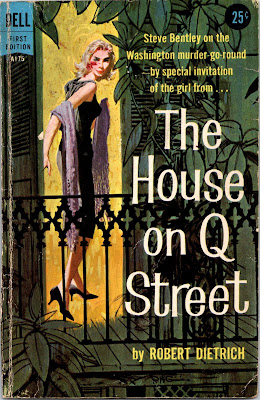
Steve Bentley #03 - The House on Q Street

Many fans point to the Steve Bentley series as the best representation of E. Howard Hunt's literary work. Hunt, a former CIA operative and convicted Watergate conspirator, authored over 70 novels using a variety of pseudonyms. The Steve Bentley series was written under the name Robert Dietrich between 1957 through 1962, with one additional novel penned in 1999. I've previously read the first two installments and thoroughly enjoyed them. The books were originally published by Dell and have recently been reprinted by Cutting Edge Books. Savoring the series, it's been 20 months since I've visited the character. Continuing in series order, I'm picking up with the third installment, 1959's The House on Q Street

Steve Bentley is a Korean War veteran that was once employed by the U.S. Treasury Department to break up black market rings internationally. Now, he is employed as a busy tax accountant surrounded by the I-495 beltway in Washington, D.C. In The House on Q Street, Bentley is referred by a friend to Major General Walter Ferrand Ballou, U.S.M.C. Retired. The desired meeting is for Bentley to possibly replace Ballou's recently deceased accountant. But, when the two meet face to face, it's a rather unusual discussion. 

Ballou's family is immensely wealthy based on old Washington money. Ballou is quite the war hero, fighting in WW2's Pacific Theater and earning his fruit salad the hard way. In a cavalier approach, Ballou never cashed his paychecks because he felt it was his duty to serve America. Ballou retired and then served as Chief of State Police before later declining a bid for governor. Bentley, respecting Ballou, asks how he can assist the retired general. Without stating the obvious, Ballou needs Bentley to hide a $100,000 payout to a blackmailer by creating a corporation and providing various write-offs and losses. The secrecy is to protect both his son and daughter from noticing the withdraw from their eventual lucrative trust. 

By creating the corporation, Bentley learns that Ballou's daughter Francie is a drop-dead knockout that's divorced and flirty. Her brother Winston is a screw-up that dabbles in horse racing and slowly whittles away his trust funds. Upon a return visit to Ballou's house, Bentley tackles an intruder and then notifies the police. The next day, Bentley learns that a former state police officer that Ballou had previously fired had been shot to death. What's interesting is that the dead man's wife shows up to bail out Ballou's intruder from jail. How are these connected? When Bentley discovers that this same woman was married to a doctor eight years earlier, he finds out that the man was murdered as well. Two husbands. Two murders. The link turns out to be way more than Bentley bargained for.

There is a lot to unpack in The House on Q Street, but it's never too convoluted for its own good. I read the novel in nearly one sitting and absolutely loved the pace and the influx of clues as each chapter scurried by. Hunt sometimes floundered in the “literary hack” echelon of crime-noir and espionage writers. But, with these Steve Bentley thrillers, he absolutely nails it every time. Bentley's probing into the murders leads to a missing gun, a mysterious nurse, the General's secrets, and a high-level criminal in Baltimore. Of course, the hero still has time for the Scotch and Ballou's hot daughter.

The House on Q Street is another D.C. thriller, complete with a twisty mystery and compelling characters. Steve Bentley remains a competent paperback hero that rubs shoulders with politicians while also digging into their darkened past to expose hidden truths. The combination of romance, intrigue, violence, and scandal makes it an absolute pleasure to read. Get a copy of the book HERE.

Monday, July 19, 2021

Sam Watchman #02 - The Threepersons Hunt

Brian Garfield (1939-2018) wrote westerns throughout the 1960's. Beginning in the early 1970s, the author began writing crime-fiction, highlighted by Death Wish in 1972, I loved his 1972 thriller Relentless, featuring Sam Watchman, an Arizona state police officer. Luckily, Garfield revisited the character with his 1974 novel The Threepersons Hunt. I purchased the Fawcett Gold Medal paperback edition hoping for the same reading pleasure as Relentless.

Watchman is a Navajo and has been working as a State Trooper for a decade. He has a strong track record but has not been promoted. His curiosity is peaked when his direct supervisor offers him a special assignment. A prisoner named Joe Threepersons escaped from prison and is suspected of returning to his Apache Reserve. The agreement is that Watchman will be assigned a temporary detective role that can potentially shift to a full-time role if he can successfully retrieve the prisoner. Simple, right? The problem is that Watchman and Threepersons come from two different Indian tribes. Historically, Navajo and Apache do not mix well. As such, the work may become very dangerous for Watchman.

Threepersons originally went to prison for a murder he happily confessed to. His wife and young son profited financially from his captivity by receiving substantial sums of money. These funds were used to invest in a business and the child's future expenditures at college. Did Threepersons take the fall so his family could become financially independent? Before Threepersons escaped from prison, he learned that his wife and son were killed in a car accident. Watchman's pursuit of Threepersons evolves into an elaborate murder investigation.

The placement of Sam Watchman in this big investigation is different from the high-action formula of Relentless. I love both books, but I think Watchman is more in his element with the procedural style story. There are many shootings and action to satisfy the readers, but I really enjoyed the complex mystery. Central to the story is a legal battle between the Indians and a large cattle ranch belonging to a businessman with close ties to Threepersons. Garfield's characters reflect greed, deadly intent, sexual desire, poverty and revenge. There are plenty of characters, but that's not enough to make the plot dense or confusing. 

In some respects, Watchman is like Craig Johnson's Longmire character. Both are astute with a penchant for solving issues with logic and proof. Still, the two are capable of holding their own when it comes to the inevitable struggle. I also compare Watchman with the Dakota character of Gilbert Ralston. It could be the rural rocky areas or the interaction among the Native American tribes. I wanted Garfield to follow up on a third novel starring Sam Watchman. I think there was so much potential with that character. Regardless, The Three Persons Hunt is a real pleasure to read. Highly recommended.

Buy a copy of this book HERE

Saturday, March 28, 2020

Hunt the Killer

Along with Harry WhittingtonGil Brewer and John D. MacDonaldDay Keene (real name Gunnard R. Hjerstedt) presented many of his crime-noir novels in Florida locations. These prolific authors were Florida natives or had simply adopted the state as their home. Often, these crime-fiction talents would even spend weekends together swapping ideas and fishing along Florida's Gulf Coast. So, it's only natural that their literary works were spotlighted by the Sunshine State. Day Keene's Hunt the Killer (1952) exemplifies that trait.

When readers first meet Charlie White, it's on the last day of his prison sentence. As he is stepping out of a Florida prison, there's a backstory explaining why White wore stripes for four-years. White, a WW2 veteran, owned a fishing boat and was making a meager living hauling in fish from warm Gulf Coast waters. Married to Beth, the two lived in an older Victorian styled house on a small island near Tampa. With dreams of escaping normality's prison, White was delighted to receive an anonymous call from a man simply calling himself Senor Peso. This unusual caller asked White if he would like to make $2,000. The $2,000 quickly snowballed as White found himself illegally importing goods, duty free, into Tampa.  After a few successful imports, White was caught by the Coast Guard and sentenced to prison.

Upon his release, White is picked up by the beautiful Zo, a Cuban woman that White was having an affair with before his capture. The two head to a coastline cabin to celebrate White's release. However, White discovers a letter that his wife wrote him advising that she has forgiven him for his past discretion and would like to reconcile their marriage. Truly loving Beth, White breaks off the fling with Zo. Shortly thereafter, White finds himself unconscious in the cabin with a gun he doesn't own. Readers aren't as surprised as White when he finds Zo's corpse riddled with bullets near by. Who shot Zo?

It's the age-old genre trope – the innocent man wakes up with a corpse. In the skillful hands of Day Keene, it's still an entertaining retelling. The novel's first half focuses on White's flee from the police across Florida, transporting readers into rural and tropical locations like Ocala, Ybor City, Fort Myers and Palmetto City. There's a satisfying relationship that White strikes up with an old trucker named Kelly. But, it's White's visit with his wife Beth that ratchets up the suspense. Keene's atmosphere –  an old, desolate mansion shrouded in Spanish moss – is nearly a main character as the “hunt for the killer” propels the narrative. The eventual reveal of Senor Peso was well worth the price of admission.

Thankfully, this novel has been reprinted by Stark House Press as a three-in-one volume that also contains two of his 1959 novels, Dead Dolls Don't Talk and Too Hot to Hold. There's no reason why you shouldn't own this in your collection. Purchase a copy HERE

Monday, August 13, 2018

The Hunter #01 - "Scavenger Kill"

Ralph Hayes was extremely active in the 1970s, enterprising a multitude of action adventure series' including 'Stoner', 'Buffalo Hunter', 'Agent for Cominsec' and 'Check Force'. The prolific author contributed to the 'Killmaster' series, penning eight novels under the Nick Carter name. While little is known about Hayes, his passion for traveling is conveyed in his writing. Often his books are international endeavors, capturing the full spectrum of the story-line with multiple locations and characters. That extensive storytelling is presented in 'The Hunter' series, debuting with “Scavenger Kill” in 1975 (Leisure).

Hayes introduces John Yard, the obligatory Vietnam war veteran. As a Green Beret, Yard “knew more ways to kill a man than he cared to remember”. He abandoned the Army, going AWOL after losing the cause altogether. My suspicion is that his immense inheritance contributed to his decision to ditch and run. With a deceased uncle's fortune, Yard sets up a travel company in New York that cleverly sends rich Caucasians to Africa to hunt big game. This fuels the hunter's manhood, but also allows Yard two hands in the money-jar; the left for the travel agency and the right as the hunting guide. It's in Africa that our story begins.

Yard is leading a lion hunt with an arrogant, inexperienced sportsman that can't complete the kill. After wounding the lion, it's up to Yard to enter dense foliage and finish off the hunter's deficiency. This is an important lesson for the hunter as well as the reader. This scene plays an important role in the book's thundering finale. After the hunt, Hayes receives word that his former Army buddy, Joe Algers, has experienced a horrifying sequence of events in New York. 

Chapter Two explains the nightmarish misfortune of the Algers family. Weeks after giving birth, Holly and Joe realize the child is a hairy mutant that may not have brain activity. In what amounts to a horror novel, Holly receives confirmation from the doctor, then drowns the baby in a bath and jumps to her death. The cause for these events is a medication called Moricidin manufactured by Maurice Pharmaceuticals. Despite warning signs, the medication was still on the market and the end-result of its dosage is creating mutant babies. The owner of the company is an obese, vile villain named Maurice Lavalle. 

With plot and villain in hand, Yard and his African police-friend Moses seek the whereabouts of Lavalle. The book is presented in grand scale, scouring places like London, New York, Nairobi and Canada for clues and contacts. While not overly erotic or graphic, there are two brief sex-scenes as Yard goes “undercover” with one of Lavalle's secretaries. Often Moses follows one lead while Yard tails another – on a different continent. The two have a number of physical confrontations on their globe-trotting odyssey, culminating in explosive gun-play at a high-rise before wrapping during an action-packed river firefight. It's these final scenes that run full-circle to the book's beginnings, proving Yard, while hunting big-game, was seemingly destined to become this vigilante.

Hayes would follow this debut with four additional series installments. Yard is often teaming with Moses in the series, righting the wrongs of 70s society while still being prominent in 2018. The blunt writing style, frequent action and unyielding protagonist makes 'The Hunter' debut a prized trophy.

Tuesday, September 11, 2018

Parker #12 - The Sour Lemon Score

The twelfth installment of Donald Westlake’s 'Parker' series - published in 1969 under the pen-name Richard Stark - is a fantastic hardboiled crime novel with a plot that significantly diverts from the formula of a standard heist story with favorable results.

Unlike previous books in the series, the paperback opens mid-heist with Parker in a four-man crew successfully executing a bank robbery during an armored car delivery. The thieves flee to a hideout to split the cash when a violent double-cross occurs sending the betrayer, George Uhl, into the wind with the stolen loot. Parker survives the ordeal with a new mission: Find Uhl and get back the money.

Stranded with no cash, no car, and no gun, Parker uses his resourceful mind to hunt Uhl up and down the east coast in a multi-state, high-stakes game of cat and mouse. What follows is part treasure hunt, part vendetta tale, and part man-on-the-run story. Parker also leads the reader through a tour of the criminal underworld filled with gun-selling black marketeers, fences for stolen items, duplicitous homosexuals, and an underground banking system where guys like Parker can stash their nest eggs.

“The Sour Lemon Score” is a testament to Westlake’s versatility as a storyteller as the criminally-minded Parker serves as his own private investigator in a missing person case that, if successful, will culminate in the murder of his prey and the re-theft of ill-gotten gains. Westlake’s invention of a subculture where an informal network of professional thieves can be manipulated and leveraged against one of their own is utterly fascinating and filled with colorful characters and great moments.

On the hunt, Parker is perpetually irritated by the exasperating array people he encounters as he chases the leads to locate Uhl. For the most part, Parker lacks the charm, patience, and people skills to engage in the normal slow-dance that brings fictional investigators closer to the truth. However, a manhunt investigation conducted “Parker-style” makes for some exciting reading while turning the traditional P.I. genre novel on its ear.

The ultimate confrontation between Parker and Uhl is incredibly satisfying and fraught with further complications for our anti-hero. “The Sour Lemon Score” is a short book that seems even shorter because the propulsive nature of the events makes it hard to put down. Like all the Parker capers, consider this one required reading for fans of classic men’s adventure and crime fiction. Highest recommendation.

Postscript:

Check out the helpful blog from our friends at www.theviolentworldofparker.us for more in-depth literary analysis of the Richard Stark Universe.

Wednesday, July 27, 2022

Steve Bentley #04 - Mistress to Murder

Mistress to Murder, the fourth installment in the Steve Bentley series, was published in 1960 by Dell. The book's author, E. Howard Hunt, wrote the series using the pseudonym Robert Dietrich. Bentley is former military and runs a successful accounting business in Washington D.C.'s turbulent political beltway. While dabbling with stocks and blondes, Bentley always finds himself as a pseudo private-eye working random cases that fall into his lap. In the aptly titled Mistress to Murder, now available in a brand new edition by Cutting Edge, Bentley becomes entangled with a wealthy international family in the posh D.C. suburbs. 

From a rural stretch of Northern Virginia blacktop, Bentley sees a young woman fall from her horse. After running to her aid, Bentley is stopped by the woman's chauffeur. Helping the woman into the car, the chauffeur becomes aggravated with Bentley's assistance and nearly K.O.'s him with one punch. Thankfully, Bentley memorizes the vehicle's license plate. Later, back at his home, Bentley discovers that the woman secretly placed a necklace in his pocket.

Consumed with the woman's odd behavior and injury, Bentley hires his old PI friend, and series staple, Artie to locate the vehicle's residence. It belongs to Baron Alejandro Esquivel, located in the high-end district of Georgetown. Bentley goes to the home, receives a cool welcoming, and meets Esquivel's young wife Anita, which eventually leads to a quick make-out session. Bentley pries himself away from Anita and is re-introduced to 19-yeard old Megan, the woman Bentley helped previously. Megan behaves normally, is “sick in bed” due to the fall, and both Anita and The Baron are keeping watch. But, Megan slips a note to Bentley asking him to meet her that night.

At the meeting, Bentley learns that Megan, and her half-sister Anita, are originally from Venezuela. Their father, the original Baron, was partners with Esquivel in a shady, yet lucrative, business. Long story short, their parents were suspiciously killed, Esquivel became the new, yet fraudulent Baron, married Anita and now the three of them live unhappily ever after. Anita cheats on Esquivel and Megan is the princess trapped in the castle. But, the wrench in the gears is a string of pearls that are internationally coveted and now owned by Esquivel. They are a sort of collector's piece worth well over $100K. Like these things tend to go, murders begin, the pearls are stolen, and Bentley is caught up in the deadly ruckus.

Hunt borrows similar plots of the first two Bentley novels. In the series debut, Murder on the Rocks, the plot involves a precious emerald, a South African ambassador and two women searching for the stone. In the series second installment, End of a Stripper, a man being dragged from a strip club discreetly places a small camera in Bentley's pocket. The camera is then traced back to the man and the purpose of the novel. However, Hunt writes Bentley so well that the recycled elements can be easily overlooked. 

Mistress to Murder, and the Steve Bentley series as a whole, is excellent crime-fiction written by an experienced, seasoned pro. While Bentley doesn't receive the same fanfare as other private-eye literary heroes, I think his steadfast willingness to do good things for people in peril is unmatched. The crimes are detailed, the characters dynamic, and the pace is flawless. All of the elements contribute to Mistress to Murder's success. This is just another great novel proving that this series is a cut-above your average gumshoe procedural. 

Buy a copy of this book HERE.

Saturday, November 16, 2024

Conan - Savage Sword of Conan #01 (Titan)

Robert E. Howard's Conan licensing is a moving target in the comics industry. Many associate the character with Marvel based on the success of the 1970s Conan the Barbarian comic and the Savage Sword of Conan magazine. However, the character was a dominant force when Dark Horse comics purchased the license, only to lose it to Marvel decades later. Recently, the entertainment studio company Heroic Signatures purchased the licensing and offers their IP to anyone with a thick wallet – like British publisher Titan Comics.

Titan began publishing their series, Conan the Barbarian, in August of 2023 through a licensing agreement with Heroic Signatures. In February, 2024, the inevitable The Savage Sword of Conan black and white magazine was published. Like any respectable Conan fan, I bought two copies of the first issue in hopes that I can wallpaper my future grandchildren's home in thousand-dollar bills. I hope to review more modern Conan publications so I thought I would begin here with the first issue of The Savage Sword of Conan by Titan Comics. 

My issue features the cover created by Joe Jusko, an astounding artist that painted Conan the Barbarian trading cards in the 1990s. In other Conan-related works, he provided interior illustrations for the Conan: Adventures in an Age Undreamed RPG and Dynamite's Red Sonja. The other Jusko cover associated with this issue is the FOC cover which is the full panel with no fonts or title. The cover is also featured in black and white in the inside to accompany a Conan short-story titled "Sacrifice in the Sand" by Jim Zub, which was inspired by Jusko's art. 

Roberto De La Torre is an important artist in modern Conan. De La Torre was an active contributor on the Conan the Barbarian (2019-2021), King Conan (2021-2022), and Conan: Exodus and Other Tales (2021) titles that were all published by Marvel. I really enjoy his artwork and his amazing Conan pin-up is on page three. Additionally, Rebeca Puebla (007: King and Country, Bettie Page) provides a pin-up of Belit on page six. Fans of the 1970s Conan the Barbarian comic will enjoy artist Howard Chaykin's pin-up of Solomon Kane on page 77.

As you open the magazine, the first thing that really stands out is a personal introduction by Conan royalty, Roy Thomas. He provides a brief history of Conan in the comics and the pains and triumphs of the character in print. Thomas also adds that he was invited by Titan to write more Conan stories for this magazine – an offer he is apparently taking them up on.

The issue's main story is "Conan & The Dragon Horde". It was written by John Arcudi, a veteran comic storyteller that wrote in Savage Sword of Conan issues #150-152, 158, 165, 182 and also penned stories for Savage Tales. Arcudi is a dynamic, all-around author that has contributed to hundreds of comic titles since 1986. The story's art was created by Max Von Fafner. He created the cover for Conan the Barbarian #3 (2023), Conan: Battle of the Black Stone #2 (2024), and a variant cover for this Savage Sword of Conan issue. 

In the story, Conan is serving as a general in a Hyrkanian cavalry division headed to a large fortress in the Hyrkania desert. Conan is leading a band of soldiers, bandits, and mercenaries that are assisting an ousted prince in returning to the fortress to seize a lucrative treasure hold. There are twin soldiers serving the prince (who totes around two lions) that immediately piss Conan off when they insult a Turanian woman, Ineah, serving as a weapons engineer. 

Soon, Conan beds down Ineah and Von Fafner leaves nothing to the imagination. She is gorgeous. But, she proves to be a capable fighter and a brilliant mastermind in terms of weapon placement and use. The bizarre part of the story is when a dinosaur – yes a dinosaur – breaks from the fortress and attacks Conan's men. Thankfully, Ineah saves the day with her ballista. 

When Conan and company make camp outside of the fortress, they are surprised that no one from within the compound has bothered to attack them. As the days continue with no activity, Conan uses his thief background to climb into the city to determine what is actually happening there. 

I felt that the story was just okay. The artwork leads the way, as usual, and Conan's mannerisms and leadership is par for the course. There's nothing to dislike about Arcudi's writing, but it didn't wow me like a traditional first issue's lead story should. 

The aforementioned “Sacrifice in the Sand” short story by Jim Zub followed. Honestly, I just skipped it to jump into the Solomon Kane story, “Master of the Hunt”. This is the first of a promised trilogy of stories that places Kane on the hunt for a monster terrorizing a village. The story and art is by Patrick Zircher, a veteran that has worked on numerous Marvel and DC titles like Action Comics, Detective Comics, Superman, Captain America, Avengers, and Iron Man just to name a few. I love Solomon Kane so I was anxious to see what he could do with the character.

The story is set in Glamorgan, Wales on All Hallow's Eve. A blind man drinking ale in a bar explains that this night is when the gateways between worlds is very thin. Outside the tavern, readers are treated to small panels showing some sort of monster attacking and killing sheep. The next day Kane arrives and sees the monster's tracks. He chances upon a woman and her son living in a small farmhouse. The woman explains that her husband has embarked on the “great hunt” with other villagers in search of the monster.

I can't give too much away here due to spoilers, but this was a well-written, fast-paced narrative that excellently “got” REH's Kane character. There are scenes of Kane praying as well as dialogue emphasizing Kane's commitment to God to rid the world of evil. Although the twist ending could be seen a mile away, it didn't detract me from the story and art. The promised sequel should take the characters and monster in a new direction and I'm looking forward to that. 

More Solomon Kane is included at the end with an excellent essay penned by Jeffrey Shanks explaining the character's publication history and failure to equal the popularity of Kull and Conan. 

Overall, The Savage Sword of Conan #1 was pretty good. There's nothing to complain about, but at this point there is just so many Conan comics, books, collections, ebooks, and stories being published that the market is completely saturated. You could read nothing but Conan your entire life and never get through it all. With that being said, my failure to be overly stimulated by this new version of Savage Sword can partly be blamed on too much too fast. I have the same issue with Batman. It's an embarrassment of riches available to anyone anytime.

Get this issue plus the following two issues HERE.