Showing posts sorted by date for query Margaret Millar. Sort by relevance Show all posts

Monday, April 27, 2026

The Only Good Secretary

Jean Potts specialized in cozy mysteries that quietly rivaled the best of Margaret Millar and Charlotte Armstrong. Her literary catalog, spanning 1954-1975, featured fourteen novels; the most celebrated being her debut, Go, Lovely Rose, which earned a 1954 Edgar Award for Best First Novel. Stark House Press are all in on Potts, rightfully so, and have published seven twofers collecting her mysteries. At the time of this writing, the publishers has just unveiled Jean Potts: The Complete Short Stories. I've been a little behind on my Stark House reading, so I took a road trip opportunity to devour the workplace mystery, The Only Good Secretary, which was first published as a paperback in 1965 by Ace (G-608). It exists in both physical and digital editions as a combined SHP collection with The Man with the Cane (1957)

The Only Good Secretary reads as if Agatha Christie has invaded Mad Men. It's a tight, expertly woven mystery centered around an employee, Fern, who is found with a fatal scissor wound in a business office. The unnamed detective is brought in on the case, but quickly is disposed of in a quest to present an amateur sleuth duo – in this case a combination of Louise, the office secretary, and High Dudgeon, the office owner/operator.

Potts has a unique way of presenting her stories conversationally. You won't find the author describing a room, or spending much time on trivial character activities. Instead, Potts uses her pagecount wisely by allowing the characters to tell the complete story. Its all fair play for the reader, as these characters possess no information that would reveal the identity of the murderer. Instead, the conversations – and there are a lot – ebbs and flows as suspects are revealed, red herrings are dismissed, and the elimination of motives increases. The reader doesn't need to commit any guesswork, although that part of the reading experience is very rewarding. 

Another interesting aspect to Potts' writing style is the way she turns characters against each other. This formula worked exceptionally well in The Evil Wish (1962), pitting two thirty-something sisters against each other in suffocating living quarters. In this novel, Potts uses a young college student and a teacher, with each of them throwing the other under the proverbial bus. It is this consistent shifting in their testimony and actions that keeps Louise and High digging into the changeable narrative. There is a killer – but the Devil's in the details. 

If you enjoy the tight whodunits of the mid 20th century, then The Only Good Secretary should be your next read. Get the book HERE.

Friday, April 21, 2023

Death of an Intruder/Twice So Fair

Nedra Tyre (1912-1990), who was born in Offerman, Georgia, received her B.A. from Atlanta's Emory University and her M.A. from Richmond School of Social Work in Virginia. She worked as a teacher, staff writer, social worker, typist, and a sales clerk in addition to being a notable mystery and suspense author. She wrote six stand-alone novels and approximately 40 short stories for magazines like Ellery Queen's Mystery Magazine, Sleuth, Alfred Hitchcock's Mystery Magazine, and Mystery Monthly

Stark House Press have recently reprinted two Tyre novels in one volume, Death of an Intruder (1954) and Twice So Fair (1971), along with an introduction by Curtis Evans. Tyre's name was new to me, but thankfully this twofer served as a wonderful introduction to this talented author. Billed as “suspense classics”, both of these novels deliver deeply embedded mysteries that are ratcheted up to higher levels of tension and psychological edginess that is similar to Elizabeth Fenwick (real name Elizabeth Phillips) or Margaret Millar

The better of the two novels, Death of an Intruder, introduces readers to Miss Allison, a middle-aged woman who strives for independence after the death of her aunt. Allison finds a charming house, purchases the home, and begins a solitary life of enjoyment and simplicity. However, her bliss is short-lived when an elderly woman, Miss Withers, knocks on her door and invites herself in. After complaining about a rainstorm, Withers begs to stay the night. Allison, a quiet, non-confrontational individual, agrees to allow her uninvited guest to sleep on the sofa. The next morning, Allison is horrified to learn that Withers hasn't left. And she never will.

Through 150ish pages, Allison must contend with an unwanted roommate that violates her sanctity. As the narrative grips readers, Allison learns that Withers may have killed her pet, ruined her relationship with a prospective boyfriend and close friend, and alienated her from the life she once enjoyed. Debating on how to rid herself of the woman, Allison's only choice may be murder. 

Like Allison's introspective problems within her own home, Twice So Fair presents a recent widow, Rosalind, learning about her late husband's mysterious involvement with one of his students. Both of them were found dead in a college studio, but what was their relationship? As Rosalind contends with the loss of her husband, and the obligatory affairs of dissolving a happily married lifestyle by unforeseen circumstances, she is thrust into a mystery when a stranger invades her home. In a darkened room, the man confesses to be an estranged friend of the student found dead beside Rosalind's husband, and begins a conversational journey explaining his orphaned upbringing and potential “six degrees of separation” from Rosalind's life. But, could this uninvited stranger be a killer?

Nedra Tyre is a phenomenal storyteller, and it pains me to know that I've now read nearly half of her novels. I'm surprised, and disappointed, that she didn't write more full-lengths, but due to publisher issues in her late career, she was submerged into the short story market. Her perspectives on life, literary work, social inadequacies, marital harmony, and paranoia are center-stage attractions of these novels. It's nearly uncanny how well she can enter the minds of the characters she creates. 

According to Twentieth Century Crime and Mystery Writers, Tyre had a niche for “superbly handled suspense”, evident with these novels and her short stories “Locks Won't Keep You Out” (1978, Ellery Queen's Napoleons of Mystery) and “On Little Cat Feet” (1976, Ellery Queen Mystery Magazine). I enjoyed her characterizations of both protagonists, with Allison and Rosalind sharing similar outlooks – as dreary as they may be. Interesting enough, there is a sense of wrongdoing on the part of supporting characters, those acquaintances of both Allison and Rosalind. When the support system is most needed, both intimately and professionally, it fails these less-than-confident protagonists. It was clever plotting and development by Tyre to force these characters into independent (irrational?) action. 

If you are new to Nedra Tyre, then by all means this twofer is highly recommended. In general, if you are new to female mystery and suspense writers, Stark House Press have an abundance of long-forgotten, entertaining classics by the likes of Mary Collins, Helen Nielsen, Dolores Hitchens, Ruth Wallis, and Jean Potts to name a few. 

Buy a copy of this book HERE.

Thursday, March 31, 2022

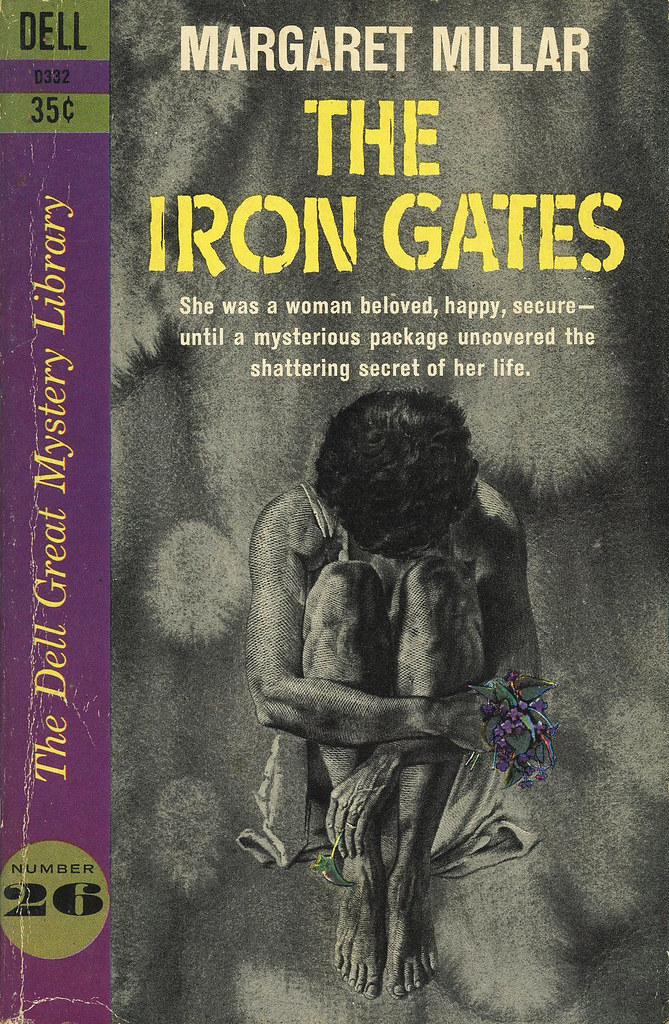
Inspector Sands #02 - The Iron Gates

Along with her contemporaries like Dorothy B. Hughes, Charlotte Armstrong, Dolores Hitchens and Helen Nielsen, California native Margaret Millar helped solidify the presence of talented female mystery authors in the 1940s and 1950s. She wrote over 25 original novels, mostly as stand-alone works. However, her first three novels starred a Canadian sleuth named Dr. Paul Prye and she repeated that creation with another Canadian detective, Inspector Sands. 

The Toronto homicide detective starred in Wall of Eyes (1943) and The Iron Gates (1945), as well as a short story called "The Neighbors Next Door" in a 1954 issue of Ellery Queen Mystery Magazine. I chose to read the latter novel based on an article by Curtis Evans (via Stark House Press) praising the book. It has been reprinted multiple times in hardcover, paperback, and most recently as an audio book. It was also printed in the U.K. as Taste of Fears.

In The Iron Gates, Millar's prose is pure psychological suspense. In the book's opening chapters, Lucille Morrow is mourning the unusual death of her friend Mildred. These scenes are beautifully written and drape the imagery in a white pane of frosted glass reflecting Lucille's loss and mental anguish. It's a hazy precursor to what eventually occurs later in the book as a historical flashback or retelling. 

Later, readers learn that Lucille is now married to a retired physician named Andrew, Mildred's previous husband. She is the stepmother of his two adult, but childish, kids and the in-law to his worrisome sister, all of which reside in the same house. Due to the death of Mildred, and Andrew's replacement of her with Lucille, there are strict dividing lines in the household based on suspicions and shifting judgments. These alliances and strategic family placements play into the novel's central themes of jealousy and lust.

Inspector Sands becomes involved in the narrative when Lucille goes missing. There's early discussion between characters about a nearby park where a grisly murder took place. There's a cautionary tale told about a wandering ax-man preying on park guests. The idea that Lucille is missing, the nearby murder, Mildred's prior death and this strange ax-man all play into the mystery. Sands doesn't know what to believe and finds the family obtuse about Lucille's whereabouts. Only Andrew seems genuinely concerned about her well-being, opening up a string of guesses on which family member committed murder.

The book takes an interesting twist for the second half. Without spoiling the plot development, a major character ends up in a mental asylum behind “iron gates”. Her reason for being there is cloudy, leaving Sands and a detective to investigate the events surrounding her confinement in the asylum. Most of the book's second half does take place in the asylum as the character interacts with other mental patients and the hospital's staff. I enjoyed these parts of the story, but felt it was a little distracting at times. The behavior of the patients and their involvement in the main character's psyche definitely contributes to the story's development, but it's a marathon. 

As a psychological suspense novel, Millar conveys a lot of emotion in her writing. I enjoy the shading she provides as she draws out each character for the reader to suspect. As I learn more and more about female mystery authors of the 20th century, my research always leads to Millar. She was a a real talent and sadly isn't as relevant now. Her work is mostly forgotten aside from a few reprint houses still preserving her novels. Her spouse, Ross MacDonald, the creator of the California detective Archer, is in more abundance, but honestly Millar may have been the one to read all along. 

The Iron Gates was optioned for film to Warner Brothers and allegedly Millar wrote the screenplay. It was to star either Bette Davis or Barbara Stanwyck, but the film never came to fruition. This novel remains rather timeless and would make for a great modern film with it's real world complexity. My vote is for director David Bruckner (The Night House, The Ritual). Anyone have his number? 

Buy a copy of this book HERE

Monday, July 26, 2021

Do Evil in Return

Margaret Ellis Millar (born Margaret Ellis Sturm, 1915-1994) was a mystery writer originally from Ontario, Canada. In 1938, Margaret married Kenneth Millar, the author who used the pseudonym Ross Macdonald to create and write the bestselling Lew Archer character. Margaret Millar authored over 25 novels, including series titles like Paul Pry, Inspector Sands and Tom Aragon. My first experience with Millar is her 1950 Dell paperback Do Evil in Return. In 2006, Stark House Press reprinted the book as a double along with the author's 1957 novel An Air That Kills.

Charlotte Keating is a private-practicing physician who lives and works in a small town in the Pacific Northwest. One evening before close she receives a young woman named Violet. Desperate for help, Violet tells Charlotte that she is a married woman from Oregon who had an affair with a married man and is now four months pregnant. The purpose of her visit is to request Charlotte to perform an abortion. Charlotte rejects and explains that the term of pregnancy is too advanced while reminding Violet that abortions are illegal. Charlotte learns that Violet rents a one-bedroom apartment in town. While offering to bring her there, Violet runs away. 

Afterwards, readers learn about Charlotte's emotional problems. She has an extended relationship with a married man named Lewis. Her mental barriers are thick with a sense of insecurity, self-doubt and vulnerability. She wants Lewis to divorce his spouse or just have the internal fortitude to end their own long affair. With all of these underlining conditions, Charlotte somehow feels as if she has failed Violet.

On the other side of the city, Charlotte speaks with one of Violet's neighbors and has the impression that they are not pleasant people. After her visit, Charlotte shockingly learns that Violet’s body has washed ashore and all signs point to a suicidal drowning as the cause of death. 

Charlotte's brief participation in the young lady's life has now become rather dangerous and complex. Violet’s violent uncle and conniving husband break into Charlotte’s house and attempt to extort her for money. She refuses and things quickly become grim when a skeptical police detective starts asking questions about Charlotte's role in Violet's suicide. When Violet's husband and uncle are discovered with bullet holes in the head, Charlotte finds herself in a whirling nightmare.

Millar's plot was structured as a suspenseful mystery with a handful of characters who might have turned out to be a killer. I liked the author's inclusion of extramarital affairs and the way these characters viewed themselves and their marriages. Except for Charlotte, nearly all the characters were married and had difficult relationships. Millar’s unmarried characters "survive" the ordeal. It seems to me that Millar's suggestion is that two people can find independent happiness. 

While Millar is considered a mystery writer, I also like to think of Do Evil in Return as a stylish crime-noir. It has some detective procedural elements, the concept of an average citizen thrust into extreme circumstances and the alarming idea that an innocent person could find themselves guilty of a crime they didn't commit. These are all genre tropes that adapt uniformly to most of these crime novels of the mid-20th century. As a short read, I found it to be an entertaining experience. 

Note: There is an informative biography HERE that discusses Millar’s fascinating life, influences and her superb writing style. 

Buy a copy of this book HERE

Saturday, April 11, 2020

Lew Archer #01 - The Moving Target (aka Harper)

Author Kenneth Millar's most utilized pseudonym was Ross MacDonald, a name created to avoid confusion with his wife Margaret's literary career. As MacDonald, the author's most coveted and celebrated work is the Lew Archer series of private-detective novels. Like an uncanny second coming of Raymond Chandler and Dashiell Hammett, MacDonald sculpted Archer as a studious, more sensitive California sleuth. While equally tough with guns and fists, Archer's procedural style is in stark contrast to the era's most iconic private-eye, Mickey Spillane's Mike Hammer.

Archer debuted in a 1946 short story titled Find the Woman. MacDonald's first full-length Archer novel was 1949's The Moving Target.  The book was adapted to film in 1966 under the title Harper with Paul Newman in the starring role as Lew Harper instead of Archer. Newman portrayed the character again in the series’ second adaptation, The Drowning Pool, in 1970. My only experience with Millar's writing was his enjoyable 1953 stand-alone novel Meet Me at the Morgue, also known as Experience with Evil. Being unfamiliar with the Archer series, I'm beginning with the first installment, The Moving Target.

The book begins with Archer's arrival in a posh suburb in the fictional California city of Santa Teresa (probably based on the real Santa Barbara). Archer has been hired by a woman named Mrs. Sampson to locate her missing husband Ralph. The family is old money with Ralph making a fortune in oil and real estate and Mrs. Sampson seemingly indifferent to where, when and how her husband spends his free time. After the initial meeting, Archer is introduced to Ralph's gorgeous 20-year old daughter Miranda and his personal pilot, Taggert. Archer also reunites with an old friend named Graves, a former District Attorney who now specializes in private practice.

Archer's procedural investigation leads to Las Vegas through a criminal named Troy. Both Ralph and Troy had some sort of business relationship and Archer feels that Troy could be a suspect in Ralph's disappearance. But, like most genre works, the idea of magically solving the mystery is way more complex. Archer learns the rabbit doesn't come easy when a ransom note appears demanding $100,000 for Ralph's safe delivery. Entwined in the ransom attempt is a washed up jazz singer named Betty and a declining actress named Fay. Archer teams with Graves to successfully deliver the ransom money but ends up with a corpse to elevate the mystery to murder.

Obviously, there is a lot to unpack in Millar's debut Archer novel. While my synopsis might be muddied, it's for your own good. This is a complex but enthralling narrative that showcases Millar's private-eye as a determined, thinking man's hero who isn't easily swayed into fisticuffs. The mystery is a complex one with a number of possible leads and directions that all circulate around Ralph Sampson's disappearance. Archer is centralized but the cast of characters help bulk up Millar's prose - two hot-blooded female performers, a strongman pilot, the complacent attorney and Ralph's eccentric family. Without the dynamic supporting cast, The Moving Target would be a wholly different novel, albeit still a very good one.

While The Moving Target is technically a 1940s private-eye novel, it should appeal to fans of 1950s crime-noir and hardboiled crime. It feels a bit more modern than I, the Jury, the runaway bestseller that placed detective fiction at new heights of popularity in 1947. In addition, Millar's use of California's rolling seaside hills provides so much more literary space than the rather mundane urban settings of New York City. Archer thrives as a suburban detective and the author's descriptive usage of the surroundings played key parts in the book's climactic scenes.

The Moving Target is a fantastic American novel and deserves the heaps of praise it has received over many decades. The book is still in print and widely available. Buy a copy of the book HERE and see for yourself what genre fans have been talking about this whole time. Lew Archer is simply awesome.